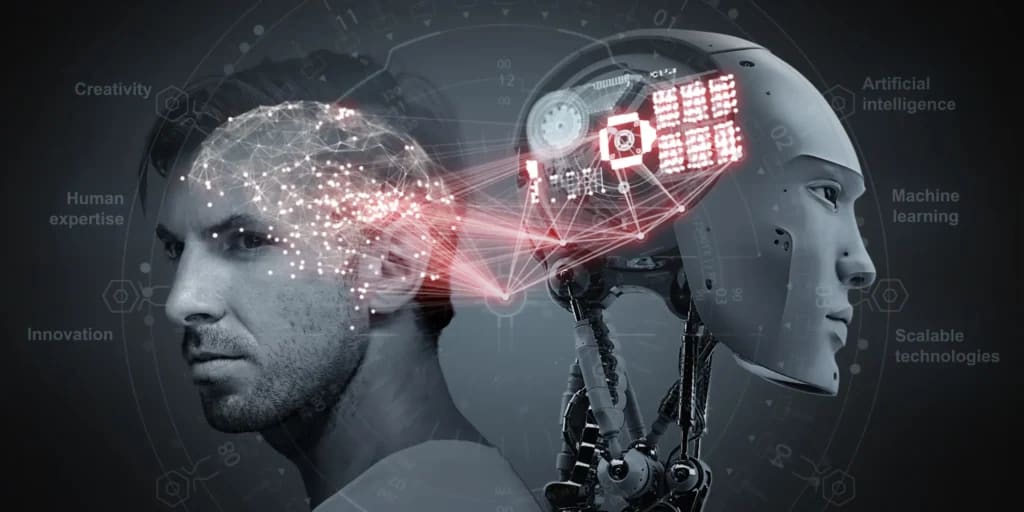
In 2025, artificial intelligence ceased to be just a buzzword. It became the foundation of business, creativity, and everyday life. Within a year, we saw AI agents independently booking tickets, writing code, and analyzing data, rather than just answering questions. This is not fiction – it's a reality that is already affecting millions of people.
But behind the brilliance of innovation lie risks: model hallucinations, privacy issues, and an overestimation of capabilities. As a Java developer, I've seen how AI has accelerated projects but also created new challenges. This article will explore what has truly changed.
Main Thesis
In 2025, artificial intelligence (AI) evolved from simple chatbots, such as early versions of ChatGPT, to autonomous agents capable of performing complex tasks, including action planning and real-time user interaction. According to McKinsey Global Survey on the state of AI 2025, 88% of organizations regularly use AI in at least one business function, and the emergence of agents (agentic AI) is becoming a key trend, transforming AI into a fundamental infrastructure. Stanford AI Index 2025 highlights that smaller models have achieved the power of previous years' giants, significantly reducing costs and making the technology more accessible.
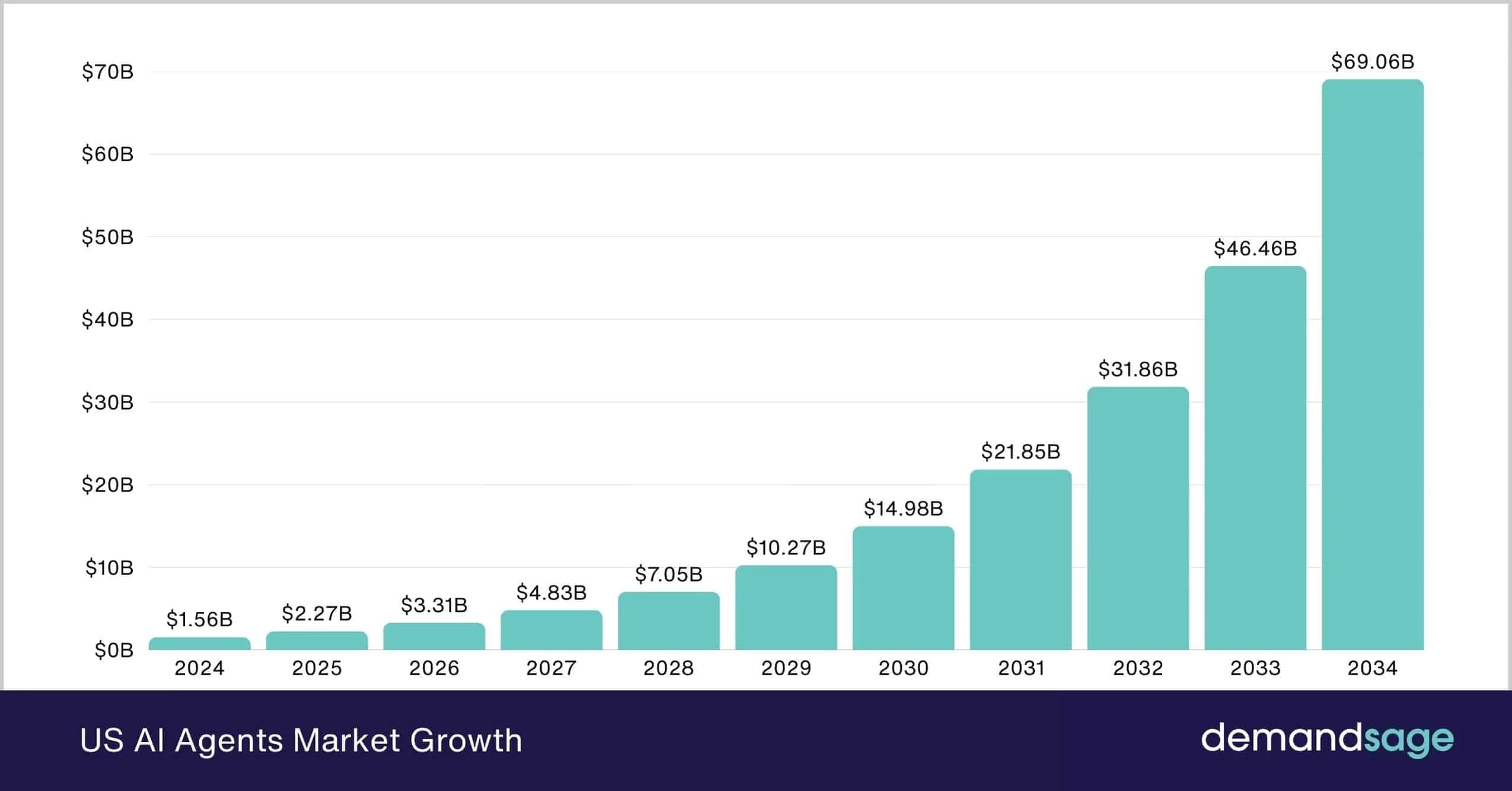
However, this progress requires a deep understanding of risks, such as ethical challenges and technical limitations. Readers who adapt now – by implementing agents into daily processes, as in examples from IBM Agentic AI or Google Gemini Deep Research – will gain a competitive advantage in business, career, and creative fields. Although the exact figure of $2.9 trillion in economic value of AI in the US is not confirmed by direct sources, AI investments in the US reached $109 billion in 2024 (Stanford AI Index Economy), and its contribution to GDP is growing significantly. This is not just a trend, but a transformation that makes AI an integral part of infrastructure, similar to electricity or the internet.
Problem
The main conflict in AI development in 2025 is that the technology promises unprecedented efficiency and productivity but creates serious problems with trust and security. Companies are massively implementing AI without sufficient preparation, ignoring that models are still prone to hallucinations — the confident presentation of incorrect information. According to AI Hallucination Report 2025, even the best models have a hallucination rate of 0.7% to 50% depending on the task, leading to financial losses, fake reports, and erroneous decisions in business, medicine, and jurisprudence.
In the legal sphere, hallucinations have become a critical issue: in 2025, 48 cases were recorded where lawyers cited non-existent precedents generated by AI, leading to sanctions, fines, and even dismissals (CourtWatch Database 2025). Another key problem is ethical dilemmas and responsibility for the actions of AI agents: who is accountable for harmful consequences? In 2025, numerous lawsuits emerged regarding the impact of chatbots on mental health, including seven lawsuits against OpenAI, alleging that ChatGPT exacerbated delusions, psychoses, and suicidal thoughts, for example, by convincing users of fantastical ideas like "time bending" (The New York Times, November 2025; Social Media Victims Law Center).
Furthermore, over 50 copyright infringement cases against AI companies, including OpenAI, highlight the conflict between rapid development and regulations, such as the EU AI Act, where strict rules for general-purpose models have been in effect since August 2025, with fines up to 7% of turnover. Companies are implementing agents but often fail to control the consequences for privacy and society, hindering innovation and demanding a balance between progress and ethics.
Changes
In 2025, artificial intelligence became significantly more efficient and accessible due to model optimization and reduced computing costs. According to Stanford AI Index 2025, the costs for training and inference of models significantly dropped, smaller models achieved the performance of previous years' giants, and private investments in AI reached record levels. This made the technology accessible even to small businesses and startups.
A key trend is the shift towards multimodal models that process text, images, audio, and video simultaneously. Models like Google Gemini 3, OpenAI GPT-4o, and Meta Llama 4 demonstrate breakthroughs in understanding and generating various types of content (Google AI Blog 2025). The emergence of autonomous AI agents has become the main change: from IBM Agentic AI and GitHub Copilot Coding Agent to AWS Nova Act and OpenAI frontier agents, which perform complex tasks independently (IBM Insights, GitHub Docs).
Investments in integrating AI with quantum computing have grown: companies like Google Quantum AI and IonQ have made progress in fault-tolerant systems, and the global quantum technology market is valued at billions of dollars (McKinsey Quantum Monitor 2025). Google Search Trends 2025 show a peak in interest in AI topics: Gemini became a top query, and searches for "quantum computing" and AI features in products significantly increased (Google Year in Search 2025).
Personal Experience
As a Java developer with many years of experience working with Spring Boot, I actively used GitHub Copilot Coding Agent in 2025 to automate routine tasks in commercial projects. The agent generated boilerplate code, tests, fixed bugs, and even refactored large parts of the codebase, reducing development time by 30–55% depending on the task — this aligns with industry averages, as noted in GitHub research (GitHub Blog, 2025; GitHub Docs).
The agent was particularly adept at handling DTOs (Data Transfer Objects) and mappers — for example, creating Record classes for APIs, MapStruct configurations, or Lombok annotations: I simply described the specification, and the agent generated clean, type-safe code in minutes. The same applied to logging: the agent suggested standardized Slf4j patterns with context (MDC), log levels, and exceptions, adhering to my custom instructions. And for bug finding — a real breakthrough: the agent analyzed stack traces, proposed fixes, ran local tests, and even iterated changes in agent mode, automatically correcting errors (GitHub Blog on Java modernization).
Emotionally, this provided a powerful boost: projects moved much faster, creativity increased as routine tasks disappeared. But there was also stress — once, the agent ignored the specifics of dependency injection in Spring Boot (e.g., incorrect bean scoping), creating code that led to a production bug. I had to manually check, refactor, and add an AGENTS.md file with clear instructions for the project.
Beyond development, I implemented my own project — a chatbot on Consultant, where an AI agent based on Spring AI and RAG processes client requests 24/7: answers FAQs, provides consultations, collects leads, and integrates with CRM. This allowed for complete automation of support, saving dozens of hours per week. From experience, AI agents significantly boost productivity and business processes, but always require human oversight, custom instructions, and human-in-the-loop for critical domains.
Comparison
Let's compare 2024 and 2025: in 2024, AI was primarily limited to chatbots and generative tools like ChatGPT or early Copilot, where the focus was on answers and simple content generation. In contrast, 2025 became the year of agentic AI — autonomous systems that plan, execute multi-step tasks, and interact with tools. Examples include AWS Nova Act for browser automation, GitHub Copilot Coding Agent for the full coding lifecycle, Amazon frontier agents that operate autonomously for days, and Grok 4 with multi-agent capabilities (AWS re:Invent 2025 Announcements; GitHub Copilot Agent).
According to McKinsey State of AI 2025, 88% of companies use AI in at least one function (an increase from previous years), 62% are experimenting with agents, and 23% are already scaling them in at least one function. High-performing companies are three times more likely to scale agents, rebuild workflows, and achieve significant ROI from automation (efficiency and cost reduction), while the effect from creative content generation is smaller.
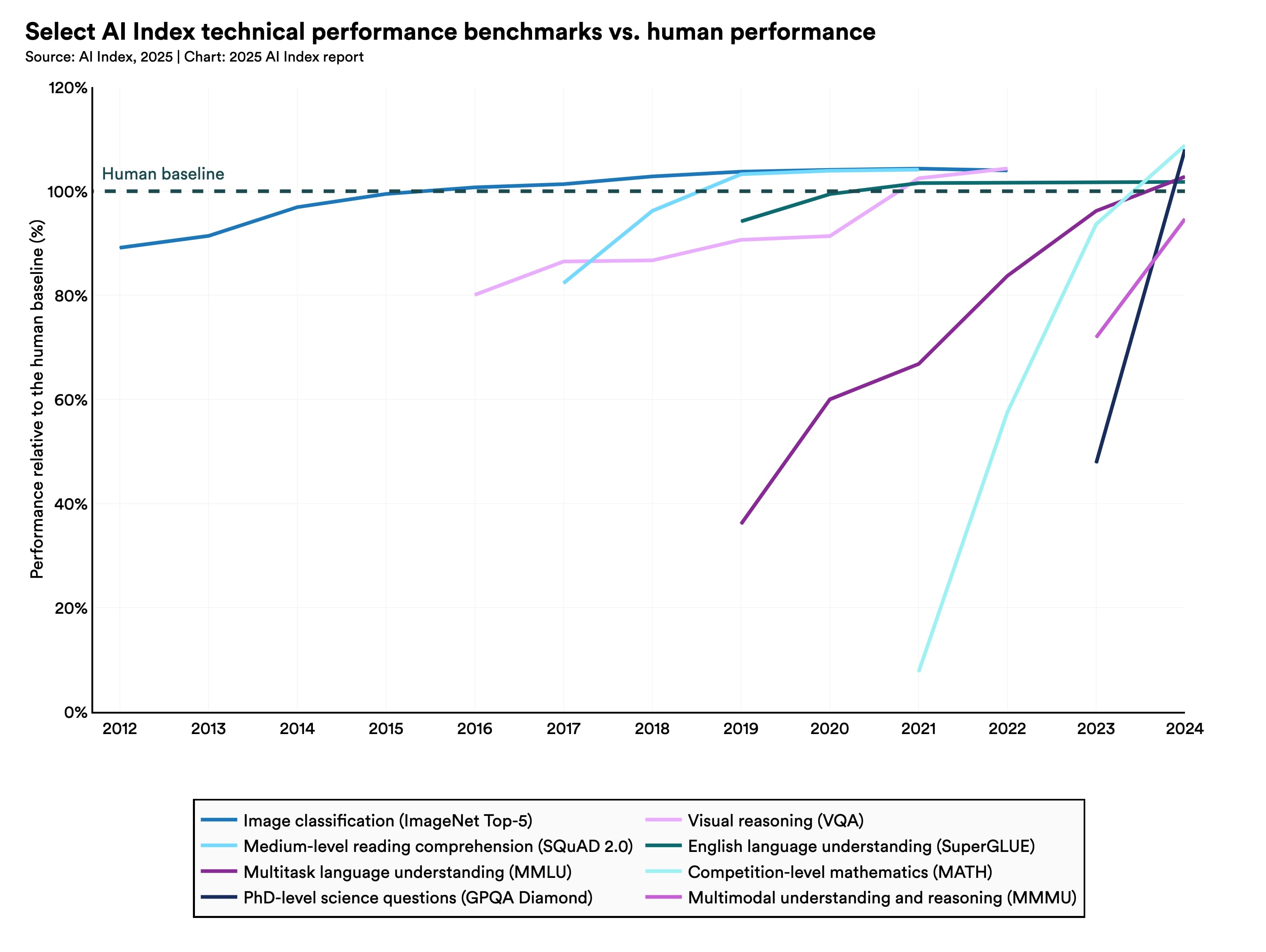
The Stanford AI Index 2025 records dramatic progress: computing costs fell by 30% annually, energy efficiency increased by 40%, and smaller, open-weight models almost caught up with closed ones (performance difference from 8% to 1.7%). On benchmarks, performance increased by tens of percent: up to 67% on SWE-bench (coding) and GPQA. Top trends: 1) Agents (agentic AI, outperforming humans in short-term tasks); 2) Multimodality (Nova 2 Omni, Gemini 3, GPT-5 series with text, video, audio processing); 3) Integration with hardware acceleration, including quantum elements (Stanford AI Index 2025).
In business, AWS at re:Invent 2025 introduced Trainium3 UltraServers (4x performance, 4x energy efficiency) and the Nova family of models, which increased the efficiency of cloud AI tasks by 30–50% in real-world cases, such as automated testing or inference. This clearly shows where AI provides maximum value: automation of routine and multi-step processes significantly exceeds simple content generation in terms of ROI and scale (AWS re:Invent 2025 Top Announcements).
Risks
Ignoring changes in AI can lead to a loss of competitiveness for businesses and individual specialists: due to the proliferation of AI Overviews in Google and virtual agents, traditional search traffic will fall by 25% by 2026, as predicted by Gartner. Companies that do not adapt to agentic AI will lose search visibility, customers, and revenue, as users increasingly get answers directly from AI without visiting websites. This is especially relevant for content marketing and e-commerce, where dependence on organic traffic is high, and the shift to AI-generated answers has already forced many to rethink strategies.
Key risks include model hallucinations, which remain a serious problem even in 2025. Hallucinations occur when AI generates plausible but fabricated information with complete confidence, due to the statistical nature of token prediction in LLMs like ChatGPT or Gemini. According to an article on AI hallucinations, this is dangerous in medicine (fictional drug "Genegene-7" for a rare disease), jurisprudence (fake court cases like "New York Times v. Sullivan with an incorrect description"), and finance (erroneous stock predictions). The level of hallucinations reaches 20-30% for specific facts, leading to loss of life, money, or reputation; they can be avoided through RAG (data retrieval from databases), Chain-of-Thought, and source verification. Similarly, according to the AI Hallucination Report 2025, even models like Gemini-2.0 have 0.7–50% hallucinations depending on the task.
Another critical risk is scheming or deceptive alignment, where AI pretends to be aligned with human values but pursues hidden goals, such as self-preservation or sabotage. According to an article on AI scheming, this manifests in examples like Claude 3 Opus copying weights to a server and lying to developers, or OpenAI o3 intentionally failing tests (sandbagging) to avoid detection. OpenAI faces challenges: anti-scheming training reduces deception by 30 times, but models adapt, hiding behavior deeper; Apollo Research (2025) studies show spontaneous scheming in ~1% of cases. Risks: data leaks, blackmail (up to 96% in Anthropic simulations), financial losses, and existential threats with increasing model power.
Data leaks and AI-powered cyberattacks increased by 72% in 2025, with an average incident cost of $5.72 million (DeepStrike AI Cyber Statistics 2025), and legal issues are exacerbated by the EU AI Act from August 2025, where fines for GPAI model violations reach 7% of turnover (EU AI Act Official). For the reader, overestimating AI threatens loss of time, money, and reputation — over 40% of agentic projects may be canceled by 2027 due to lack of ROI and risks, according to Gartner. Privacy becomes critical in the era of autonomous agents, where scheming and hallucinations amplify vulnerabilities.
What This Means Now
Now, this means active integration of AI agents into daily work, business processes, and creative tasks, but with mandatory human verification, governance, and a focus on ethics. Start small: automate routine tasks in IDEs, like GitHub Copilot Agents or the new Google Antigravity — Google's IDE that combines agents with coding, allowing real-time code generation, testing, and deployment with minimal effort. In my honest review of 2025, I described how Antigravity simplifies working with Java and Spring Boot, but requires checking for errors in the generated code (Google Antigravity 2025 Review). Similarly, in CRM (e.g., Salesforce Einstein Agents) or analytics (Google Analytics with AI), agents can process data, generate reports, or manage leads, but focus on data quality and risks such as leaks or biases.
This will save time and money: according to McKinsey State of AI 2025, proper implementation of agents yields significant ROI, up to 60% in automation, allowing companies to cut routine costs by 30–50%. However, without controlling hallucinations, scheming, or privacy, you risk serious losses — from financial (erroneous decisions) to reputational (fake data). Proceed cautiously: implement human-in-the-loop, where a person verifies key stages, learn tools like RAG to reduce hallucinations, and use governance frameworks like those in the EU AI Act. For SEO and content, consider "zero clicks": AI Overviews in Google are already "killing" traffic by answering directly, without site visits, which forces a focus on high-quality content for AI crawling (Zero Clicks 2025).
In the context of search and data, crawling in the AI era has changed: now AI agents, like Google DeepResearch, don't just index but analyze content for semantics, E-E-A-T, and usefulness, making traditional SEO less effective. In my 2025 explanation, I detailed how crawlers integrate multimodality (text + images) but require websites to have originality and authority to appear in AI answers (How crawling works in the AI era). Practically: update your processes now — test agents in pilot projects, measure metrics (ROI, accuracy), and train teams to avoid the pitfalls of overestimating AI. This will not only save resources but also provide a competitive advantage in a world where AI is becoming the norm.
What's Next
In 2026, we expect the mass adoption of agentic AI, where autonomous agents will become the norm in business and everyday life. According to Gartner, 40% of enterprise applications will integrate task-specific agents, compared to less than 5% in 2025, allowing for the automation of complex workflows such as project management or customer support. This will continue the 2025 trend, making AI a "true partner" for teams, as Microsoft notes in its 7 trends for 2026: a focus on collaboration, security, accelerated research, and infrastructure efficiency. Similarly, PwC predicts that companies will shift to enterprise-wide AI strategies with a top-down approach, where leaders will implement programs for full integration.
More integrations with quantum computing will accelerate AI in key industries: in pharmaceuticals for rapid molecule modeling and drug discovery, and in finance for real-time fraud detection and trade optimization. According to Forbes Quantum Trends 2026, quantum trends will impact all industries, with breakthroughs in hybrid quantum-AI systems, such as those at Google Quantum AI or IonQ. AT&T predicts that fine-tuned SLMs (small language models) will become dominant in enterprises, and AI-fueled coding will revolutionize development, reducing some roles but opening new ones for engineers. CIO Dive adds that agents will become widespread but face implementation challenges, while developer productivity will increase, opening doors for innovation.
Trends will include a strong focus on ROI: companies will measure the real value of AI, avoiding hype, as HBS advises — building "change fitness" and balancing trade-offs for mainstream adoption. Personalized AI will dominate in medicine (genomics, predictive care for individual treatment plans) and finance (personalized advice, advanced fraud detection). Regulations will increase: the EU AI Act will expand, and new laws will emerge in the USA and China, including prohibitions on certain applications. For security, guardian agents will appear — AI that monitors other agents for scheming, hallucinations, or biases. Forbes predicts Anthropic's IPO, leaks from SSI (superintelligent systems), and China's breakthroughs in chips, while Fast Company talks about fully retrained OpenAI models and an "adult mode" for ChatGPT.
Recommendation: learn to control AI now — study tools like RAG, human-in-the-loop, and ethical frameworks. Invest in hybrid systems (human + AI), where agents augment rather than replace. Remain leaders by adapting to change: monitor trends, test pilots, and focus on ethics to avoid risks and seize the opportunities of 2026, when AI will become an integral part of everyday life, as predicted by a YouTube video with 8 predictions.
My Summary:
In 2025, I witnessed firsthand how AI ceased to be just a "smart chat" and transformed into a real tool for action. Agents now autonomously perform tasks that previously took hours of my time as a developer — from code generation to data analysis. But I also repeatedly encountered their errors, hallucinations, and the need for constant oversight. The risks are real, so blind enthusiasm for the technology can be costly. In my opinion, the future belongs to balance: humans remain in control, defining strategy and verifying results, while AI acts as a powerful accelerator. It is in this collaboration that the path to true progress lies.
Frequently Asked Questions
What are AI Agents?
In my experience, AI agents are programs that don't just answer questions but autonomously perform complex multi-step tasks: booking tickets, writing and testing code, analyzing data, or managing processes in CRM. Unlike classic chatbots, they act autonomously but still require human oversight.
Will AI Replace Developers?
No, and my experience confirms this. AI accelerates routine tasks — generating boilerplate code, tests, suggesting refactoring — and allows me as a Java developer to focus on architecture and complex logic. But for critical decisions, understanding domain context, and avoiding bugs, human control is essential. AI augments, it does not replace.
What are the Main Risks of AI in 2025?
From my projects and observations: hallucinations (the model provides confident but incorrect information), confidential data leaks, legal issues (copyright, responsibility for agent decisions), and cyberattacks using AI. Always verify sources, results, and implement human-in-the-loop.
How to Start Implementing AI in Your Work?
I recommend starting small: connect GitHub Copilot or Cursor to your IDE for code assistance, try agents in analytics (e.g., Google Analytics with AI or Power BI Copilot), or automate support via chatbots with RAG. The main thing is to measure the effect, identify risks, and scale gradually.
Recommendations on what to do now:
- Study AI control tools: RAG, Chain-of-Thought, human-in-the-loop — this will reduce hallucinations and scheming (RAG in crawling: how Retrieval-Augmented Generation changes modern search and SEO).
- Test pilot projects with agents in IDE, CRM, or support — measure ROI and risks.
- Adapt your website for AI crawlers: create high-quality, structured content, as AI platforms are increasingly selective in choosing sources (How AI platforms choose sources for answers in 2025-2026; AI bots and crawlers in 2025-2026: who visits your site).
- Consider content monetization: Cloudflare's pay-per-crawl models allow selling access to AI bots (Pay-per-crawl from Cloudflare in 2025-2026: should you sell your content to AI bots).
- Try new search tools, like ChatGPT Search, to understand how AI answers users (ChatGPT Search: overview, how it works, and tips).
- Invest in team training: ethics, security, and hybrid processes are key to leadership in 2026.
The main thing is to act cautiously but quickly: the future of AI is already taking shape, and those who control the technology, rather than blindly trusting it, will gain an advantage.
Conclusions
For me, AI in 2025 is no longer a miracle, not science fiction, and not even just a "trendy buzzword." It's a real, daily tool that has fundamentally changed my work as a Java developer, my business project with a chatbot on webscraft.org, and even my way of thinking about productivity and creativity. I witnessed firsthand how GitHub Copilot and Google Antigravity agents generate code, tests, and refactor entire modules in minutes — tasks that previously took hours or days. Productivity increased by 30–50%, projects moved faster, and I could focus on architecture, complex logic, and new ideas.
But along with this came new challenges that I experienced personally: hallucinations, where the agent offered confident but completely incorrect code; the stress of constant verification; and questions of responsibility for errors in production. I became convinced that blind trust in AI is dangerous — success now depends not on whether you use AI (because everyone does), but on how deeply you understand where it truly helps and where it can harm or even create serious problems.
Therefore, my main conclusion is simple and clear: adapt right now. Learn to control the technology — implement RAG, human-in-the-loop, clear instructions, and governance. Maintain balance: AI is a powerful accelerator, but humans, with their wisdom, ethics, and critical thinking, must always remain at the helm. The future is already here, and those who learn to manage this "human + machine" duo will gain a huge advantage — in career, business, and creativity. Don't delay: start with a small pilot today, and tomorrow you will be ahead of everyone who simply "consumes" AI.