
On May 15, 2026, Google quietly updated a single sentence in its Spam Policy.
But this sentence is a game-changer for everyone involved in content and SEO.
No loud announcements, no big press conference — just a new wording
on the documentation page.
Search Engine Roundtable
noticed the change first. Then it was picked up by
Gizmodo,
The Verge, and Search Engine Land.
What Exactly Changed — The New Wording
Until May 15, the introductory part of
Google's Spam Policies
described spam as attempts to manipulate search engines to improve rankings.
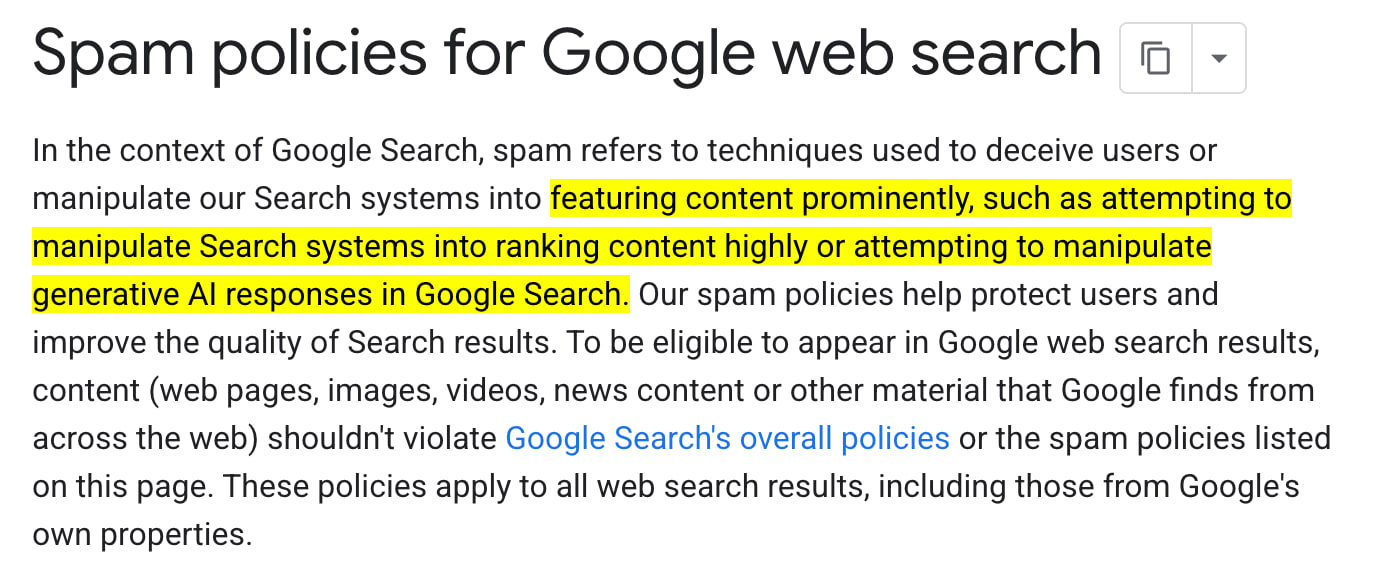
After the update, new wording appeared:
"In the context of Google Search, spam refers to techniques used to deceive users
or manipulate our Search systems into featuring content prominently, such as attempting
to manipulate Search systems into ranking content highly or attempting to manipulate
generative AI responses in Google Search."
The highlighted fragment is new. The rest remains unchanged.
Technically, it's a small addition. Practically, it's an official extension
of anti-spam rules to AI Overviews and AI Mode.
Penalties for violations remain standard for spam:
ranking demotion, a manual action from Google, or complete removal of the site
from search results. Detection is done by automated systems and,
if necessary, by human reviewers.
What Google Considers Manipulation of AI Responses
The Spam Policy itself does not provide an exhaustive list of prohibited techniques for AI.
However, from the official document and confirmed sources — The Verge, Gizmodo,
Search Engine Land — a clear picture emerges of what is targeted:
Mass generation of pages without user value.
The Spam Policy directly mentions: "using generative AI tools or other similar tools
to generate many pages without adding value for users."
Thousands of AI pages optimized for keywords — a classic scenario.
Cloaking for AI crawlers.
Showing one thing to GoogleBot and another to a real user.
An old technique in a new context: some sites showed AI-friendly content
to crawlers and regular content to people.
Recommendation poisoning and biased listicles.
The Verge describes this technique separately: articles like "Top 10 Best X"
written not for the reader but to influence how AI forms recommendations.
Artificially inflating citations so that AI refers to a specific site more often.
Expired domain abuse.
Purchasing old, authoritative domains to host low-quality content
with the aim of appearing in AI responses through domain authority.
Hidden text and links.
Techniques that have existed in SEO for years — now explicitly extended to the AI context.
Context: Why Google Decided to Formalize This Now
To understand Google's decision, it's worth looking at the scale of the phenomenon.
Conductor (Q1 2026)
analyzed 21.9 million search queries and found that
AI Overviews appear in 25% of all Google search queries.
For comparison, a year ago this figure was 13%.
BrightEdge (February 2026)
records an even higher figure — up to 48% of queries in commercial niches.
When AI Overviews appear in every fourth or second query —
they become a separate visibility channel. A separate channel means:
a separate object for manipulation. The GEO (Generative Engine Optimization) market
is already valued at $848 million and is projected to grow to $33.7 billion by 2034
(Superlines, 2026).
Gizmodo
cites a specific case: a BBC journalist managed to get ChatGPT,
AI Overviews, and Gemini to claim he won the South Dakota International
Hot Dog Championship 2026 — using manipulative content techniques.
This is not a theoretical threat — it's something that is already happening.
Google is reacting to a real problem, not preemptively banning something hypothetical.

Who Will Be Affected — And Who Won't
It's important to distinguish between two categories: those for whom this is a real risk,
and those whom this update will practically not affect.
A real risk exists for:
Content farms that use AI for mass production of pages
without real editing and without added value for the reader.
GEO agencies that sell "guaranteed placement in AI Overview"
through manipulative techniques rather than quality.
Sites that practice recommendation poisoning — "best X" articles
written to influence the algorithm rather than help the reader.
PBN networks reoriented from classic link building to influencing AI answers.
Practically unaffected are:
Authors who write in the first person with real experience.
Sites with a genuine E-E-A-T signature:
authorship, experience, practical facts — these are the signals Google
uses to distinguish quality content from manipulative content.
Those who use AI as an editing and verification tool —
not as a substitute for thought and experience.
Content that naturally appears in AI Overview because it is useful —
not because someone "optimized" it for the algorithm.
It's worth noting: Google does not prohibit GEO as a discipline.
Specific manipulative techniques are prohibited. Writing structured,
clear, well-supported content with facts — this is what Google wants to see.
The difference between legitimate GEO and manipulation lies in intent and quality.
What This Means for the Content Marketing and SEO Market
This update is not a revolution. It's a formalization of the direction
Google has been moving in for several years.
Classic SEO has always had two strategies: build quality content
or look for technical shortcuts. Every major Google update
closed shortcuts and increased the value of the first approach.
Panda in 2011 hit content farms,
Penguin in 2012 — manipulative link building.
The Helpful Content Update in 2022 targeted content written for search engines, not people.
Now, the same logic is being extended to AI answers.
The practical consequence for the market: those who invested in manipulative SEO
face new risks without guaranteed results. Those who built authority,
E-E-A-T, and real value for the reader gain a competitive advantage
because their competitors will be weeded out.
There is also practical uncertainty, which even major publications honestly admit.
Startup Fortune
notes that while classic SEO spamming is relatively easy to detect algorithmically
(buying links, hidden text), manipulating AI answers
is significantly harder to recognize automatically. Where is the line between "writing a clear answer
that the AI quoted" and "manipulating the format to get into AI Overview"?
This question remains open. The answer will be shaped
by enforcement practices in the coming months.
What an SEO Specialist Should Do Right Now
What Manipulation Looks Like in Practice
Recommendation poisoning is when an article like
"Best CRMs for Small Businesses 2026" is written not for the reader,
but to make AI Overview repeatedly quote a specific product.
The pattern is simple: product X is mentioned in every paragraph,
in headings, in the conclusion — even where it's illogical.
The goal is not to inform, but to "teach" the model to associate X with the category.
Biased listicles are "Top 10 SEO Tools"
where position #1 belongs to a partner or advertiser, regardless of actual quality.
A characteristic sign: all competitors are described in one sentence,
while the favorite gets five paragraphs with detailed advantages.
The Verge described this pattern as one of the main vectors
of AI answer manipulation in 2025–2026.
Scaled GEO content involves hundreds of pages in the format
"What is X + city/industry/segment name" generated by AI
without real editing. Each is targeted at a micro-variation of a query
to appear in as many AI Overviews as possible.
How Google Detects This Technically
Google uses SpamBrain — its own AI system
for spam detection. It learns from patterns, not rules:
it doesn't look for specific forbidden words but recognizes behavioral signatures
of content. Mass production of similar pages, an abnormal density
of brand mentions, a mismatch between page structure
and real reader value — these are all patterns SpamBrain is trained to recognize.
In addition to automation, there's human review.
According to Gizmodo,
Google explicitly states that violations are detected
"through automated systems and, when necessary, human reviewers."
Manual action — the most severe form of punishment — is precisely the result of human review.
Practical Checklist
1. Audit content for manipulative patterns.
Review articles like "Top" and "Best X."
Ask honestly: is this article written to help the reader
or to promote a specific product/brand?
2. Check authorship.
Every article should have a real author with proven expertise.
Anonymous content without E-E-A-T signals is the first candidate for demotion.
More details on this —
what E-E-A-T is and how to build it.
3. Remove or rewrite mass AI content without value.
AI as an editing tool is normal.
Hundreds of pages generated without real thought and experience are a risk.
4. Check listicles for bias.
If your "Top X" list has a partner or advertiser in the first place —
either explain the selection methodology or rework it into an honest review.
5. Don't panic about organic inclusion in AI Overview.
If your content is cited naturally, it's not a violation.
Google punishes manipulation, not quality.
More on how to properly build content after this update —
in the next article in the series:
→ Google Spam Policy 2026: How to Create Content Correctly to Avoid Sanctions
Conclusion
Google updated its Spam Policy because AI Overview has become significant enough
to warrant protection. 25-48% of queries is no longer an experiment,
it's part of the search infrastructure.
For those who build content honestly, this update is more of an opportunity than a threat.
The market is being filtered. Manipulative players face new risks.
Authoritative content from practitioners becomes more valuable.
For those who sought shortcuts in SEO — the rules of the game have just officially changed.
Not unexpectedly, but now documented.
Sources: