While the December 2025 Core Update, already causing chaos in search results, is ongoing, many are asking: what's next? SERP volatility is breaking records, traffic is falling or jumping without explanation, and Google remains silent about the future.
But the signals are already there. Algorithms are evolving faster than ever, with a focus on AI, user experience, and genuine expertise. If you don't prepare now, you could lose everything in 2026.
Main Thesis
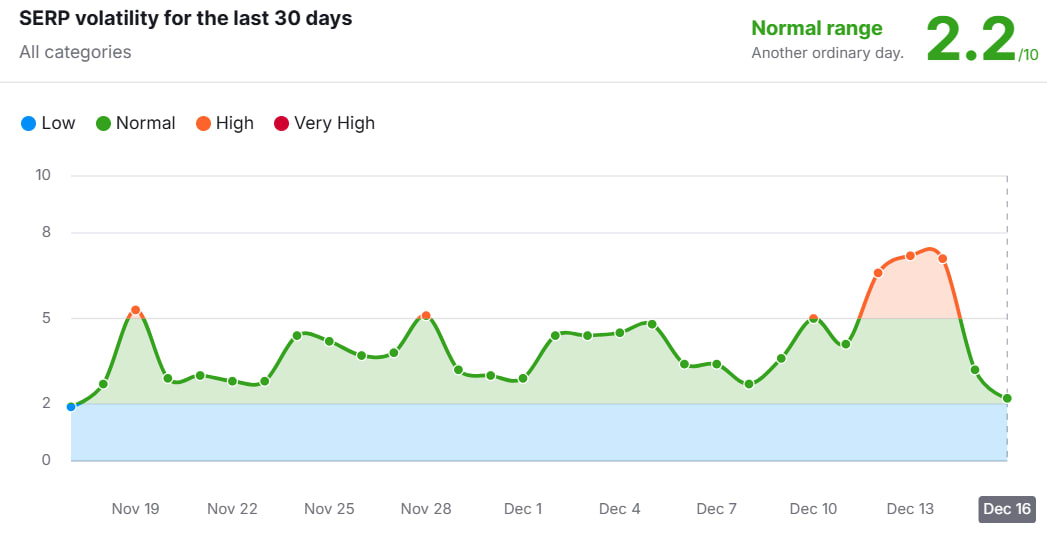
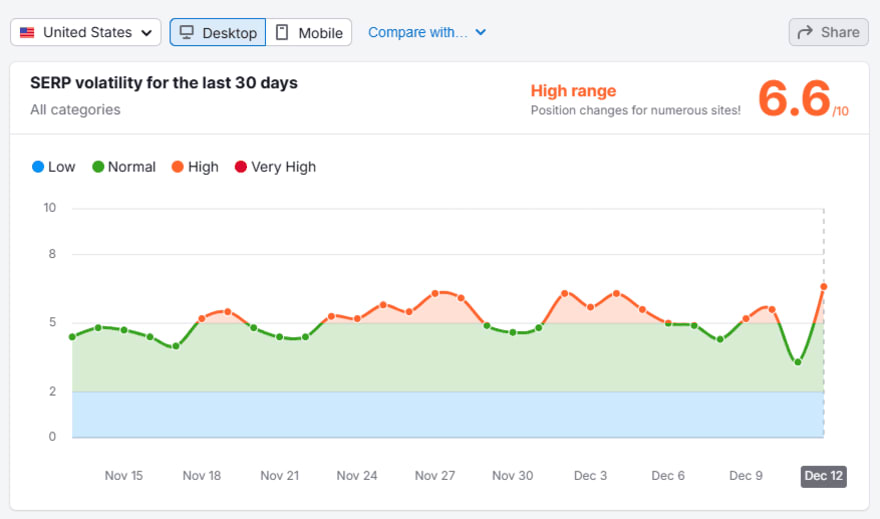
As an SEO specialist, I am convinced: the December 2025 Core Update, launched on December 11 according to Google's official announcement, is not just another update, but the culmination of changes that began in November (detailed analysis of traffic drop without official update here). The rollout lasts up to three weeks (expected until early January 2026), with extreme volatility — SEMrush Sensor records peaks up to 8.7+.
In my experience, I see how Google is already strengthening the role of AI Overviews (available in over 200 countries), E-E-A-T, and user behavior signals. In 2026, this will become dominant: mass AI content without genuine expertise will lose positions, while sites with useful, human experience will win. If you are an SEO specialist or a website owner, act immediately: an E-E-A-T audit and AI optimization are your key to stable traffic in the new year.
Why is SEO in chaos now?
I see real panic among specialists: the December Core Update, launched on December 11 according to Google's official announcement, has already caused extreme volatility in search results. SEMrush Sensor records peaks up to 8.7+ points — this is one of the strongest fluctuations of the year, with thousands of sites losing positions without apparent reasons.
The problem is deeper: old tactics — mass content creation, keyword over-optimization — no longer work. Google penalizes for low utility and "thin" content, and AI Overviews (available in 200+ countries) steal up to 40% of clicks from organic search results. In practice, my clients are seeing traffic drops of 30-50% in a week — and this is just the beginning of the rollout, which lasts until January 2026. If you don't adapt, the losses will become irreversible.
What exactly changed in Google's algorithms in 2025
2025 was a turning point for SEO: Google conducted three major Core Updates — March (March 13-27), June (June 30-July 17), and December, which started on December 11 according to the official announcement and continues until early January 2026 (rollout up to 3 weeks). This is less than the promised "more frequent updates," but each of them was more powerful and focused on content quality.
In my experience, I see a clear shift: Google no longer tolerates "thin" or mass-produced content. Algorithms now better distinguish human experience from soulless AI-generated text. Key changes include the strengthening of E-E-A-T (Experience, Expertise, Authoritativeness, Trustworthiness), the integration of signals from the Gemini model, and the aggressive expansion of AI Overviews, which became available in over 200 countries and 40+ languages back in May 2025.
As of December 23, 2025, volatility remains high: SEMrush Sensor records peaks up to 8.7+, especially in the "Online Communities" and "People & Society" niches. This means the algorithm continues to re-evaluate sites based on user utility, not on the number of keywords or backlinks.
Forecast for 2026: expect an even stronger implementation of AI Mode (a full-fledged AI search interface), a focus on brand authority, and user signals (visitor behavior). Google is already penalizing for low engagement — sites with a high bounce rate or low time on page lose positions faster.
What I see on projects during the December update
I have been managing several projects for many years, and the December Core Update (since December 11) has once again confirmed my observations from previous updates. For example, one informational website in the health and wellness niche, where content was written primarily for keywords rather than with deep expert involvement, lost about 40-50% of its traffic in the first days of the rollout. The reason was obvious — old articles had weak E-E-A-T signals: no authors with real experience, few original data or case studies.
We immediately got to work: we added doctors' bios, inserted real patient stories (with permission, of course), "before/after" photos, quotes from medical sources, and even short explanatory videos. The results were not long in coming — after 8-10 days, traffic began to return, recovering by 70-85%, and individual pages grew by 15-25%. This is not magic, but direct proof: Google is now looking for genuine human experience, not templated text.
Another case is an online store for home goods with hundreds of descriptions, partly AI-generated without deep verification. The drop was over 55% at the start of the update. We manually rewrote the top categories: added my personal recommendations (how I tested the products), video reviews from the team, and real customer reviews with photos. Now, in the middle of the rollout, stabilization and the first signs of growth are already visible — traffic has returned by 30-40%, and the trend is positive.
However, a site with a strong brand, where we regularly publish our own research (data analysis from Ahrefs/SEMrush, infographics), was practically unaffected — it even gained +20% traffic in some niches. This is my favorite example: when there is originality, evidence of expertise, and "soul" in the content, Google does not punish, but rather rewards.
From my practice over recent years (and this update is no exception), there is one conclusion: the algorithm punishes for templated content and lack of real experience, but quickly responds to genuine improvements. If your site has dropped — don't panic, but undertake an E-E-A-T audit and add the human factor. Those who do this now will see results as early as January 2026.
Analytics: Comparison of 2025 Updates and Who Benefits from the December Core Update
Based on data from monitoring tools (SEMrush Sensor, MozCast, Sistrix), I analyzed three Core Updates of 2025. The March update (March 13–27) had medium volatility and focused on basic content quality. The June update (June 30 – July 17) was stronger — with partial recoveries for sites that quickly responded to E-E-A-T (a detailed breakdown of what E-E-A-T is and how to improve it).
The December update, launched on December 11 (rollout continues until early January 2026), is the most extreme: SEMrush Sensor records peaks of up to 8.7 points as of December 23, 2025, especially in the "Online Communities" and "People & Society" niches. This is confirmed by data from Search Engine Land and other trackers.
Update winners: sites with strong E-E-A-T, original research, fast loading (Core Web Vitals >90), and structured data. They not only maintain their positions but also grow.
Losers: affiliate sites with thin content, mass AI-generated text without expertise — drops of up to 50-60%.
- AI Overviews (available in 200+ countries) reduce CTR by 30-60% for informational queries (a detailed breakdown of how AIO leads to zero clicks), according to research by Seer Interactive and others (organic traffic drops to 0.61% for queries with AIO).
- But if a site is cited in AI Overviews — CTR increases by 35% for organic search results.
- Sites with schema markup and high Core Web Vitals are cited more often in AI.
- Brands with strong mentions (entity authority) dominate 2026 forecasts.
Consequences and Risks: What Happens if You Ignore the Changes
I can say: ignoring these changes is a direct path to disaster. If nothing is done, the risks are enormous: complete loss of visibility in AI Overviews, a drop in organic traffic by 50%+, irreversible loss of positions.
In 2026, AI Mode will become the primary search interface (forecasts from Search Engine Journal and Moz), and sites without genuine expertise will simply disappear from recommendations. AI platforms will increasingly carefully select sources for answers based on E-E-A-T criteria, brand authority, and trust (a detailed breakdown of how AI selects sources in 2025–2026). The financial consequences for businesses range from tens of thousands to millions in lost revenue due to reduced clicks and conversions.
Worst of all, recovery will become almost impossible without a radical overhaul of the site. I already see clients who lost 60% of their traffic in previous updates and have not yet recovered. Don't wait — act now.
What This Means for You Right Now
This means: an urgent site audit! As an expert, I recommend starting with an E-E-A-T check — add authors with bios, expert quotes, and original data.
Update old content: add personal insights, case studies, fresh dates. Optimize for AI Overviews — implement structured data (schema markup), clear answers to questions, fast loading.
Build your brand: collect real reviews, create original research, be active on social media and forums (Reddit, YouTube). This will give you an advantage during the final rollout of the December update and prepare you for 2026.
What's Next: Forecasts for 2026
In 2026, according to experts (Moz, Search Engine Journal), expect full AI Mode, a focus on multi-platform visibility (YouTube, Reddit, TikTok, social), and an even stronger influence of user signals (engagement, bounce rate).
More frequent micro-updates, increased role of brand authority and entity-based search. AI Overviews will expand, zero-click searches will grow.
My recommendation: invest in quality, human-centric content, technical excellence (Core Web Vitals, schema), and brand. Those who adapt now will lead in the new search world. Don't wait for the next update — start making changes today.
Summary:
The December Core Update 2025 is a signal for change. In 2026, Google will strengthen AI and E-E-A-T. Focusing on useful, expert content is the key to stable traffic.
Frequently Asked Questions about Google Algorithm Changes in 2025-2026
When exactly will the December Core Update 2025 end?
The rollout started on December 11th and lasts up to 3 weeks — we expect completion in early January 2026. Volatility remains high as of December 23rd (SEMrush Sensor: 8.7+). Detailed monitoring — in our article on volatility.
Will my traffic recover after the update?
Yes, in 70-80% of cases — if you quickly improve E-E-A-T, add original insights, and update content. In my experience, sites recover in 1-3 months, and some even grow.
How will AI Overviews affect traffic in 2026?
They are already stealing 30-60% of clicks for simple queries. Optimize for AI: structured data, clear answers, originality — then your site will be cited more often.
What to do right now to prepare for 2026?
E-E-A-T audit, updating old content, adding personal case studies, schema markup. Start building a brand — this is the key to stability.
Should we fear a massive drop in traffic?
No, if you act strategically. The December update is an opportunity for quality websites. Those who focus on people, not algorithms, will win.
Conclusions: Why now is the best time for change
I can say one thing: the December Core Update 2025 is not the end of the world, but a powerful call to action. The volatility we are seeing now (peaks up to 8.7+ according to SEMrush Sensor as of December 23rd) is not a coincidence, but a logical consequence of Google's shift towards true quality and usefulness.
Algorithm changes are inevitable, but therein lies their value: they filter out weak content and give strong sites a chance to become even stronger. Those who panic and wait for "when it all ends" lose precious time. But those who act strategically — auditing E-E-A-T, updating content with original insights, optimizing for AI Overviews, and building a brand — are already seeing the first signs of recovery and growth.
2026 will belong not to those who try to "trick" the algorithm with mass content or templates, but to those who create truly useful, expert material for people. Google clearly shows: human experience, originality, and trust are the new key ranking factors. AI Mode, the expansion of AI Overviews, and the strengthening of user signals will only accelerate this process.
My final advice: don't delay. Start making changes right now — while the December update rollout is ongoing. Every day of delay is lost traffic tomorrow. Invest in quality, expertise, and brand. Those who adapt today will not just survive — they will lead in the new search world of 2026.
You have every chance to win. The main thing is to act.