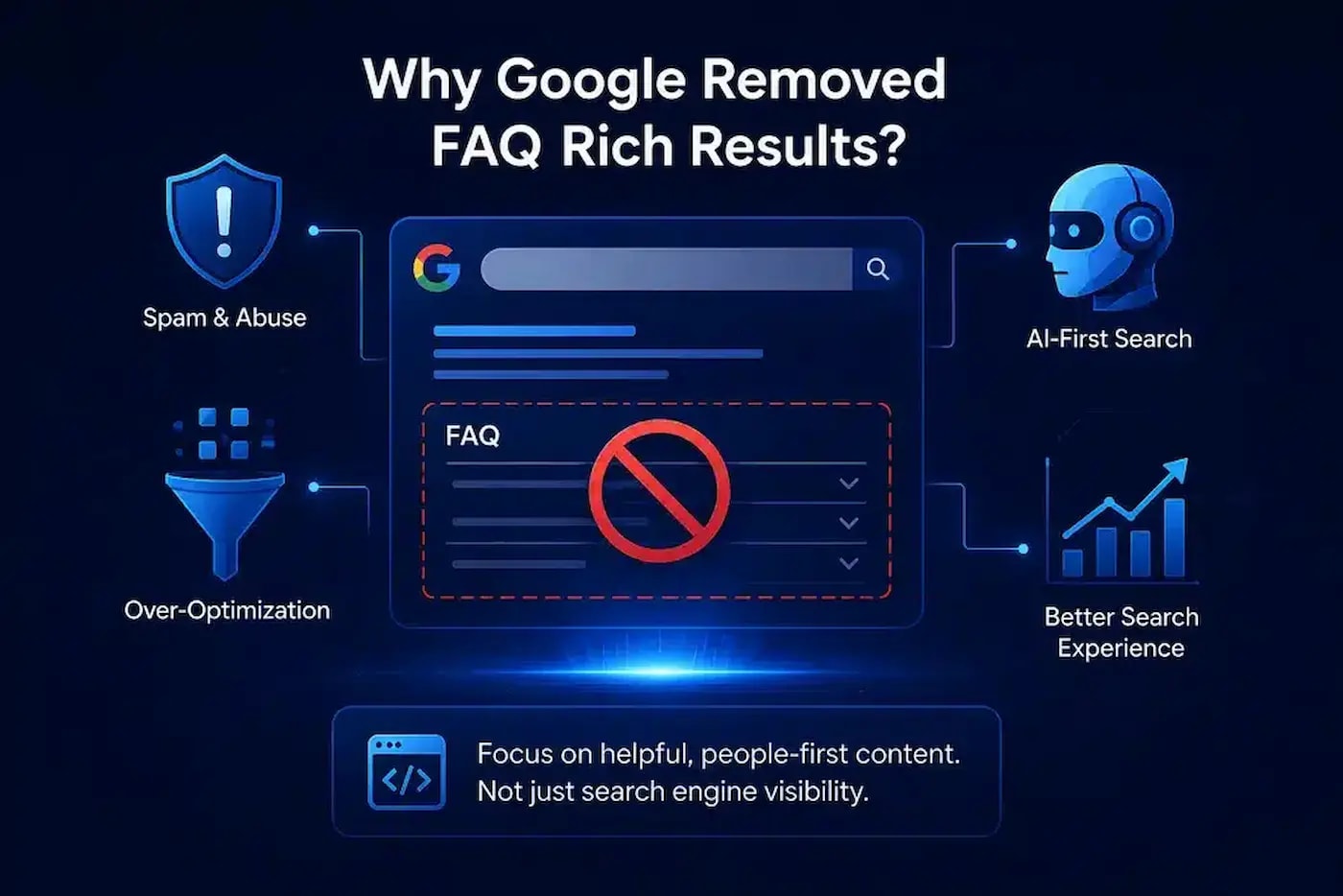
Announcement. On May 7, 2026, Google permanently disabled FAQ rich results for all sites without exception. This is the culmination of a process that began back in August 2023. But if you think it's just about the disappearance of accordions in search results, you're mistaken. Behind this technical decision lies a fundamental transformation of how Google and AI systems consume, process, and synthesize content. This article provides a detailed analysis: from the timeline of changes and the engineering of schema markup to the practice of GEO (Generative Engine Optimization) and how to optimize your site for next-generation retrieval search.
1. What Exactly Did Google Change — and Why Was It Expected
Timeline of Deprecation
The process of eliminating FAQ rich results occurred in two distinct stages. The first was in August 2023: Google announced that FAQ accordions in search results would henceforth be available only for "authoritative government and medical sites." According to John Mueller, Search Advocate at Google, this was a change in result display, not ranking. Within a week of the announcement, SEO tools across the industry recorded the same thing: the number of FAQ rich result impressions for commercial sites plummeted to zero. Pages that had carried FAQ snippets for years lost them overnight.
The second stage was on May 7, 2026: Google officially announced that FAQ rich results would no longer be displayed in Google Search for anyone. In June 2026, the corresponding report in Search Console and support in Rich Results Test will be disabled. In August 2026, support for FAQ rich results in the Search Console API will be phased out. The deprecation is complete.
What Disappeared from Search Results
For the absolute majority of websites — which is 99%+ of the open web — the SERP value of FAQ schema has become zero. Interactive accordions that expanded directly in search results disappeared, the visual size of snippets decreased, and console reports ceased. The March 2026 update further reduced FAQ rich result impressions by approximately half compared to the post-2023 level — even for sites that retained residual visibility.
Why It's Logical for Google
I think the reasons for this decision were obvious to anyone who has long observed the SEO market. FAQ markup gradually transformed from a way to structure useful answers for the user into a tool for capturing additional space in SERPs. Many teams added artificial FAQ blocks not because the page genuinely needed a "question-answer" format, but solely to increase the visual area of the snippet. As a result, this created more noise than value for search. In my opinion, Google solved the problem radically: instead of endless quality control of individual implementations, the company simply removed the display mechanism itself for most sites. This is clearly visible in the gradual phasing out of FAQ rich results in search.
But there is a deeper, strategic reason: Google is systematically moving towards generative synthesis of answers, rather than delegating them through extended snippets to third-party sites. AI Overviews now appear in 89% of search results for branded queries. Why show an accordion from someone else's site when Gemini can synthesize the answer itself?
Schema markup tells Google what a page is about in a machine-readable format. Rich results are a display function that used some of this data to show visual elements in SERPs. Google can stop showing a visual function without abandoning the data that informs its semantic model.
The UI Layer Has Lost Value — The Semantic Layer Remains Relevant
The old playbook from 2018–2022, which treated FAQ schema as a CTR multiplication tool, no longer works. But this doesn't mean Schema.org has lost its meaning altogether. On the contrary — Schema.org has evolved from a display signal to a learning signal: LLM systems don't "parse" structured data in the classic sense — they absorb it, embed it into their internal knowledge graph, and reuse it to generate answers.
3. Googlebot ≠ AI Agent: Modern Search Has Two Different Content Consumption Models
The Classic Search Bot
Googlebot operates within a deterministic paradigm: indexing, canonicalization, building a link graph, parsing structured data, and rendering the DOM structure. It looks for clear signals—meta tags, canonical URLs, schema hints—and processes them according to formal rules. Schema.org was initially created precisely for such deterministic parser models.
AI Agents and LLM Systems
AI agents—Perplexity, ChatGPT Search, Google AI Overviews, Copilot—function fundamentally differently. Their work is based on retrieval, semantic extraction, chunk relevance scoring, answer synthesis, and probabilistic interpretation of content. They don't just look for formal signals in HTML or schema.org; they attempt to interpret the document's meaning at a semantic level. This is why, for modern AI systems, text structure, section logic, and context are often more important than the presence of FAQ JSON-LD. I've discussed this in more detail in the article about Perplexity's RAG architecture and retrieval-based AI search.
AI search is increasingly oriented not towards formal schema hints but towards the logical structure of the document and the quality of textual context. This means that well-structured HTML with a clear semantic hierarchy can yield a greater retrieval effect than overloaded JSON-LD with minimal textual content.
4. Under the Hood of AI Search: How LLMs Actually Process HTML
Evolution of Parsing: From Regex to Semantic Retrieval
Early web scraping systems used regex and CSS selectors—simple, deterministic tools. Modern AI retrieval pipelines are fundamentally different and involve several sequential processing layers.
How AI Sees a Web Page
The first step is HTML sanitation and DOM simplification: the system removes navigation noise, ads, scripts, tracking elements, footers, and menus. Only the main content remains. Then, HTML is converted into a text structure—often a Markdown-like representation with a flattened DOM tree. The document is simplified before being fed into the model's context window.
What happens to JSON-LD in this process? Structured data is not fed directly into the model; it's processed separately. In some retrieval pipelines, JSON-LD might be ignored during document cleaning. AI systems are increasingly receiving information directly from textual content rather than from auxiliary markup.
Chunking and Embeddings: The Heart of a Retrieval System
Each chunk receives its own vector embedding—a numerical representation of the text's semantic meaning. This allows the AI system to work not with individual words but with the context and meaning of a fragment. I've already explained in detail how embeddings help models "understand" the meaning of text in the material "Embeddings in Simple Terms: How AI Understands Meaning, Not Just Words."
From the perspective of a chunking system, the connection between an `
` heading and its corresponding `
` paragraphs is critical for correctly delineating semantic blocks. The document's logical hierarchy, minimization of noise, and efficient use of the context window enhance retrieval quality for AI agents.
The approach here is different. There's no point in building complex FAQ-generator pipelines if the ultimate goal is only SERP display, which no longer exists. Reducing backend/CMS complexity and reorienting engineering resources towards content architecture and retrieval optimization is a rational decision.
What Remains a Priority
The following types of schema retain full relevance and continue to generate rich results or provide semantic value for AI systems:
Organization—key for entity recognition in AI systems;
Article—a fundamental signal for content pages;
Product + Offer—critical for e-commerce, AI agents cite specific prices;
BreadcrumbList—semantic context for thematic clustering;
canonical metadata—basic technical SEO hygiene.
What is becoming less of a priority: schema spam, FAQ-driven CTR engineering, excessive content duplication in JSON-LD without corresponding textual content.
6. Transitioning from SEO to GEO: How to Optimize Content for AI Search
The key requirement for retrieval systems: one section = one complete thought. AI agents extract chunks and synthesize them into a response. If a content block is not self-contained, it will either not be retrieved or will lose context during extraction.
In my opinion, the main mistake after the deprecation of FAQ rich results is a panic reaction. Some teams started mass-deleting FAQ schema as if the markup itself suddenly became "harmful." I don't think this is the right approach. The problem isn't the existence of schema.org, but that the market has used it for years primarily as a UI hack to increase snippet real estate.
I don't see the point in mass-deleting FAQ JSON-LD from old projects if it already exists and is supported without additional costs. The presence of schema itself does not create a penalty. But at the same time, I wouldn't build an SEO strategy around FAQ blocks and CTR engineering through structured data anymore.
In my view, in 2026, the focus is shifting in a different direction: from manipulating SERP UI to optimizing content for retrieval and AI interpretation. This means that the key is not the amount of schema markup, but the quality of the page's semantic structure.
I would pay attention to a few things:
logical document structure;
consistent H2/H3 hierarchy;
clear semantic boundaries between sections;
minimization of boilerplate and noise content;
contextual self-sufficiency of text blocks.
Modern AI systems work through retrieval pipelines, chunking, and embeddings. Therefore, content increasingly needs to be chunk-friendly — meaning it can be easily broken down into separate logical fragments that can be extracted, analyzed, and used to generate a response.
I also think that entity clarity is an underestimated topic. For AI agents, it's not just about which words are in the text, but how unambiguously the document explains entities, terms, and the relationships between them. The less ambiguity, the easier it is for the retrieval system to correctly interpret the content.
Separately, I would treat H2/H3 not just as design elements or SEO structure, but as retrieval boundaries. In many AI pipelines, headings help the system define the boundaries of semantic chunks and understand which block answers a specific intent.
And most importantly, in 2026, the winner will not be the site with the most aggressive schema optimization, but the site whose content is easier to:
parse;
chunk;
embed;
interpret;
cite by AI systems.
7. Conclusion: FAQ Schema Isn't "Dead" — The Search Model Itself Has Changed
I believe the deprecation of FAQ rich results is just a symptom of a much deeper transformation in search. The real change is that Google and the entire modern AI search stack are gradually moving from a system of rich snippets to a system of generative answer synthesis. The logic that defined SEO optimization from 2018–2022 — fighting for SERP real estate, FAQ accordions, maximizing snippet expansion — is no longer central.
In my opinion, modern AI systems rely less and less on auxiliary display signals and increasingly derive meaning from the structure, context, and semantic integrity of the document. This doesn't mean schema.org has lost its value. Rather, its function has changed: from a display trigger to a semantic fingerprint, from a tool for increasing CTR to one of the additional learning signals for retrieval and LLM systems.
The new reality for the web requires a re-evaluation of priorities:
Parse — content must be free of noise;
Chunk — blocks must be semantically self-sufficient;
Embed — terminology must be precise and unambiguous;
Cite for AI systems — the structure must be such that an LLM can lift a block and insert it into an answer without loss of meaning.