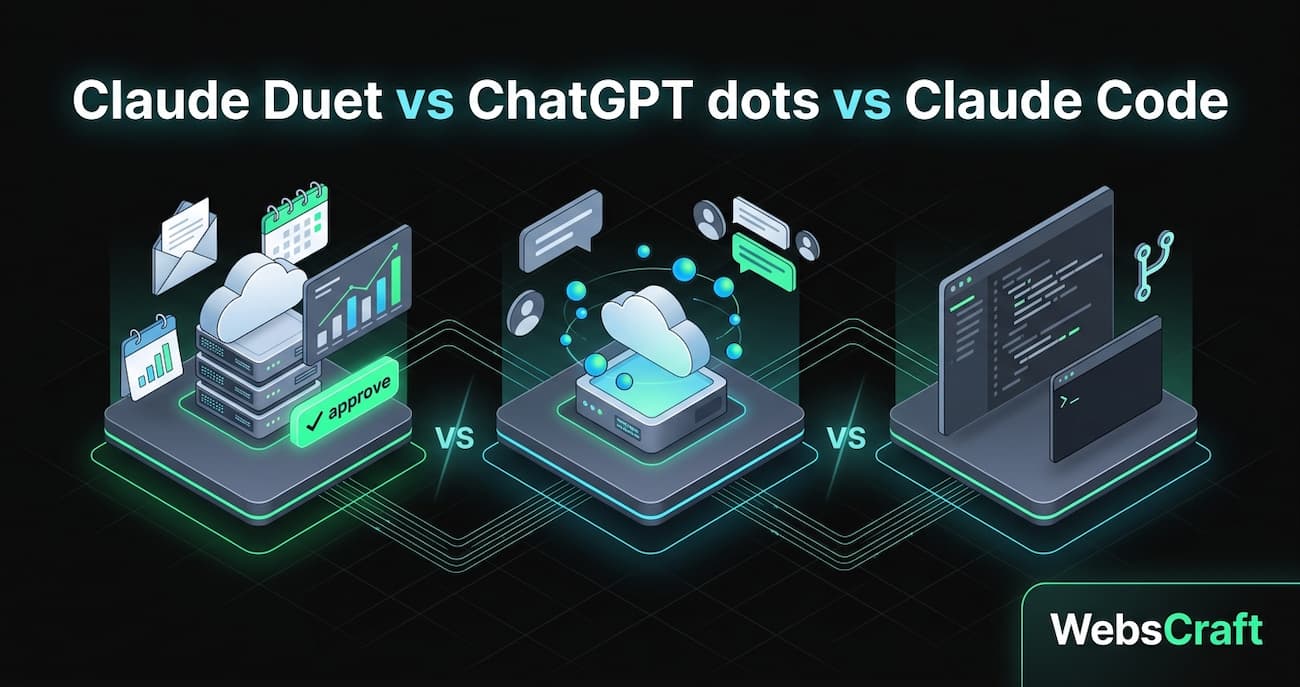
In two months, three major companies have released "persistent" AI agents: Meta - Muse, OpenAI - dots, Anthropic - Claude Duet. In parallel, agents for developers like Claude Code and Codex are being developed. The names are similar, the promises too, but the tasks they handle are different. In this article, I compare them in essence: access, price, limits, control, and what job each is suitable for.
If you are not yet familiar with Duet, first read the review of Claude Duet: what it is and how it works. I will not repeat the basics here, but will focus immediately on the differences.
Contents
🧭 Briefly: who is who
These tools can easily be lumped together because they are all "agents." In reality, there are two different categories here.
Agents for work routine — Claude Duet and ChatGPT dots. They live in the cloud, connect to email, calendar, CRM, and financial services, remind you of important things themselves, and perform tasks in the background. Their job is to relieve you of operational tasks.
Agents for code — Claude Code and OpenAI Codex. They work with the repository: read code, make changes, run tests, prepare pull requests. Their job is development.
Meta Muse stands apart. It is free with a limit, works in WhatsApp, and is geared more towards personal matters — bookings, bills, purchases — rather than work processes (ToolColumn). Therefore, I will not consider it further in the comparison.
⚔️ Claude Duet vs ChatGPT dots: main differences
The idea behind both is the same: an agent with its own cloud computer that works while you do other things. dots was released on September 29th at DevDay and runs on GPT-6 Astra, Duet on October 21st on Claude Opus 5.5 (OpenAI help, Anthropic announcement). The difference is in the details, and they are what determine what suits you.
Access, price, and geography
Claude Duet is included in Claude Pro (from $20 per month) and Max at no extra charge, but only for accounts in the USA and via a waiting list (Anthropic help).
ChatGPT dots is available in ChatGPT Pro, which starts at $100 per month. Pro users from the EEA, Switzerland, and the UK have not yet received dots. In Business Premium, it is available in all regions where ChatGPT operates, and for Enterprise, there is a beta that is enabled by the administrator (OpenAI help). A seat in Business Premium costs $100 with annual payment or $125 with monthly payment, with a minimum of two seats (ToolColumn).
💡 In practice: entry into Duet is cheaper, but getting there is more difficult. dots is more expensive, but it is available in more countries and already works for teams. If you are outside the USA, the realistic option today is dots: in Europe and the UK through Business Premium, in other countries also through Pro.
How limits are counted
Here the approaches are opposite. With Duet, everything comes from your regular Claude limit: both the chat with the agent, the morning brief, and background checks (Anthropic help). If you work in Claude Code in parallel, both tools draw from the same limit.
With dots, conversations with the agent do not reduce ChatGPT limits, and a separate limit is provided for deeper work. Tasks that dots launches in Codex or ChatGPT Work are counted as usual (INSIDE). For the first month after launch, the use of dots was not counted at all, and OpenAI promised to publish the terms for the subsequent period separately (OpenAI help).
Control: is it visible what the agent is doing
With dots, you can open its cloud computer, see what is happening, and take control if necessary (OpenAI help). For each type of action, you can set a rule: execute without request, only with prior permission, ask, or transfer to you.
Duet cannot show its browser yet. Instead, it has a stricter confirmation scheme: before sending a message, making a payment, signing, or deleting, it always asks for permission, and some actions, such as transferring money between accounts, are prohibited even with permission (Anthropic help).
Another difference is access to your computer. dots can optionally work with local files (disabled by default), while Duet only sees the cloud and connected services.
Integrations, channels, and teamwork
dots can be written to not only in ChatGPT but also in Slack and Microsoft Teams, and in the USA for Pro there is a beta with text messages (ToolColumn). OpenAI is also integrating dots into Agent 365 with Microsoft (INSIDE).
Duet works in a separate application and on claude.ai, through Claude connectors: Gmail, Google Calendar, Slack (with limitations), QuickBooks, HubSpot, and others. Microsoft 365 is not yet supported, nor are Team and Enterprise tariffs.
💡 Conclusion for the section: if your company uses Microsoft 365 and Teams, Duet is simply not suitable right now. If you are a solo entrepreneur on Google Workspace and live in the USA, Duet is cheaper and more cautious.
📊 Vergleichstabelle
| Kriterium |
Claude Duet |
ChatGPT dots |
Claude Code |
OpenAI Codex |
| Hauptzweck |
Arbeitsroutine: E-Mails, Kalender, Finanzen, Berichte |
Ständiger Agent für Projekte und Routine |
Entwicklung im Repository |
Entwicklung im Repository |
| Autonomie |
Überprüft Konten selbstständig, riskante Aktionen nur mit Bestätigung |
Arbeitet zwischen Gesprächen, Aktionsregeln sind konfigurierbar |
Interaktiv oder in der Cloud nach Zeitplan (Routines) |
Interaktiv oder Cloud-Aufgaben |
| Programmierung |
Prototypen und einfache Webanwendungen |
Startet Aufgaben in Codex |
Hauptfunktion |
Hauptfunktion |
| Dateiverwaltung |
Fertige Dateien in der Anwendung, kein Zugriff auf Ihren Computer |
Eigener Cloud-Computer, lokaler Zugriff – optional |
Lokales Repository oder Cloud-Klon |
Repository, CLI, IDE |
| Integrationen |
Claude-Konnektoren, kein Microsoft 365 |
ChatGPT-, Slack-, Teams-Anwendungen |
Repositories und Konnektoren |
ChatGPT- und GitHub-Ökosystem |
| Hintergrundaufgaben |
Ja |
Ja |
Ja, über Routines (Research Preview) |
Ja, Cloud-Aufgaben |
| Für Teams |
Nein, nur persönliche Pro und Max |
Business Premium, Beta für Enterprise |
Pro, Max, Team, Enterprise |
ChatGPT-Pläne, einschließlich Business-Pläne |
| Kosten und Einschränkungen |
Ab 20 $, nur USA, Warteliste, gemeinsame Claude-Limits |
Ab 100 $, Pro nicht verfügbar in EWR, Schweiz, Großbritannien |
Ab 20 $, gemeinsame Claude-Limits |
In ChatGPT-Plänen enthalten |
💻 Und was ist mit Claude Code und Codex?
Oft wird gefragt, ob Duet Claude Code ersetzen wird. Nein, denn sie tun unterschiedliche Dinge. Duet arbeitet nicht mit Ihrem Repository: Es kann einen Prototyp erstellen, aber es wird kein Projekt öffnen, keine Tests ausführen und keinen Pull-Request vorbereiten. Das ist das Territorium von Entwicklungsagenten.
Der nächstgelegene Duet-Analogon für einen Entwickler existiert bereits in Claude Code. Das sind Routines – gespeicherte Konfigurationen mit Prompts, Repositories und Konnektoren, die in der Anthropic-Cloud nach Zeitplan, über die API oder bei einem GitHub-Ereignis ausgeführt werden. Sie sind auf Pro, Max, Team und Enterprise verfügbar (AgentsRoom, DataCamp).
💡 Beispiel: nächtliche Überprüfung offener Pull-Requests, wöchentliche Abhängigkeitsaudits oder die Überprüfung der Dokumentation vor einem Release. Im Wesentlichen ist es ein „Duet für das Repository“: Es arbeitet ohne Sie, aber mit Code, nicht mit E-Mails.
Bei OpenAI ist die Verbindung anders: dot kann selbst Cloud-Aufgaben in Codex erstellen, wenn Sie die Umgebung im Voraus eingerichtet haben (OpenAI-Hilfe). Das heißt, im ChatGPT-Ökosystem sind der Routine-Agent und der Code-Agent bereits verbunden. Bei Anthropic leben Duet und Claude Code bisher getrennt. Mehr über Codex selbst – in unserem vollständigen Leitfaden zu OpenAI Codex.
🧑💻 Meine Erfahrung: Ich benutze Claude Code gelegentlich für Nebenprojekte. Für Java und Spring Boot ist entscheidend, dass der Agent das gesamte Projekt sieht und nicht nur einen Code-Schnipsel im Chat: Paketstruktur, Konfiguration, Tests. Weder Duet noch dots bieten das, und sie sind nicht dafür konzipiert. Daher wähle ich für Code weiterhin einen Entwicklungsagenten und betrachte „ständige“ Agenten nur als Assistenten für den operativen Betrieb.
🎯 Was wählen für welche Aufgabe
| Aufgabe |
Was nehmen |
Warum |
| Entwicklung in Java und Spring Boot |
Claude Code oder Codex |
Sehen das gesamte Repository, führen Tests aus, bereiten Änderungen für die Überprüfung vor |
| SEO und Marketing |
Normaler Chat für Texte und Analysen; Duet oder dots — für regelmäßige Berichte und Korrespondenz mit Kunden |
Kreativität lässt sich besser gemeinsam mit dem Modell entwickeln, Routineaufgaben können an den Agenten delegiert werden |
| Automatisierung kleiner Unternehmen |
Duet, wenn Sie in den USA mit Google Workspace arbeiten; dots — für Teams oder Microsoft 365 |
Duet ist günstiger und vorsichtiger bei risikoreichen Aktionen; dots ist breiter verfügbar und funktioniert in Slack und Teams |
| Dokumente und Analysen |
Duet oder dots |
Beide erstellen Dashboards und Berichte aus verbundenen Diensten; Duet gibt auch die Quelle jeder Zahl an |
| KI-Anwendungen und RAG-Systeme |
Claude Code oder Codex |
Das ist Entwicklung: Pipelines, Embeddings, Backend. Permanente Agenten bauen hier nichts auf |
🔗 Können Werkzeuge kombiniert werden
Ja, und das ist das realistischste Szenario. Agenten für Routineaufgaben und für Code konkurrieren nicht, sondern decken verschiedene Teile des Tages ab.
💡 Wie das aussehen könnte: morgens hebt Duet im Briefing eine E-Mail von einem Kunden mit einer Beschwerde über einen Bug hervor. Sie öffnen Claude Code, reproduzieren das Problem und beheben es. Nachts führt Routine eine Überprüfung von Pull Requests durch, und am nächsten Morgen erinnert Duet daran, dass der Kunde antworten muss, und schlägt einen E-Mail-Entwurf vor.
Im OpenAI-Ökosystem ist dieselbe Kette teilweise automatisiert: dot übergibt die Aufgabe selbst an Codex. Das Mischen von Ökosystemen ist ebenfalls möglich — zum Beispiel dots für Teams in Teams und Claude Code für die Entwicklung. Das Wichtigste ist, die Limits im Auge zu behalten: bei Claude beziehen alle Werkzeuge aus einem Limit.
✅ Fazit
Einen universellen Gewinner gibt es hier nicht, und das ist in Ordnung: Werkzeuge lösen unterschiedliche Aufgaben.
- Claude Duet — für Solo-Unternehmer oder Fachleute in den USA, die einen günstigen und vorsichtigen Assistenten für E-Mails, Kalender und Finanzen benötigen.
- ChatGPT dots — für Teams und diejenigen, die in Slack oder Microsoft Teams arbeiten, sowie für alle, für die Duet geografisch noch nicht verfügbar ist.
- Claude Code und Codex — für alles, was mit Code zu tun hat. Permanente Agenten ersetzen sie nicht.
Wenn Sie Duet genauer verstehen möchten — seine Möglichkeiten, Sicherheit und Einschränkungen —, lesen Sie unsere detaillierte Analyse von Claude Duet.
❓ Häufig gestellte Fragen
Ist Claude Duet besser als Claude Code?
Sie sind für unterschiedliche Aufgaben. Duet entlastet von der Arbeitsroutine — E-Mails, Kalender, Berichte. Claude Code arbeitet mit Code im Repository. Für die Entwicklung ist Duet nicht geeignet, und Claude Code kümmert sich nicht um Ihre E-Mails.
Kann Claude Duet ChatGPT ersetzen?
Nein. Duet ist ein separater Agent für Hintergrundarbeit, kein universeller Chat. Außerdem ist sein direkter Konkurrent nicht ChatGPT im Allgemeinen, sondern dots, der permanente Agent innerhalb von ChatGPT.
Welcher KI-Agent ist besser für die Programmierung?
Agenten für die Entwicklung: Claude Code oder OpenAI Codex. Sie sehen das gesamte Projekt, führen Tests aus und bereiten Änderungen vor. Duet und dots können einen Prototyp erstellen, sind aber nicht für die vollständige Entwicklung gedacht.
Welches Werkzeug ist besser für die Geschäftsautomatisierung?
Wenn Sie in den USA sind, alleine arbeiten und Google Workspace nutzen — Claude Duet. Wenn Sie ein Team haben, Microsoft 365 oder Teams nutzen oder sich außerhalb der USA befinden — ChatGPT dots.
Können Claude Code und Codex gleichzeitig verwendet werden?
Ja. Es handelt sich um separate Werkzeuge mit separaten Abonnements, sie stehen nicht im Konflikt zueinander. Manche nutzen eines für die Hauptentwicklung und das andere für Überprüfungen oder Cloud-Aufgaben. Man muss jedoch bedenken, dass man für zwei Abonnements bezahlt.
📚 Quellen