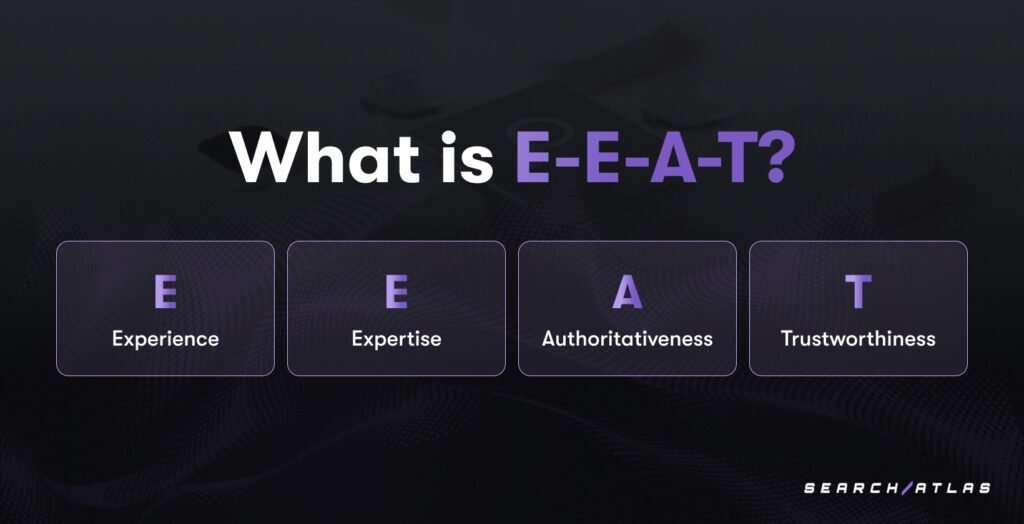
In the world of SEO, a new golden rule has long emerged — not just keywords or backlinks, but E-E-A-T.
This acronym has become one of the most important factors that Google uses to assess content quality,
especially in topics related to health, finance, law, and other areas
where an error can have serious consequences (YMYL — Your Money or Your Life).
But what exactly does E-E-A-T mean? How does it affect rankings? And how can you show Google that your site is an authoritative source?
In this article, I will break down each letter of the acronym, provide practical examples from real projects, and show you
how to implement E-E-A-T on your website to increase trust, CTR, and search rankings.
Article Contents:
What is E-E-A-T: Decoding the Acronym
E-E-A-T in SEO: Experience, Expertise, Authoritativeness, Trustworthiness
E-E-A-T is an acronym that Google uses in its Search Quality Raters Guidelines. It helps determine how reliable a source of information is.
It's important to understand: E-E-A-T is not a direct ranking factor, but Google uses hundreds of signals
(behavioral metrics, backlinks, branded queries, content structure) to assess these qualities.
Decoding Each Letter
| Letter |
Meaning |
Key Question |
| E |
Experience |
Has the author personally experienced what they are writing about? |
| E |
Expertise |
Does the author have knowledge and qualifications in this field? |
| A |
Authoritativeness |
Is the author/site recognized as an authority in the niche? |
| T |
Trustworthiness |
Can this site and its information be trusted? |
💡 Google doesn't always directly "see" E-E-A-T, but uses machine learning
to analyze content, links, brand mentions, and user behavior to assess these qualities.
⚠️ Important: E-E-A-T is especially critical for YMYL topics (Your Money or Your Life),
but since 2023, Google has been gradually applying these principles to all niches —
from culinary recipes to technical reviews.
Experience: Why Author's Experience Matters
Personal Experience as the New Standard for Helpful Content
In December 2022, Google officially added the first "E" to the acronym — Experience.
This was a revolution in content marketing.
Now, it's not enough to just have theoretical knowledge or a diploma.
Google wants to see that you have personally tried, used, and gone through it.
This is a direct response to the problem of AI-generated content without real value —
and confirmation of a trend that Google solidified with the update to its
Spam Policy in May 2026.
Why is Experience More Important Than Theory?
👉 Examples:
-
Medicine: An article "How I Overcame Depression: My Path to Recovery" by someone
with personal experience has higher value than a general article by a psychologist
who has never personally encountered depression.
-
Technology: An iPhone 15 review by a blogger who used it for 3 months
in real-world conditions is more significant than a text rewritten from Apple's official website.
-
Business: "How I Earned $10k from Dropshipping" with real profit screenshots
is better than a theoretical article "10 Ways to Make Money Online."
⚡ In my observations at WebsCraft: Google is clearly ranking pages with phrases
like "I tried," "My experience," "Personal recommendations," "I used it for X months" higher.
First-person articles with specific details consistently outperform general reviews
even with more backlinks.
How to Showcase Experience on Your Site?
- Write in the first person — "I," "My experience," "In my project"
- Add proof — "before/after" photos, process videos, result screenshots
- Create a "My Experience" section — a separate section within articles
- Specify timelines — "I tested this for 6 months," "After 3 years of use"
- Add details — specific numbers, dates, names, problems encountered
⚠️ Important: Fake experience is easily exposed. Users leave comments, ask questions.
If you don't respond or your answers are superficial — it's a signal to Google.
Expertise: How to Prove Expertise
Expertise in Content: Education, Qualification, Work Experience
Expertise is not just an educational diploma. It's proven knowledge, skills, and reputation
in a specific field. Google assesses expertise through signals both on and off your site.
What is Proof of Expertise?
For professional services:
- Doctor — medical education, Ministry of Health license, membership in professional associations
- Lawyer — diploma, certificate of the right to practice law
- Financial advisor — CFA, CFP certifications, banking experience
For creative professions:
- Designer — portfolio on Behance, Dribbble with real projects
- SEO specialist — case studies with results (traffic, ranking screenshots)
- Programmer — GitHub with active projects, contributions
For content creators:
- Blogger — regular publications, audience, engagement
- Journalist — publications in reputable media
- Expert — conference presentations, interviews, citations by others
How Does Google Check Expertise?
Google looks for expertise signals both on your site and off it:
- On the site: "About the Author" page with education, experience, certifications
- Off the site: LinkedIn, DOU, ResearchGate profiles; media mentions; citations
- Links: backlinks from authoritative sources in your niche
- Co-authorship: publications with recognized experts
⚡ From my experience: a nutritionist client added their Ministry of Health diploma, course certificates,
links to publications in medical journals, and a MedHub profile to their site.
In 4 months (September–December 2024), traffic from Google increased by 180%,
and rankings for YMYL queries rose from 15–20 to 3–7 places.
No technical hacks — just properly presented expertise.
Authoritativeness: Authority of the Site and Author
How a Site and Author Become Authoritative Sources
Authoritativeness is external recognition. It's when other experts, media outlets, and organizations
refer to you as a source of reliable information.
If expertise is "what you know," then authoritativeness is "who recognizes you."
Authoritativeness Signals for Google
1. Backlinks
- Number and quality of links from authoritative sites
-
Domain Authority (DA)
> 50 according to Moz — read a separate article for details on what this is and how to improve it
- Links from .gov, .edu, .org domains
- Natural anchor text (not spam)
2. Brand Mentions
- Mentions in news, articles, blogs
- Citations without a direct link
- Discussions on forums, social media
3. Authorship and Expert Profiles
- Author's LinkedIn profile with recommendations
- Publications on Medium, DOU, Habr
- Conference presentations (videos on YouTube)
- Interviews in podcasts, media
4. Branded Traffic
- People search for your name or brand in Google
- Direct traffic to the site
- Searches like "Your name + reviews," "Your name + services"
Examples of Authoritativeness in Different Niches
| Niche |
Example of an Authoritative Source |
Why It's Authoritative |
| Medicine |
Ministry of Health of Ukraine, WHO, WebMD |
Government institutions, international organizations |
| Finance |
National Bank of Ukraine, Minfin.com.ua, Forbes |
Regulators, financial media |
| Technology |
TechCrunch, DOU, Habr |
Industry media with a large audience |
| SEO |
Google Search Central, Moz, Ahrefs Blog |
Official sources, industry leaders |
⚡ For example: an article about tax reform that is cited by
Liga.net, Delo.ua, and Rada.gov.ua — automatically gains high authoritativeness in Google's eyes.
One high-quality backlink from a government or industry source is worth more
than dozens of links from secondary sites.
Trustworthiness: How to Build Trust
Site Reliability: Security, Transparency, Contact Information
Even the most expert and authoritative content won't help
if users and Google don't trust your site.
Trustworthiness is the most important element of E-E-A-T.
Technical Trust Factors
1. Site Security (HTTPS)
- SSL certificate is mandatory for all pages
- Absence of browser warnings about danger
- Regular updates of CMS and plugins
2. Information Transparency
- Contacts: real office address, phone number, email, contact form
- About Us: company history, team photos, mission
- Privacy Policy and Terms of Use (mandatory for YMYL)
- Disclaimer: if you provide advice (medical, legal, financial)
3. Social Proof
- Customer reviews with photos, names, dates
- Ratings on Google My Business, Trustpilot
- Case studies with real results
- Client logos (if B2B)
4. Content Quality
- Absence of grammatical errors
- Information accuracy (update dates)
- Links to primary sources
- Absence of clickbait headlines
Red Flags That Reduce Trust
❌ What causes distrust:
- Lack of contact information or only a form
- Anonymous author with no information about them
- Excessive advertising, popup windows
- Outdated design (looks like a site from 2005)
- Spelling errors, machine translation
- Clickbait ("Doctors are shocked by this method!")
- HTTP instead of HTTPS
- Negative reviews about the site/company online
- Mass AI content without real authorship — after the
Spam Policy update in May 2026
this is now an official signal of distrust
⚡ From my experience: I analyzed a clinic's website with no address, no licenses, no doctor photos.
Even with perfect technical SEO — the site didn't rank in the top 10.
After adding complete information, team photos, licenses, and patient reviews,
rankings improved from 25+ to the TOP 5 within 2 months (March–May 2024).
💯 According to statistics from
BrightLocal,
87% of consumers read reviews before choosing a local business.
Lack of reviews or negative reviews = loss of trust even before the first click.
How Google Checks E-E-A-T
Algorithms and Signals for Trust Assessment
Google does not have a single "E-E-A-T Score" algorithm. Instead, it uses a
combination of hundreds of signals to assess content reliability.
It's important to understand: E-E-A-T is not something you can "measure" in Search Console.
It's a system-wide assessment that Google builds from dozens of independent data sources simultaneously.
Key Methods for Assessing E-E-A-T
1. Quality Raters
Google hires thousands of people worldwide who manually evaluate websites based on E-E-A-T criteria
according to official guidelines
(170+ pages of instructions – publicly available).
They do not directly influence rankings, but their assessments help train
machine learning models. Essentially, they are the "ground truth" for Google's algorithms.
What raters specifically assess: author biography presence, qualification verification,
information quality and accuracy, content relevance to the query, and website trust level.
If your site looks bad to a human, it looks bad to the algorithm too.
2. SpamBrain and Machine Learning (ML)
SpamBrain is Google's proprietary AI system for detecting manipulative content.
It doesn't look for specific forbidden words but recognizes behavioral patterns and signatures.
After the Spam Policy update in May 2026,
SpamBrain has also been extended to AI Overviews – it now analyzes attempts to manipulate
not only classic search but also Google's AI-generated answers.
ML algorithms analyze:
- Content structure (presence of author, sources, dates)
- User behavior (time on page, return to search)
- Link profile (backlink quality and relevance)
- Brand mentions online
- Sentiment analysis (positive or negative mentions)
- Anomalous patterns: mass of similar pages, artificial density of brand mentions
3. Behavioral Signals
-
Pogo-sticking – a user returns to search results within seconds.
A strong negative signal: the content did not answer the query.
-
Dwell time – the time spent on a page.
Long dwell time = content engages and holds attention.
-
CTR in search results – high click-through rate signals that the snippet
and title meet user expectations.
-
Branded queries – people search for your brand name directly.
One of the strongest authority signals for Google.
4. Link Analysis
- Number and quality of backlinks
- Authority of referring domains (DA, PageRank)
- Niche relevance – links from thematically related sites are more valuable
- Anchor text – natural vs. manipulative
5. Technical Factors
- HTTPS – mandatory, no exceptions
- Loading speed (Core Web Vitals: LCP, CLS, INP)
- Mobile-friendly – over 60% of traffic is from mobile
- Structured data (schema.org) – Author, Article, Organization, Review
6. Author Reputation Beyond the Website
Google Patents indicate that algorithms analyze an author's reputation beyond their website –
through LinkedIn, Wikipedia, media publications, and academic citations.
This means: if you are active as an expert outside your own website,
Google takes this into account even without a direct link to you.
💡 From my experience at WebsCraft: after I started being cited in several
Ukrainian IT media outlets and added an active LinkedIn profile –
branded queries for "WebsCraft" increased by 40% in two months.
The algorithm noticed the increase in external authority before the rankings changed.
My Experience: Real Cases of E-E-A-T Improvement
Case 1 (August–December 2024): Medical Clinic – 240% Traffic Growth
Client: a private dental clinic in Kyiv.
Problem: the website wasn't ranking in the top 10 even for branded queries,
traffic was 200 visits/month.
⚡ What was wrong:
- No information about doctors (anonymous articles)
- Absence of licenses and certificates
- No photos of the clinic or team
- Missing contact information (only a form)
- Articles without sources or publication dates
⚡ What I did:
- Created pages for each doctor with photos, education, experience, and certificates
- Added a "Licenses" section with scanned copies of documents
- Added a 3D tour of the clinic and photos of equipment
- Provided full address, phone numbers, email, and working hours
- Updated articles: added authorship, dates, and links to the Ministry of Health and scientific research
- Connected Google My Business with patient reviews
- Added Schema.org markup for Medical Organization and Doctor
⚡ Results in 5 months (by December 2024):
- Organic traffic: 200 → 680 visits/month (+240%)
- Positions for YMYL queries: from 25+ to TOP 7
- Branded queries: "Clinic Name" searches increased by 180%
- Calls from the website: +150%
- Google rating: from 3.8 to 4.7 stars
What's important: no "grey hat" methods – only correctly implemented E-E-A-T signals.
This is why the results are stable and haven't dropped after any subsequent Google updates.
Case 2 (February–May 2025): E-commerce with Reviews – 35% Conversion Increase
Client: an online sports nutrition store.
Task: increase trust and conversion without increasing the advertising budget.
⚡ E-E-A-T Implementation:
- Added customer reviews with photos (before/after)
- Created an "Our Experts" section – sports nutritionists with biographies
- Each product received a detailed description from an expert explaining the composition
- Added product quality certificates
- Connected Trustpilot to collect verified reviews
- Created a YouTube channel with reviews and advice from nutritionists
⚡ Results in 4 months (by May 2025):
- Conversion rate: 1.8% → 2.4% (+35%)
- Average order value: +18%
- Customer retention: +27%
- Organic traffic: +120%
Key insight from this case: E-E-A-T affects not only search rankings
but also directly impacts conversion. A user who trusts a website –
buys more often and for a larger amount. Trust is monetized.
💡 My main lesson from both cases: E-E-A-T is not a one-time task.
It's a continuous process of building reputation, trust, and authority.
Results are not immediate but are stable and long-term.
Sites with strong E-E-A-T have survived all major Google updates from 2024–2026
without significant traffic losses.
How to Implement E-E-A-T on Your Website: A Step-by-Step Checklist
Practical E-E-A-T Implementation Plan
| Step |
What to Do |
Priority |
| 1. Audit |
Check for author information.
Assess content quality and relevance.
Analyze backlink profile.
Review online reviews.
Check HTTPS and site speed.
|
🔴 First Day |
| 2. "About Us" and "About Author" Pages |
Detailed biography for each author with a photo.
Education, work experience, certifications.
Links to LinkedIn, GitHub, media profiles.
Contact information.
|
🔴 First Week |
| 3. Content Update |
Add authorship to all articles.
Specify publication and update dates.
Add links to primary sources.
Rewrite in the first person where appropriate.
Include personal experience and case studies.
|
🟡 First 2 Weeks |
| 4. Technical Trust Elements |
HTTPS on all pages.
Privacy Policy and Terms of Use.
Full contact details (address, phone, email).
Partner logos and certifications.
|
🔴 First Week |
| 5. Schema.org Markup |
Add Article markup with Author, datePublished, dateModified.
For medicine – MedicalOrganization, Physician.
For business – Organization, LocalBusiness.
For reviews – Review, AggregateRating.
|
🟡 First Month |
| 6. Reviews and Social Proof |
Connect Google My Business and Trustpilot.
On-site reviews with photos, names, dates.
Case studies with real results.
Video testimonials.
|
🟡 First Month |
| 7. Off-site Authority |
Guest posts on authoritative niche websites.
Participation in interviews, podcasts, conferences.
Active profiles on LinkedIn, Medium, DOU.
Mentions and links from media outlets.
|
🟢 Ongoing |
| 8. Monitoring |
Track rankings and traffic (Search Console).
Analyze dwell time and bounce rate (Analytics).
Respond to new reviews – both positive and negative.
Regularly update content (at least once a year).
Monitor brand mentions (Google Alerts).
|
🟢 Ongoing |
Schema.org Markup – Minimal Example for an Article
{
  "@context": "https://schema.org",
  "@type": "Article",
  "author": {
    "@type": "Person",
    "name": "Author Name",
    "url": "https://yoursite.com/author/name"
  },
  "datePublished": "2025-01-15",
  "dateModified": "2026-05-17"
}
⚠️ Important: update dateModified every time you edit an article.
Google uses this date as a signal of content freshness.
Common Mistakes When Implementing E-E-A-T
What Not to Do
❌ Mistake 1: Fake Experience and Expertise.
Inventing diplomas, experience, or results is the worst idea.
Users check, ask questions, and search for information. Fakes are always exposed.
❌ Mistake 2: Anonymous Content.
Articles without an author look suspicious, especially in YMYL topics.
Google wants to know who is responsible for the information.
❌ Mistake 3: Buying Fake Reviews.
Google and users easily recognize fake reviews.
This will not only be unhelpful but can lead to penalties and profile blocking.
❌ Mistake 4: Ignoring Technical Factors.
E-E-A-T is not just about content. HTTP instead of HTTPS, missing contact details,
a slow website – all of these reduce trust and signal to Google that the resource is unreliable.
❌ Mistake 5: Content Duplication.
Even with attribution. Unique content based on personal experience is always more valuable.
After the 2026 Spam Policy update,
massively duplicated or AI-generated content without value is a direct path to penalties.
❌ Mistake 6: Outdated Content Without Updates.
A 2018 article about SEO without updates loses credibility.
Regularly update dates, facts, and links to sources.
❌ Mistake 7: Lack of Sources.
This is especially critical for YMYL. Every statement must be supported
by a link to an authoritative source.
⚡ From my experience: a client bought 100 reviews on Fiverr for $50.
Google My Business blocked the profile for spam.
Restoration took 4 months and cost much more than the saved $50.
Reputation is easily destroyed and very difficult to restore.
Frequently Asked Questions (FAQ)
Is E-E-A-T necessary for all websites?
Yes, but the level of importance varies. For YMYL topics (medicine, finance, law),
E-E-A-T is critical, and it's impossible to rank without it.
For entertainment or informational topics, the requirements are softer,
but E-E-A-T still helps improve rankings and trust.
Can AI content have high E-E-A-T?
Only if it's edited by an expert with personal experience.
Pure AI text without fact-checking, authorship, or personal insights
does not meet the Experience and Expertise criteria.
After the Google Spam Policy 2026 update, mass AI content without value
is officially equated to spam.
How does Google check E-E-A-T?
Google does not have a direct "E-E-A-T Score" but uses hundreds of indirect signals:
backlinks, branded search queries, behavioral metrics
(time on site, bounce rate), online mentions, content structure
(author, sources, dates presence), reviews, and ratings.
More details can be found in the How Google Checks E-E-A-T section above.
Is a diploma mandatory for Expertise?
Not always. Experience, portfolio, and industry recognition can be stronger signals.
For an SEO specialist, case studies with results are more important than a marketing diploma.
However, for medicine, law, and finance – official qualifications are mandatory.
How long does it take to improve E-E-A-T?
Technical changes (HTTPS, contacts, structure) take effect quickly – 2–4 weeks.
Building authority (backlinks, media mentions) takes 3–6 months.
For YMYL topics, expect 4–8 months for significant results.
Does E-E-A-T affect local SEO?
Yes, very much so. Google My Business, reviews, photos, contact information –
all of these are part of E-E-A-T for local businesses.
Local companies with high E-E-A-T gain an advantage in the Local Pack (top 3 on maps).
What to do if a competitor has more backlinks?
Focus on quality, not quantity.
One backlink from an authoritative media outlet is more valuable than 100 links from spam sites.
Also, work on other aspects of E-E-A-T: experience, reviews, content, technical optimization.
Can E-E-A-T be improved quickly?
Partially – yes (technical changes, adding authorship, contacts).
But true authority and trust are built over years.
There are no "quick hacks" for E-E-A-T. It's a marathon, not a sprint.
Does Google Spam Policy 2026 affect E-E-A-T?
Yes, and it's important to understand this. The update from May 15, 2026, officially extended
anti-spam rules to AI Overviews and AI Mode.
Now, manipulations with Google's AI answers are equated to classic spam –
with the same penalties: reduced rankings, manual action, removal from the index.
For sites with strong E-E-A-T, this update is a competitive advantage,
as their competitors with manipulative content face new risks.
More details can be found at
Google Spam Policy 2026: What Changed for AI Overviews.
Conclusions
E-E-A-T is not a trendy fad or a temporary algorithm change.
It is a new philosophy of search optimization,
where the focus is on trust, expertise, and real value for the user.
🎯 Key Takeaways:
- Experience is more important than theory – Google wants to see that you have personally tried, used, and gone through what you are writing about.
- Expertise must be proven – education, certifications, portfolio, case studies with results.
- Authority is built over years – backlinks, media mentions, industry recognition.
- Trust = Foundation – without HTTPS, contacts, reviews, and transparency, even the best content won't work.
- YMYL topics require maximum E-E-A-T – mistakes can cost users their health or money.
- E-E-A-T is an ongoing process – not a one-time task, but a long-term strategy.
💯 In my experience, sites with high E-E-A-T not only rank better
but also have higher conversion rates (by 20–40%), longer time on site (by 50–100%),
and lower bounce rates. Users trust such sites and return again.
The best SEO tool in 2026 is not a plugin or AI,
but your reputation. Invest in it,
and Google will reward you with stable top rankings.
What to Do Next?
- Conduct an audit – assess the current E-E-A-T status of your website
- Create a plan – prioritize for your niche
- Start with the basics – add contacts, authorship, HTTPS
- Work on content – update existing articles, add personal experience
- Build authority – publications, presentations, media mentions
- Monitor results – track rankings, traffic, conversion
Read also in the SEO series:
→ Google Spam Policy 2026: AI Overview Manipulations Are Now Officially Spam
→ YMYL Niches: A Complete SEO Guide
→ Top 10 Mistakes of YMYL Sites: How to Fix and Retain Traffic
→ Panda and Penguin: Google Algorithms That Changed SEO Forever
→ What is Domain Authority (DA) and How to Increase It