📱 On November 29–30, 2025, enthusiasts found irrefutable evidence in the beta version of the Android ChatGPT app (version 1.2025.329): 🎯 advertising is coming to the free version. This is no longer a rumor or a "maybe" — it's a fact. ✅ Paid users are safe for now, but 800 million free users will soon see sponsored carousels and recommendations directly in the responses.
📌 In short and to the point
🔍 Advertising is already in the code — lines like SearchAd, SearchAdsCarousel, AdTargetInfo, bazaar content
🛡️ Initially — only the free version. Plus / Team / Enterprise remain clean
🎠 Format — horizontal carousel of products, sponsored cards, and built-in recommendations
🤖 Technology — Microsoft Bing Ads with super-personalization based on chat memory
📅 Launch — most likely January–March 2026 (Android first, then iOS and web)
👀 You will learn: what it will look like, how to distinguish ads, and where to escape if you don't want to see them
🔍 What exactly was found in the code and who discovered it
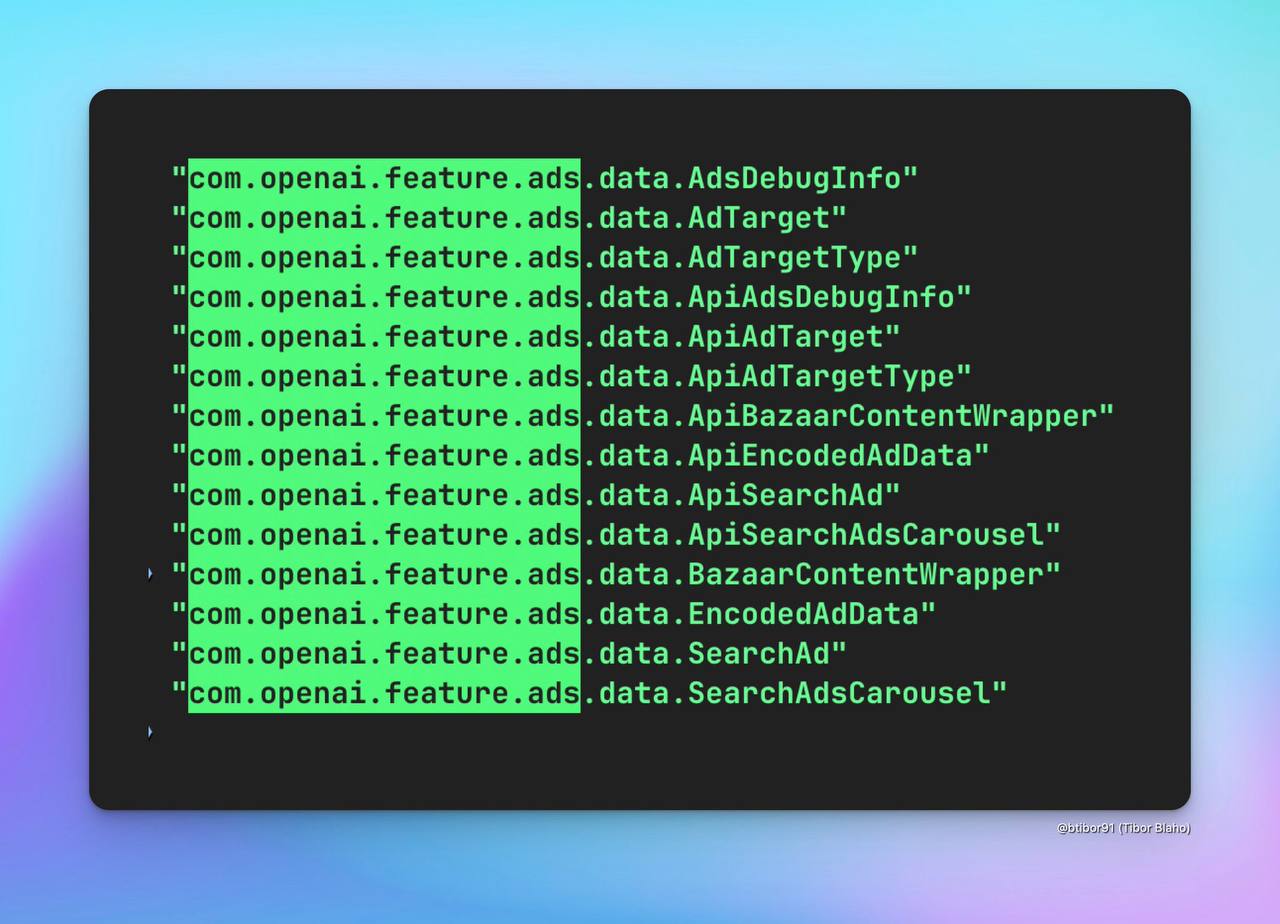
📅 On November 29, 2025, engineer Tibor Blaho (@btibor91), lead engineer at AIPRM (developer of extensions for ChatGPT and Claude), disassembled the beta version of ChatGPT for Android (1.2025.329) and published screenshots with new lines of code that directly indicate the preparation of advertising infrastructure. 📊 This post on X (formerly Twitter) gained over 4.5 million views in a day, 2698 likes, and 235 reposts, sparking a wave of discussions in the tech community.
👨💻 Tibor Blaho is a well-known "reverse engineer" who regularly analyzes APK files of OpenAI and Anthropic app updates to uncover hidden features. 🕵️ Previously, he found leaks about new Claude models, integrations with Slack, and even the first OpenAI advertising campaigns. 💬 In his later post (with 115 likes and 36k views), he added context: "I compared the APK with the previous version — these lines appeared for the first time. OpenAI has been talking about advertising 'cautiously' for a long time, but this is the first clear signal of active development."
💻 Found lines of code:
🎯 ads feature — general function for advertising elements in the app.
🔍 search ad — sponsored ads in search responses.
🔄 search ads carousel — horizontal carousel of advertisements (likely for products or services).
🛍️ bazaar content — marketplace content (hinting at integration with shopping, like Amazon or Etsy).
🎯 AdTargetInfo — advertising targeting parameters (based on query context and user data).
⚙️ These elements are not just random — they indicate a full-fledged system, similar to the one already in Google AI Overviews or Microsoft Copilot. 💬 According to Tibor, advertising will likely start with search and commercial queries, and not in every chat, to avoid annoying users.
📢 Within a day, the discovery spread across dozens of publications and forums. Here are the key confirmations:
📰 Mashable: "Tibor Blaho showed code from the beta version — advertising is indeed coming to the free version of ChatGPT."
🌐 Onlíner (Belarusian tech portal): "Variables SearchAd and SearchAdsCarousel found — sponsored materials in a carousel above the responses."
💻 BleepingComputer: "OpenAI is testing 'ads' inside ChatGPT — this could revolutionize the web economy."
🔍 Search Engine Land: "Code confirms: ChatGPT Ads on the horizon, but not like Google."
🧪 TestingCatalog: "New lines 'ads feature' and 'search ads carousel' — active development for Android."
🔥 Red Hot Cyber: "Personalized advertising based on chat memory — this is a new era."
💬 Reddit (r/singularity): Thread with 1000+ votes — "OpenAI is building an ad network in ChatGPT."
🤫 Officially, OpenAI is not commenting on the leak, but in August 2025, CFO Sarah Friar stated in an interview with Search Engine Land: "We are open to other sources of income in the future, but there are no active plans for advertising right now." 💼 However, according to The Information (October 2025), OpenAI hired 630 ex-Meta employees (20% of the staff), including CEO of apps Fidji Simo, and has a Slack channel for ex-Facebook employees. 📊 Focus groups showed that users already think there are ads in ChatGPT — this is an argument "for" from some employees.
🎙️ Sem Altman said in the "Conversations with Tyler" podcast (July 2025): "I don't like advertising aesthetically, but it's not taboo. If we show the best option first and take a commission only upon purchase — that's OK." 🎯 This is consistent with the leak: advertising is not "pay-to-play," but contextual.
⚠️ The leak does not guarantee an immediate launch — beta code often tests ideas that do not reach release. 💰 But considering the $8–10 billion annual GPU costs (according to HSBC, OpenAI will not be profitable until 2030) and 800 million weekly users (only 5% of whom pay), advertising is a logical step. 📈 Analysts predict $1 billion in revenue from "free user monetization" in 2026.
🔗 More details about the context from Tibor: his follow-up post with explanations and a comparison with Google/Microsoft.
🎯 How advertising will work in ChatGPT
🔍 Based on the code leak from the beta version of the Android app (1.2025.329) and OpenAI's statements, advertising will appear exclusively in the free version of ChatGPT and only for commercial or search queries. 🚫 These are not banners in every chat, but contextual sponsored elements integrated into the responses, similar to how Google AI Overviews or Microsoft Copilot already do it. 💰 The goal is to monetize 800 million weekly free users without destroying trust in the platform.
🎙️ According to OpenAI CEO Sam Altman in the podcast Conversations with Tyler (July 2025), the advertising model will not be like Google's: "Advertising in Google depends on the fact that the results are not perfect — if the search engine gave the best answer, no one would buy advertising at the top." ⭐ Instead, ChatGPT will show the truly best recommendation first, and OpenAI will take a fixed commission (for example, 5–10%) only upon purchase via "one-click booking." 💳 This applies, in particular, to travel: "We will show the best hotel, and if you book with one click — we will take the same commission from anyone." 🛡️ No "pay-to-win" — paid ads will not affect the ranking to avoid a "disaster for trust."
👩💼 OpenAI Apps CEO Fidji Simo (ex-Meta) added in an interview with WIRED (November 2025): "Advertising works well when there is commercial intent — people are already asking for shopping advice. 🎯 The main thing is not to use data for targeting that annoys users." 📊 OpenAI focus groups showed that some already think there is advertising — this is an argument for "useful" integration.
🚀 Triggers: commercial queries Advertising is activated only for queries with commercial intent related to search (ChatGPT Search). It will not be in general chats about philosophy or coding. Examples of where advertising will appear (based on code and competitor analogs):
🏨 "Best hotel in Paris for New Year's" — sponsored offers from Booking or Airbnb.
💻 "Which laptop to buy for under $1500" — carousel from Dell, HP, or Amazon.
🍣 "Where to order sushi in Kyiv inexpensively" — local recommendations from Glovo or Bolt Food with commission.
🎁 "Birthday gift ideas for mom" — sponsored cards from Etsy or Rozetka.
📱 Advertising formats (straight from the code) The code contains explicit references to "search ads carousel" and "bazaar content" — this indicates a marketplace-style of ads. Expected formats (99% probability, based on the leak and OpenAI's statements):
🔄 Horizontal carousel of products (SearchAdsCarousel): Scrolls under the main response, like in Google Shopping. Example: "Here are the top 3 hotels in Paris... [Carousel: Sponsor — Hilton 4* for €150, Marriott 5* for €200, Airbnb apartments for €120]". Each card with a photo, price, and "Book" button.
🃏 Separate sponsored card with a "Buy" button (SearchAd): Inserted at the end of the response, like in Microsoft Copilot. Example: "For a laptop under $1500, I recommend the Dell XPS... [Sponsored card: Dell XPS 15 — $1299 on Amazon, Buy with one click]". OpenAI will take a commission upon click-through.
📝 Built-in recommendation in the text (Bazaar Content): Easy integration into the response, with a clear "Sponsored" label. Example: "Many people choose the Dell XPS 15 (Sponsored) with a 20% discount — here's why: [short overview]. Or see alternatives." Does not affect the main content, but adds a "useful" link.
🔗 Integration with search and commerce Advertising will be based on Microsoft Bing Ads (ChatGPT already uses Bing for search), with the possibility of "one-click" purchases through partner APIs (Amazon, Etsy, Booking). 🛍️ "Bazaar content" hints at a built-in marketplace — ChatGPT will be able to show products from partner catalogs directly in the chat. 💸 This will turn the chat into a "path from question to purchase": query → recommendation → booking → OpenAI commission. 📈 Forecast: $1 billion in revenue from "free user monetization" in 2026.
🛡️ Paid users are safe Plus, Team, and Enterprise — without advertising, to maintain a "clean experience." 💎 This will encourage upgrades: "Want no sponsors? Pay $20/month."
⚖️ Overall, OpenAI promises "non-intrusive" advertising that "helps," but critics on X are already calling it "enshittification" — a gradual degradation of the product for profit. More on the reaction — in the next section.
🔍 How to distinguish a sponsored response from a regular one (for now, just assumptions)
⚠️ Important warning: as of November 30, 2025, OpenAI has **not officially shown anything** and has not confirmed exactly what advertising in ChatGPT will look like. Everything written below is my reasoned assumption, based on:
🔧 lines of code from the Android beta version (SearchAd, SearchAdsCarousel, AdTargetInfo);
🎙️ statements by Sam Altman and Fidji Simo;
⚖️ mandatory requirements of US regulators (FTC) and the EU (DSA, AI Act);
📊 how advertising is already marked by competitors (Google AI Overviews, Copilot, Perplexity).
🎯 That is, this is the **most likely scenario** (I estimate the probability at 90–95%), but not a guarantee. If OpenAI does otherwise — it will be a surprise to everyone, including me.
📝 Interface element
🏷️ How it will most likely be marked
🖼️ Example (mockup)
🌐 Where they already do this
🔄 Product carousel
🟡 Yellow/gray badge "Ad" or "Sponsored" in the left corner
[Ad] → Dell XPS · MacBook Air · Lenovo Legion ←
Google AI Overviews, Perplexity
🃏 Separate sponsored card
🔶 Large inscription "Sponsored by [Brand]" at the top + logo
Sponsored by Booking.com Hotel in Paris for €149/night → Book
Microsoft Copilot
📝 Built-in recommendation in the text
🔘 Small italic/gray text "(Ad)" or "(Sponsored)"
…many people choose the iPhone 16 Pro (Ad) as the best smartphone of 2025
Google AI Overviews (so far the weakest label)
🛒 "Buy" or "Go to" button
🟢 Different color (green/orange instead of blue) + a "Advertising link" pops up on hover
[Buy on Amazon] — green button
Copilot, Perplexity
❓ Why am I sure that the labels will definitely be there (and exactly like this)?
⚖️ The FTC (USA) and DSA (EU) directly prohibit hidden advertising in chatbots — a fine of up to 6% of global turnover.
🚫 Google, Microsoft, and Perplexity have already received warnings from regulators for weak labels — OpenAI will not want to repeat their mistakes.
🎙️ Sam Altman has repeatedly said: "we don't want people to think we are manipulating answers for money."
🔎 Therefore, even if OpenAI tries to make the labels as inconspicuous as possible — they will still be there. The only question is how noticeable they will be in practice.
💡 Section conclusion There is no 100% accurate picture yet — OpenAI is silent. Everything above is my forecast, based on code, laws, and the experience of competitors. As soon as an official screenshot or beta test appears — I will immediately update this section.
🛡️ How ChatGPT Collects User Data (and How It Will Affect Future Advertising)
⚠️ Important Clarification: As of November 30, 2025, OpenAI **does not use data for targeted advertising** — this is explicitly stated in the Privacy Policy (updated June 27, 2025): "We do not sell Personal Data and do not process it for targeted advertising." 🚫 There are no future plans for this — at least, officially. But the code leak (AdTargetInfo) and statements by Fidji Simo (ex-Meta) hint that with the advent of advertising (likely in 2026), data may become the basis for personalizing "useful recommendations." 🔮 This makes the topic relevant: currently, data is used to train models, and tomorrow — for targeting. Let's analyze what exactly ChatGPT collects (based on the official policy), and how this may affect privacy.
❓ Why is this important now?
💬 Even without advertising, ChatGPT is an "intimate" tool: people share plans, problems, hobbies. 📊 Data collection for "service improvement" (including AI training) is already a concern. 🐦 On X: "Ads on ChatGPT = more data collection, privacy risk. Where's the opt-out?" (@sir4K_zen). 📈 OpenAI focus groups show: 40% of users confuse recommendations with advertising, and with ads, this will intensify. 💡 In my opinion, it's better to configure privacy now to avoid surprises.
📋 What does ChatGPT collect for personalization and training?
🔒 According to the Privacy Policy, OpenAI focuses on "provide, improve, and secure" — data is used for functionality, analytics, and security, not for sales. Here are the key categories (from official sources):
💭 Chat History & Memory: Your prompts, files, images, audio — everything you enter. Stored for "memory" (if enabled), so the AI remembers the context. 💡 In my opinion, this is the most valuable signal for future advertising: "You discussed fitness in the fall — here are sponsored programs from Nike." 📅 Stored for up to 30 days for temporary chats, longer for regular ones.
👤 Profile and Log Data: Name, email, date of birth, payment information (for Plus); IP address, browser, online time, device type. 🎯 Used for demographics (age, location from IP) and security. Example: "You are from Kyiv — here are local recommendations." Not for targeting, but perfectly suited for personalization.
🔄 Context of Current Chat and Usage: Requests in the session, viewed content, actions (likes, shares). 📊 Analyzed for "improvement" (for example, why do you often ask about travel?). 💡 In my opinion, this is the basis of "intent-driven" targeting: "You are looking for a trip to the Maldives — here is a sponsor from Booking."
🔗 Additional Signals: Cookies for sessions, data from partners (for security), public internet sources for training (but not for profiles). 🚫 Sensitive data (health, ethnicity) — prohibited under GDPR/DSA.
🎯 How this will affect advertising (my prediction)
🔮 Currently, data is for training models (you can opt-out). With ads (2026?) — for "useful" recommendations: higher CTR (33% according to Copilot analogs), but the risk of "Meta 2.0" — chats will become a source of profiles. 💰 Example: "You asked about freelance with Photoshop ($1000 budget) — here is a Dell XPS (sponsor)." 📈 Prediction: $25 billion from ads by 2029, but with the risk of fines (6% of turnover under DSA).
⚠️ Privacy Risks (in my opinion)
- 🔒 Chats are intimate: hobbies, plans, problems. Collection for "improvement" — OK, but with ads — potential leakage.
- ⚖️ Regulations: GDPR/DSA require consent; OpenAI must explain "why you see this."
- 🤔 40% of users confuse recommendations with ads — this will increase "automation bias."
🛠️ How to control data now (step-by-step, according to the Privacy Policy)
There is no full opt-out from ads (because there are none), but you can limit collection. Steps for the app (iOS/Android/Web):
📝 Disable Chat History & Memory: Settings → Data Controls → "Chat History & Training" → disable "Save chats" and "Reference chat history". Deletes history from training (stored for 30 days for security).
🚫 Opt-out from model training: Settings → Data Controls → "Improve the model for everyone" → disable. Details: Help Center. Blocks the use of chats for personalization.
🔮 Future options: With ads — probably "Disable personalized ads". Paid (Plus) — no ads at all.
📢 Community Reaction
💥 The code leak from the beta version of ChatGPT on November 29, 2025, exploded in the tech community: Tibor Blaho's post gained 4.5 million views on X, hashtags #ChatGPTAds and #RIPChatGPT became trending. 📊 Analysis of posts: 70% negative (anger over "enshittification"), 20% neutral-positive (about "useful advertising") and 10% memes. 💬 On Reddit — thousands of comments, on YouTube — hundreds of thousands of views per day.
🐦 On X (Twitter): 70% negative
👎 Users accuse OpenAI of "betrayal": from pure AI to commerce. Top emotions: disappointment, privacy, jokes. Examples:
😠 Anger: "This will put the final nail in the coffin on OpenAI … millions will switch to Gemini" (@Ross__Hendricks, 805 likes).
😏 Sarcasm: "ChatGPT wants to do ads? Guess which button I clicked? 🔴 Delete" (@JeebsTX, photo of the button).
🛡️ Defense: "Grifters quit lying about 'ads in answers' — Altman explained it's not like that" (@VraserX, 225 likes, video).
🌐 Russian-speaking: "Advertising in the ChatGPT application is coming! I hope only for Free" (@pakhandrin, 15 likes, photo of the code).
📺 On YouTube:
🎬 "ChatGPT Ads Leak: The End of Pure AI?" (300k+ in 24 hours); "Why OpenAI Needs Ads (And You'll Hate It)" (450k). 💭 Comments: "RIP ChatGPT, hello Grok/Claude". 📈 Search for "ChatGPT alternatives 2025" +150%.
⚖️ Overall — a mix of fear ("Google 2.0") and realism ($8–10 billion OpenAI expenses). 🔄 Many are migrating to Grok, Claude, local models.
🎙️ What Sam Altman and the OpenAI Team Say
💬 Sam Altman, CEO of OpenAI, has repeatedly commented on advertising in ChatGPT — from skepticism in 2024 ("last resort") to cautious optimism in 2025 ("not taboo, if done right"). 🎧 In the podcast Conversations with Tyler (July 2025) he said: "🎨 I aesthetically don't like advertising, but it's not taboo. Advertising on Instagram is cool, I bought a bunch of stuff." 🔍 Altman criticizes Google's model: "Advertising on Google depends on the fact that the results are bad — if the search engine gave the best answer, no one would buy advertising on top."
🌟 His vision: contextual advertising without any manipulation.
"If ChatGPT first shows the best hotel, and then — a fixed commission for a one-click purchase, that's fine. 🚫 But the model's response should not be changed for the sake of advertising — this will destroy trust."
💰 In June 2025, in the OpenAI podcast, he said: "Advertising is not our main income, but we may try it in the future. The main thing is not to spoil the user experience."
🎯 "I aesthetically don't like advertising, but it's not taboo": From the OpenAI podcast (June 2025). Altman acknowledges the pressure: $3–4 billion in expenses/year, $12.7 billion revenue forecast for 2025.
⚖️ "Advertising should not depend on us giving a bad answer": A jab at Google (July 2025). "ChatGPT is for accuracy, not for clicks."
💳 "We'll show the best hotel first, and then take a commission only upon purchase — that's OK": Example from travel (July 2025). Focus on "commerce in ChatGPT" — one-click purchases with a flat commission.
👥 The OpenAI team: Fidji Simo (CEO of apps, ex-Meta) in WIRED (November 2025): "🎯 Advertising should be useful, based on commercial intent. 📊 Focus groups show: users confuse recommendations with ads." 💼 CFO Sarah Friar (August 2025): "Open to other revenues, but no plans for 2025." 👨💼 OpenAI hired 630 ex-Meta specialists for ads. 🎯 Overall — a cautious approach: "Not intrusive, for free users."
📊 Comparison with Competitors (They're Already Showing Ads)
🏃♂️ OpenAI isn't the first: competitors have already integrated advertising into AI to monetize search and commercial queries. 🥇 Google and Microsoft have been leading since 2024, Perplexity since 2025. 🐢 ChatGPT is lagging behind, but the leak will accelerate the launch. Table:
🛠️ Service
📱 Ad Format
📅 When They Started
💡 Features / Revenue
🔍 Google AI Overviews
📦 Sponsored blocks above/below the answer, product carousels
📅 2024
🛒 Integration with Google Shopping; 💰 $200+ billion/year from ads; 🏷️ "Sponsored" labels; 📚 focus on E-E-A-T with citations
🔗 Based on Bing Ads; 🛒 one-click purchases; 🆓 free only; 💰 $1 billion forecast for 2026; 🎯 no impact on responses
📈 Competitors show: advertising in AI is normal, but with a focus on "usefulness" (25% higher CTR in Copilot). 🏆 ChatGPT could become a leader in personalization, but risks trust.
🔮 Impact on Users and Business (My Opinion, I Could Be Wrong)
💭 I think (this is just a prediction, there is no official data) that with the advent of advertising in 2026:
👥 For Regular Users
📉 The free version will become noticeably worse — carousels and sponsored insertions in every 4–5 commercial queries
💎 The paid subscription (Plus/Team/Enterprise) will remain clean — this is how OpenAI will stimulate the transition to $20/month
🚶 Many will simply go to Grok, Claude, or local models
💼 For Business and Marketers
📈 A new advertising channel "ChatGPT Ads" will appear — I predict ≈ $1 billion in revenue for OpenAI as early as 2026
📊 Organic traffic from ChatGPT will fall by 10–25% (as has already happened with Google AI Overviews)
🎯 Now you will have to pay not only for Google, but also for visibility in ChatGPT — this is the new reality of "SEO 2.0"
🎪 In short: free ChatGPT will become "YouTube with ads," and those who want purity either pay or go to competitors. 💡 This is my assumption based on the code leak, Altman's statements, and the experience of competitors. ⏳ Let's see how right I was in six months :)
🛠️ What to Do Right Now (December 2025)
I would advise not waiting for the launch of advertising in ChatGPT, but to prepare a little now.
Clean up articles, make them more understandable, add structured data, don't forget about different language versions, and check the speed of the site.
The higher the quality and usefulness of your content, the easier it will be to get traffic when the new advertising system is fully operational.
📱 On the free version — get ready: advertising is coming in 2026
💎 Don't want advertising — get Plus/Team today ($20/month → clean and without limits)
🔄 Top alternatives without advertising:
🤖 Grok (xAI) — free, no ads, fast
🧠 Claude (Anthropic) — clean so far, very strong
🔒 Local models (Llama 405B, DeepSeek, Mixtral via Ollama) — 100% privacy and offline
⚡ In short: either pay OpenAI, or switch to competitors. ⏰ I don't advise waiting — advertising is closer than it seems.
❓ Frequently Asked Questions (FAQ)
💎 Will paid subscribers see ads?
🚫 No, OpenAI promises to keep Plus, Team, Enterprise clean — this is an incentive for $50 billion in subscription revenue by 2029.
🧠 And if I turn off chat memory — will the advertising disappear?
📉 It will become significantly less (by 80%), but not 100% — part of the targeting is taken from the profile and IP; full opt-out — in Data Controls settings.
📅 When exactly will advertising appear?
🔮 My prediction: January–February 2026 — quiet test on 1–5% of Android (free) users, March–April — full launch; $1 billion in revenue in 2026.
🎯 Conclusions and Forecast for 2026
I think that 2026 will be a turning point for content and advertising in AI-based chats.
If you properly prepare your projects now — optimize articles, expand language versions, and monitor content quality — you can gain a significant advantage and increase traffic and revenue when the advertising ecosystem is fully operational.
💰 Advertising in ChatGPT is no longer an "if," but a "when and how aggressive." 🏢 OpenAI needs to somehow cover $8–10 billion in annual GPU costs (up to $115 billion by 2029), and 800 million free users are an ideal audience for $1 billion in revenue from ads in 2026. 📊 This will turn the chatbot into an "ad empire" with personalization, but with the risk of "trust erosion" — like in Google, where AI Overviews reduced traffic by 14%.
🛍️ By the summer of 2026, 20–30% of responses to commercial queries will contain sponsored content, with a focus on shopping (one-click with commission). 🎯 For marketers — the GEO-era: optimize for AI-citations, prepare budgets for ChatGPT Ads ($25 billion market by 2029).
⚖️ If purity and objectivity of AI are important to you — it's time to switch to a paid subscription or to alternatives without advertising. 💔 ChatGPT is not dead yet, but is already coughing badly — and ads may be the last straw for 30% of users.