
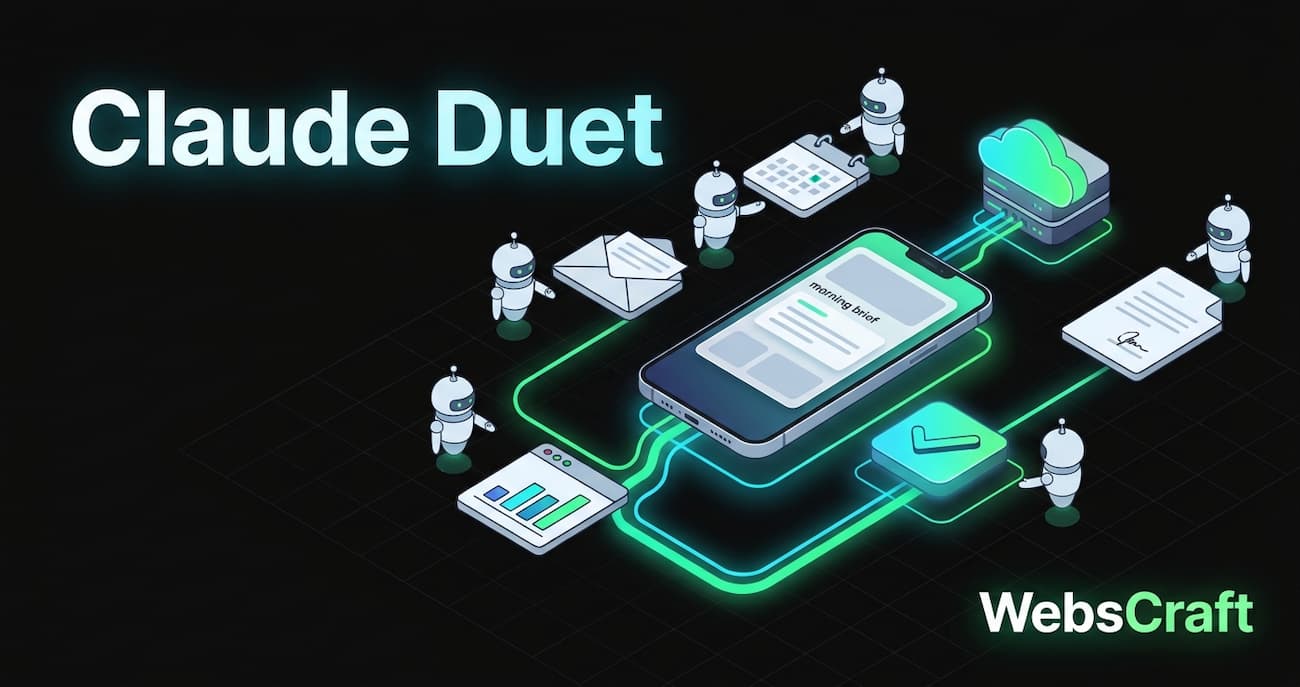
If you missed the official announcement, I've put together a brief overview of the main points for you. On October 21, 2026, Anthropic released Claude Duet (announcement) — a standalone application where Claude doesn't wait for your question but writes first. In the morning, it sends summaries via email and calendar, throughout the day it monitors connected services and performs tasks in the background, even when the application is closed.
Let's get straight to the main point: for now, this is a research preview only for paid Claude accounts in the US, and access is granted through a waiting list (Anthropic help). So, you won't be able to try it outside the US right now, but it's worth understanding where AI agents are heading today.
Contents
- What is Claude Duet
- How Claude Duet Works
- What Claude Duet Can Do
- Pros and Limitations
- How Much It Costs and How to Get Access
- Is Claude Duet Worth Using
- Frequently Asked Questions
🤖 What is Claude Duet
A regular chat works on a "you ask, you get an answer" principle. Close the tab, and the work stops. Duet is structured differently: it has its own cloud computer with a browser, so it continues to work after you've exited the application.
Anthropic describes it as an agent that highlights what needs your attention, carries out tasks, works while you're away, and asks for permission before doing anything on your behalf (official announcement).
A few details that distinguish it from regular Claude:
- Duet pulls in memory, skills, and connectors that are already configured in your Claude account — no need to explain the context from scratch.
- It runs on Claude Opus 5.5. You can't choose the model: the agent decides how much effort to put into the task.
- It's a standalone application for iOS and Android, also available on claude.ai.
The target audience is professionals and small business owners who have more tasks than they can keep track of. The launch didn't happen in a vacuum: in early September, Meta released the Muse agent, and at the end of September, OpenAI launched dots for ChatGPT (INSIDE). How Duet differs from dots and where Claude Code fits in is discussed in a separate comparison of AI agents.
⚙️ How Claude Duet Works
A workday with Duet looks like a four-step cycle:
- Morning Briefing. The agent reviews email and calendar, highlights important items, and can immediately start the first steps — for example, prepare draft responses.
- Checks Throughout the Day. Duet doesn't constantly monitor your accounts but checks in at intervals of several hours. It only writes when something requires attention. The frequency and topics of notifications can be customized (iThome).
- Tasks. You assign tasks by text or voice. Current work is visible in the Tasks tab, and completed files — briefs, financial models, presentations, dashboards — appear in the Make tab. The agent can indicate that a task is complete, but only you can close it.
- Confirmation. Before sending a message, making a payment, signing a document, or deleting something, Duet shows what it's about to do and waits for your "yes." If you're busy, it will continue with other tasks and return with the request later.
💡 Example from the announcement: brand strategist Maya Dalton shared that Duet noticed a client call scheduled right before her flight and proactively offered to reschedule it (Anthropic). These are exactly the kinds of things that are easily missed when your calendar is packed.
🔐 Security and Account Access
An agent that reads your email and can make payments raises trust concerns. Here's what Anthropic has done to address them (announcement, help):
- Passwords. If a website asks for a password, you enter it in a separate form on your device. This form sends the password directly to the agent's browser, bypassing the chat. Claude itself does not see passwords or login tokens.
- Purchases. A one-time card is created for each payment, valid only for that transaction.
- Sensitive Data. A separate classifier blocks the transmission of bank card numbers and documents.
- Strict Prohibitions. Some actions are not allowed even with your permission: trading securities, transferring money between accounts, accessing other people's accounts.
⚠️ Important: Anthropic honestly states that there is no perfect protection against prompt injection. Duet reads emails and web pages written by other people, and these may contain instructions intended to trick it. This is a classic indirect prompt injection, where the attack is hidden not in the user's prompt but in the content the agent reads itself. This is precisely why risky actions always require confirmation — and why you should read them carefully instead of just clicking "yes." I've explained why models are so easily tricked into treating external text as commands in my article about prompt injection.
🧰 What Claude Duet Can Do
The agent's capabilities depend on what you connect to it. Examples in the help documentation include Gmail, Google Calendar, Google Drive, Slack (with limitations), QuickBooks, HubSpot, Docusign, Calendly, and Stripe. If there's no connector for a website, Duet opens it in its own browser. Microsoft 365 is not yet supported (Anthropic help).
📬 Email and Calendar
Basic scenario: morning summary, draft responses for your approval, reminders in threads that have been silent for a while, scheduling meetings. A real estate agent from the announcement shared that Duet noticed a property showing scheduled for the wrong day.
💡 How this might look for a freelancer: "Find clients who haven't responded to a commercial proposal for over a week and prepare short reminders." Duet compiles a list, writes drafts, and you review and confirm sending.
📊 Reports, Dashboards, and Forecasts
This is where Duet differs from a simple email assistant. Anthropic lists tasks such as dashboards, financial and sales forecasts, finding unpaid invoices with reminders, preparing payroll for review, and monitoring business metrics — for example, delivery errors or subscriber churn — with suggestions for what to test (product page). When the agent provides figures, it indicates which email, file, or spreadsheet they were taken from.
💡 Real-world case: the owner of the Shahs of Kabob restaurant chain (around 110 employees) uses Duet for accounting, customer support, and marketing, including analyzing invoices for each establishment. His explanation: he no longer needs to keep a hundred tabs open (INSIDE).
🛠️ Prototypes and Web Applications
The announcement mentions product prototypes and web applications among more complex tasks. Anthropic has not yet provided details on how they are deployed or if it's possible to work with repositories. A smart scenario here is a quick prototype of an idea to show a client or partner, rather than full-fledged development.
If you need to write and maintain code, Duet doesn't replace developer tools like Claude Code or OpenAI Codex. The line between them is drawn in the comparison of Claude Duet, ChatGPT dots, and Claude Code.