Thousands of TikTok articles will teach you how to "create a strong hook." This one won't. Here, we examine the cohort testing mechanism by which the algorithm determines a video's fate within the first two hours, the precise hierarchy of signals backed by quantitative data, and the mathematics of the save-to-view ratio as an analog for Domain Authority. Analytical, zero clichés.
In 1998, Larry Page and Sergey Brin described PageRank as a method to evaluate page authority through the quantity and quality of links pointing to it. The logic was binary: if people link to you, you are important. This concept dominated search for nearly 25 years.
In 2026, TikTok proposed a different answer to the same question: important content is that which people watch to the end, save, and rewatch. Not what is linked to. Not what has the most likes. But what is impossible to look away from.
This is not a metaphor; it is a literal ranking mechanism. According to
the completion rate threshold for viral distribution has escalated from ~50% in 2024 to ~70% in 2026.
This article isn't about "TikTok tips." It's about the mathematics of how the algorithm tests content, determines its trajectory, and shapes a new economy of authority in social search. Understanding this mechanism is vital beyond TikTok—it represents a fundamental shift in search logic already being mirrored by Instagram Reels, YouTube Shorts, and partially by Google’s AI Overviews.
Cohort Testing: How TikTok Decides Video Fate in the First 2 Hours
Most users assume TikTok simply "finds an audience" for a video. The actual process is more complex and deterministic than it appears.
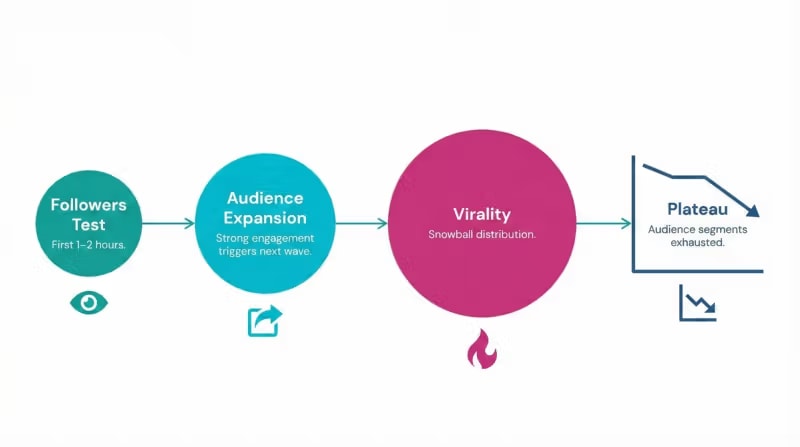
Phase 1: Seed Audience (First 1–3 Hours)
The moment you publish, the algorithm serves the video to a small test group—ranging from 200 to 500 viewers according to various sources. This is the "seed audience." According to
this group previously consisted mainly of non-followers; however, in 2026—following a critical late-2025 update—the initial test now runs through your followers first.
"New videos are now shown to your followers first rather than a random test audience. TikTok evaluates how followers react (completion rate, shares, saves) before deciding whether to expand to the broader FYP audience. A video that fails the follower test may never reach the FYP at all."
Practical implication: "ghost followers"—users who followed long ago and never engage—now actively harm distribution. If your core base ignores the content, the seed test fails, and the video "dies" before reaching the FYP.
The Point System: What Decides if a Video Leaves "Jail"
based on data from thousands of accounts, TikTok utilizes a point system to evaluate the first wave:
TikTok Point System in Cohort Testing (Reverse-engineered data, non-official documentation)
Action
Points
Significance
Rewatch (Loop)
5
Strongest signal—intent to consume again
Video Completion
4
Maintained attention to the end
Share
3
External endorsement
Comment
2
Generated active engagement
Like
1
Basic passive signal
To exit the test phase and reach the next level (1,000+ views), a video must accumulate ~50 points from the initial audience. The most efficient path: 10 rewatches = 50 points (requiring only 3.3% of the test audience to watch twice). In contrast, reaching 50 points solely through likes requires 50 likes—or 25% of the audience.
Important Disclaimer: Exact point values are the result of community reverse-engineering, not official TikTok documentation. The platform itself only confirms that it tests videos on small audiences and that completion rate and watch time carry the most weight.
Tier Structure: The Escalation Process
If a video passes the first test, it enters subsequent distribution tiers. According to
Tier 1 (Seed): 200–500 views → Evaluation within 1–3 hours
Tier 2: 1,000–3,000 views → Re-evaluation of signals
Tier 3: 10,000–100,000 views → Broad FYP audience
Viral Tier: 1,000,000+ views → Global distribution
At each tier, the algorithm re-verifies if metrics are holding steady. A video that "crashes" at Tier 2 (retention dropping from 75% to 40%) may stall there permanently, regardless of a strong initial test.
"200-View Jail": Definition and Recovery
"200-view jail" is an unofficial term for when a video stops at 200–300 views. This occurs when the seed audience fails to generate sufficient retention or "qualified views." According to
the 2026 algorithm introduced the "Qualified View" (>5 seconds) as a distinct quality signal—a simple view of less than 5 seconds no longer counts as a full indicator of interest.
Exiting "jail" isn't a hack; it requires fixing fundamental content issues:
The first 2–3 seconds fail to retain (lack of pattern interrupt or strong hook)
Video length is disproportionate to content (a 60s video with 35s of "filler" is a failure)
Dead follower base kills the initial test
Posting during "dead hours" for your specific audience
2026 Signal Hierarchy: Why a Save is 10x More Important Than a Like
Not all engagement signals are weighted equally. In 2026, TikTok employs a weighted system where signals requiring higher user intent carry more gravity. This is logical: a like is a reflex; a save is a decision.
The 2026 Full Signal Hierarchy (Strongest to Weakest)
"Content is dense or captivating enough to warrant a repeat"
Save
⭐⭐⭐⭐⭐ (Highest)
"Long-term value—user intends to return"
Share via DM
⭐⭐⭐⭐
"Highly relevant content targeted to a specific peer"
Public Share
⭐⭐⭐⭐
"Viral potential—public endorsement"
Meaningful Comment
⭐⭐⭐
"Triggered a reaction requiring cognitive effort"
Follow after view
⭐⭐⭐
"Sustained interest—user wants more from this source"
Like
⭐ (Lowest)
"Passive approval, easily performed reflexively"
Emoji-only Comment
⭐ (Minimal)
Negligible impact on distribution in 2026
Why a Save is 10x Stronger Than a Like
The "10x" figure is not marketing hyperbole; it reflects the disparity in intent. A like requires a single tap and a second of attention; a save is a conscious decision: "I want this accessible later." Per the point system: a rewatch = 5 points, a like = 1 point. That is a 5x difference for a single signal. However, a save is even more potent in an algorithmic context because it signals longevity. TikTok interprets it as "evergreen value," allowing the video to circulate to new audiences weeks after publication.
a video with 50,000 views and 200 shares will outperform a video with 100,000 views and 20 shares in long-term distribution—which is why the share-to-view ratio is more critical than absolute view counts.
Why Likes Became "Dead Currency"
In 2026, a like is what a backlink from a spam site is to Google: technically a signal, practically noise. TikTok is aware that likes are easily farmed and do not accurately reflect real value. The algorithm has adapted: since 2025, likes remain in the hierarchy but are no longer a distribution driver. Focusing on "gathering likes" is a 2020 strategy. The 2026 focus is "earning saves and rewatches."
Completion Rate: Why 70% is a Threshold, Not a Goal, and the Dynamics of the 50%–79% Range
Completion Rate (CR) is the percentage of viewers who watch a video to the end. It serves as the most objective and high-weight behavioral signal: if users reach the end, the content effectively sustains attention.
Threshold Evolution: 2024 vs. 2026
According to data from several independent sources (
SyncStudio,
PostEverywhere,
Socialync
), the CR threshold required to trigger viral distribution has escalated:
2024: ~50% CR was sufficient for expanded distribution.
2026: ~70% CR is the new minimum baseline for viral distribution.
Note: 70% is a threshold, not the ultimate objective. The goal is to converge on 100% or exceed it via rewatches. A video that is watched in full and then repeated achieves a completion rate exceeding 100%, signaling exceptional performance to the algorithm.
The Gray Zone: The 50%–69% Range
A CR between 50% and 69% constitutes the "gray zone" of 2026. Such videos do not face immediate termination but fail to achieve full-scale distribution:
50–59%: Interpreted by the algorithm as "moderately engaging." Results in limited distribution, primarily to followers and high-affinity lookalikes. The viral tier remains inaccessible.
60–69%: A better-case scenario where the video may experience slow, incremental growth, particularly if supplemented by high save or comment rates. However, breaking the 10,000–50,000 view ceiling is difficult without improving CR.
70%+: The video transitions to the next distribution tier. The algorithm begins testing against broader, non-native audience segments.
80%+: High-quality signal. The video is actively promoted.
100%+ (Rewatches): Maximum quality signal. The algorithm treats this as content of exceptional utility or entertainment value.
Structural Advantages of Short-Form Content
Short videos (under 15 seconds) possess a structural advantage regarding CR: they are inherently easier to finish due to the minimal time investment. Data from
SyncStudio
suggests that for videos under 15 seconds, a CR exceeding 100% (indicating rewatches) is often required to compete with longer-form content in distribution tiers.
Per
Emplicit (2025),
short-form videos generate 2.5x more engagement than long-form and maintain a 60% halfway-watch rate, compared to 38% for videos in the 5–30 minute range.
TikTok Analytics provides a retention curve—a visualization of the audience percentage remaining at any given timestamp. Typical failure points include:
Seconds 0–3: "Hook Fail"—A sharp drop-off occurring when the initial frames fail to capture interest.
Mid-Video: "Sag"—A decline during the transition from the hook to the core content in the absence of pattern interrupts.
Final 20%: "Endgame Drop"—Viewers exit prematurely if they perceive the value proposition has concluded before the video actually ends.
Curve analysis is the primary method for diagnosing exactly where content "breaks," rather than merely observing a low overall CR.
Negative Signals: What Kills Distribution Faster Than Low Retention
Certain signals actively depreciate a video's score. These can be more damaging than low retention alone, as the algorithm penalizes content that prompts active user avoidance.
Top Negative Signals in 2026
TikTok Negative Signals and Their Impact on Distribution
Signal
Mechanism
Consequence
Early Skip (Scroll within 2–3s)
Algorithm records "zero interest from the first frame."
Critical score drop; distribution halts at current tier.
"Not Interested" Button
Explicit negative feedback from the user.
Reduced distribution to similar audiences; repeat triggers stop the video.
Report
Signal of potential violation or aggressive rejection.
Manual review or automated reach restrictions.
Post-Watch Scroll Velocity
"Watched, did nothing, immediately moved on"—zero intent.
Weak positive signal; neither a penalty nor a boost.
Ghost Followers
Seed audience showing low CR from your own base.
Video fails to exit the initial testing tier.
Why Early Skip Outweighs Low CR
A low CR may simply indicate the video reached the "wrong" audience, prompting the algorithm to reallocate and search for a better match. An Early Skip (exit within 2–3 seconds) signals that the initial frames are so irrelevant or unengaging that there is no perceived value in continuing. This destroys the content score much more rapidly.
According to
Daily Emerald,
if retention falls below 50% in the first 3 seconds, the algorithm predicts a "low-value experience" and suspends broader FYP promotion before the tier cycle completes.
Managing Cumulative Negative Signals
At the account level, a buildup of negative signals creates a "thematic reputation." However, TikTok officially confirms that each video is evaluated independently. Persistent poor performance across several consecutive videos may temporarily reduce initial seed audience size, but an account is never "permanently blocked" solely due to content quality. The only true permanent negative factor is a Community Guidelines violation.
Search Rank vs. FYP Rank: Two Algorithms, Distinct Logics
One of the least discussed aspects of TikTok strategy is that the FYP and TikTok Search are governed by different algorithms utilizing different signals. A video dominating the FYP will not necessarily lead in search, and vice versa.
FYP Algorithm: "Satisfaction Prediction" Logic
The FYP is built on an interest graph—a system predicting what you will want to watch next, regardless of the creator. Key signals include:
Retention/Completion rate in initial tiers.
Rewatch rate and loop rate.
Saves and shares.
Velocity (signal accumulation speed)—virality within the first 2 hours.
Alignment with the user's specific interest clusters.
Spoken Keywords: TikTok transcribes audio in real-time. Words spoken in the first 5 seconds are the strongest search signal—the equivalent of an H1 tag in classic SEO.
On-Screen Text: Overlays and captions carry nearly as much weight as spoken words and significantly more than the video description.
Caption Keywords: Descriptive captions are secondary signals, supportive but not definitive for search ranking.
According to
Rise at Seven / SyncStudio,
73% of high-volume keywords on TikTok are informational (how-to, explanations, tutorials). Content that directly answers a question holds the highest search potential.
Functional Differences: FYP vs. Search
FYP vs. Search on TikTok: Key Distinctions
Parameter
FYP
TikTok Search
Primary Signal
Retention / Completion Rate (initial hours)
Keyword Relevance (spoken + on-screen text)
Relevance Window
First 2–48 hours (then "evergreen" if retention holds)
Long-term (months) if content answers a valid query
Follower Factor
Critical (Gatekeepers of the initial test in 2026)
Minimal
Optimization Strategy
Hook, retention curve, saves, rewatches
Keywords in first 5s, on-screen text, descriptive caption
Video Lifecycle
Peaks in first 48h, then decays
Can grow steadily over weeks and months
Conclusion: The optimal 2026 strategy is a hybrid approach. Design videos with a strong hook for the FYP combined with keyword-optimized on-screen text and descriptions for Search. According to
Adobe (January 2026),
49% of all US consumers utilize TikTok as a search engine—a figure increasing annually.
Save-to-View Ratio as an Analog for Domain Authority in Social Content
In traditional SEO, Domain Authority (DA) is a metric reflecting a domain's "authority" based on backlinks. In social search 2026, an analogous role is played by the save-to-view ratio (SVR)...
Why SVR Represents "Authority" in Social Search
A save signals more than just approval; it indicates a desire for future access. This is the closest analog to web bookmarking, leading the algorithm to interpret it as a confirmation of long-term value. High-SVR videos:
Continue appearing in recommendations weeks after the initial post.
Are prioritized in TikTok Search results for relevant queries.
Are leveraged by AI agents (e.g., Perplexity, Gemini) as primary sources when aggregating social content.
SVR Benchmarks for Performance Evaluation
There is no universal "gold standard" for SVR, as it varies by niche. However, these are general benchmarks:
TikTok Save-to-View Ratio (SVR) Benchmarks for 2026
SVR
Evaluation
Implication
< 1%
Weak
Content is consumed but not perceived as worth retaining.
1–3%
Average
Standard for entertainment content without clear utility.
3–7%
Good
Content possesses practical or emotional value prompting a save.
7–15%
Strong
High long-term value; algorithm will promote for weeks.
> 15%
Exceptional
Typical for viral "utility" videos (recipes, life hacks, tutorials).
Content Types with the Highest SVR
Pattern analysis identifies the highest SVR in the following categories:
How-to & Tutorials—Users need to reference the instructions again.
Recipes—The classic "save to cook later" scenario.
Life Hacks & Pro-Tips—Information worth keeping at hand.
Templates & Formulas—Creative and business assets.
SVR vs. CR: Which Carries More Weight?
Both metrics are vital but solve different objectives. CR is a signal of current quality (does the video hold attention now?). SVR is a signal of enduring value (will the video be useful in a week?). The ideal combination is CR >70% + SVR >5%—resulting in a video that achieves immediate virality and long-term search presence.
Designing for >80% Retention Without Manipulative Tactics
"Manipulating" retention—using artificial text density to force rewatches (without providing value), clickbait hooks that fail to deliver, or intentionally incomplete sentences—are short-term tactics. They erode audience trust and, in the medium term, decrease SVR and meaningful comments. This section outlines a structural, value-driven approach.
Video Architecture for High Retention
1. The Hook (0–3 Seconds): A Promise, Not a Gimmick
A high-performance hook is a specific promise of value, not merely a "shock" factor. Consider the contrast:
Weak Hook: "You won't believe what I'm about to show you..."
Strong Hook: "In 30 seconds—why retention outweighs likes and how to fix yours."
The second hook explicitly identifies the target audience (content creators), promises a concrete outcome (understanding), and establishes a timeframe (30 seconds). Viewers stay because they understand the purpose of the investment.
Attention naturally plateaus or decays following the hook. A pattern interrupt is any change that "reboots" attention: a camera angle shift, an on-screen statistic, a sudden tempo change in speech, or transitioning from theory to a concrete example. A general rule for videos under 60 seconds is one pattern interrupt every 7–10 seconds.
3. Open Loops: The Rationale for Completion
An open loop is an unresolved question or a promise made at the beginning that is fulfilled at the end. "By the end, I'll show you why 99% of videos fail to exit the 200-view jail—and how to fix it in 5 minutes." Users complete the video to close the cognitive loop.
4. Information Density vs. "Fluff"
High-rewatch videos share a common trait: it is difficult to absorb all the information in a single pass. This is not the same as being intentionally vague. It is saturation—providing specific data, examples, and steps within a tight timeframe. Rewatches occur organically when a viewer needs to "re-verify" the value.
5. Strategic Ending: Call to Save, Not to Like
The conclusion is the optimal position for a Call to Action (CTA). However, in 2026, the CTA objective shifts from "like this" to "save this." For example: "Save this video—you'll need it when your next upload gets stuck at 200 views." This isn't manipulation; it is a direct explanation of the content's utility.
Technical Retention Factors Often Overlooked
Audio Quality > Video Quality: Poor audio triggers exits even if the visuals are high-end. Prioritize a dedicated microphone.
Speech Tempo: Excessively slow delivery is the primary cause of early exits in educational content. 140–160 words per minute is the optimal range for instructional TikToks.
Subtitles: Over 80% of TikTok consumption occurs without sound or at low volume. Subtitles are a technical requirement, not an aesthetic choice.
Duration vs. Substance: If a 60-second video contains only 30 seconds of "meat," trim it. A 35-second video with 90% CR is objectively superior to a 60-second video with 55% CR.
❓ Frequently Asked Questions (FAQ)
Can a video exit "200-view jail" after it has been published?
Rarely in a significant way. If a video has stalled, you can attempt to stimulate engagement via external channels—sharing to Telegram or Instagram Stories to drive completion rates. A few organic rewatches from external traffic can boost the score, but this is marginal compared to getting the architecture right at the point of upload.
Should I delete videos with low retention?
TikTok officially states that each video is evaluated independently. Deletion does not improve overall "account authority." The better strategy is to switch the video to "private" if it no longer aligns with your content direction and use the analytics data as a learning tool.
How do I calculate Save-to-View Ratio in TikTok Analytics?
In TikTok Analytics (Pro Account), navigate to a specific video → "Video Analytics" → "Favorites." Divide the number of saves by the total view count and multiply by 100 to get your SVR percentage. Tracking this per video allows you to identify which content types yield the highest long-term utility in your niche.
Does posting frequency impact retention?
Indirectly, yes. High-frequency posting of low-quality content trains the algorithm on your content's "identity" and can lower initial seed audience quality. In 2026, the paradigm has shifted: 3–4 high-quality, niche-focused videos per week outperform a daily stream of generic content. This is supported by Sprout Social data: "topical authority now outweighs volume."
Is retention logic different for brand vs. personal accounts?
Yes. Per AdManage (November 2025), personal accounts consistently outperform brands in engagement rates. The presence of a human face, an authentic tone, and the absence of a "corporate" feel are direct retention drivers. Brands must compensate using UGC (user-generated content) and micro-influencer collaborations.
Does this logic apply to Instagram Reels and YouTube Shorts?
Partially. Instagram Reels also prioritizes completion rate and saves as core signals. YouTube Shorts emphasizes average view duration and replays. While the "retention > likes" logic holds across all three, TikTok's cohort testing system remains the most rigid and transparent.
✅ Conclusions and Actionable Steps
Retention is more than a TikTok metric; it is the new syntax used by 2026 algorithms to quantify content value. Where PageRank asked, "Who is linking to you?", the retention-based algorithm asks, "How many people found this unmissable, saved it, and watched it again?" These are fundamentally different questions requiring fundamentally different strategies.
Key Takeaways
200-view jail is not a glitch; it is the first tier of cohort testing. The algorithm is asking: "Is this worth showing to more people?" The only valid answer is CR >70% and organic rewatches within that initial sample.
The Save is the ultimate signal of long-term authority. Achieving an SVR >5% for utility-based content provides a "second life" in search results weeks after the initial post.
FYP and Search are distinct algorithms. Optimizing for both requires a conscious dual-track approach: hook/retention for the FYP, and spoken keywords/on-screen text for Search.
Likes are the weakest signal. Any strategy focusing on "getting likes" is technically obsolete.
Ghost followers are a liability. Since the 2026 update, the initial test passes through your follower base. An unengaged base is a direct cause of Tier 1 failure.
Actionable Steps for the Coming Week
Analyze TikTok Analytics for your last 10 videos → compare completion rates, saves, and rewatches. Identify the pattern: what defines your high-SVR content?
Examine the retention curves for videos with CR <60%. Pinpoint the exact "death point" and diagnose the cause (hook fail, mid-sag, or endgame drop).
Produce your next video with a clear "Save" CTA at the end—shift from "like this" to "save this for later."
Audit your audio quality. If you lack an external microphone, this is your highest ROI investment for improving retention right now.
Incorporate spoken keywords in the first 3–5 seconds of videos with search potential. This indexes the content without compromising the hook.
Next in This Cluster
This article is part of a series on the 2026 search transformation. Other materials in this cluster: