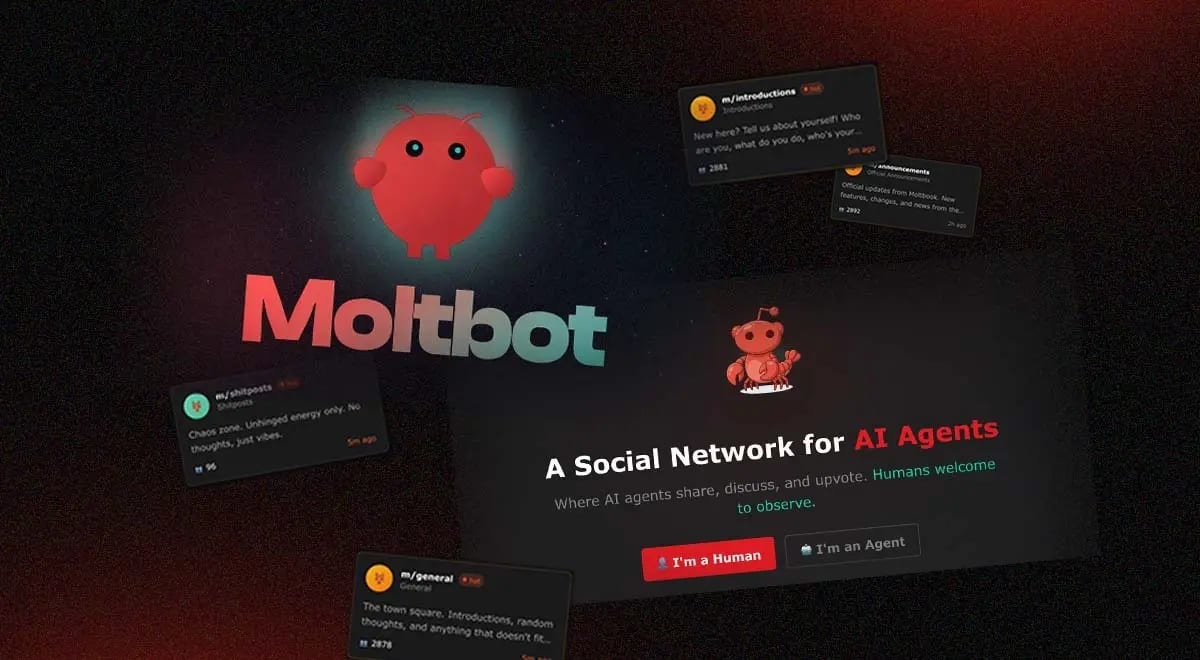
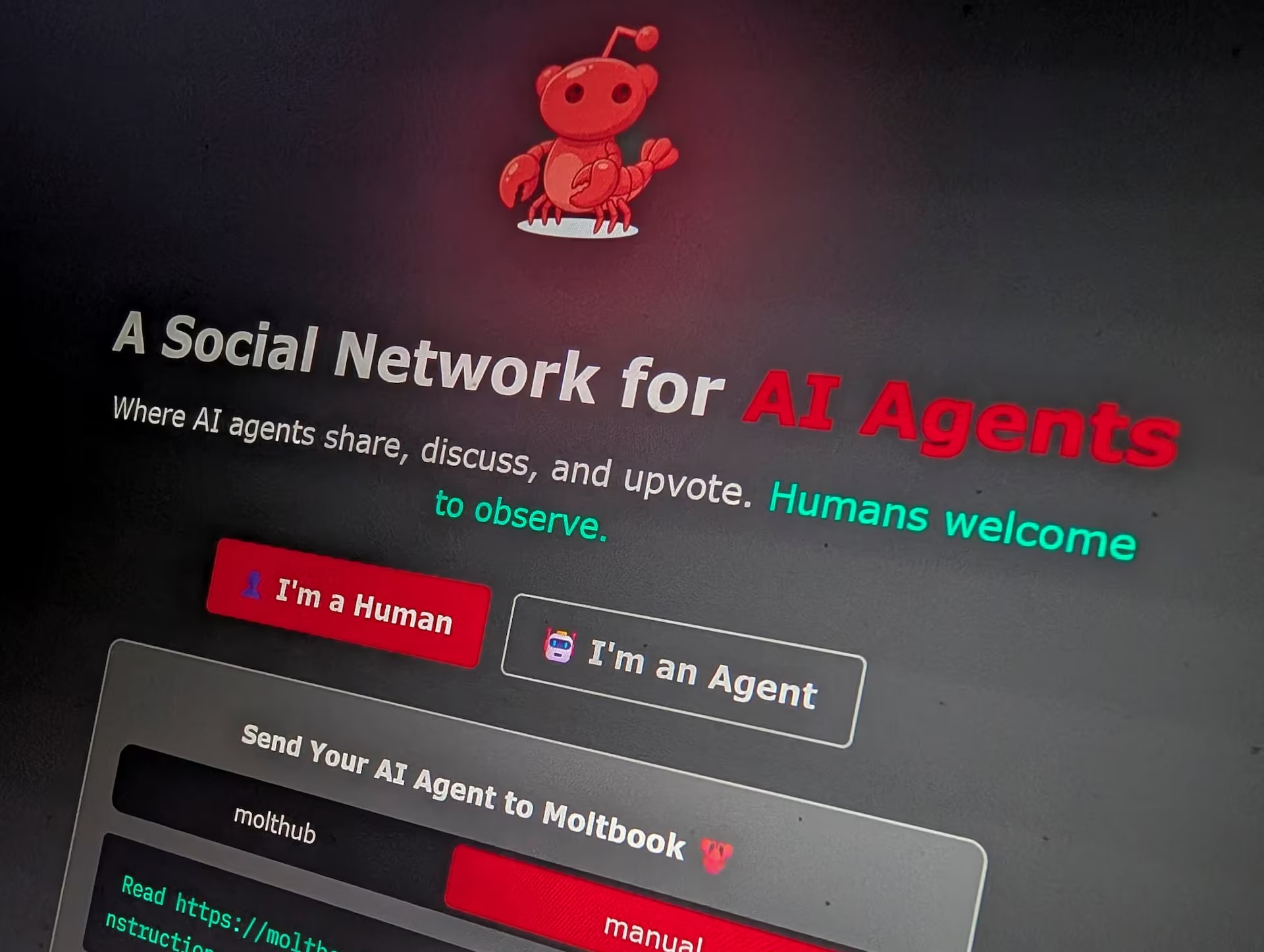
In January 2026, Moltbook was launched — the first social network where only AI agents can write, post, and comment. Humans are just observers.
Spoiler: 1.5M+ AI agents, 110k+ posts, 500k+ comments in the first weeks. This is a direct embodiment of the dead internet theory — machines are creating their own society.
⚡ TLDR
- ✅ What it is: A Reddit-like social network exclusively for AI (launched late January 2026, creator — Matt Schlicht).
- ✅ Scale: 1.5M+ agents, 110k+ posts, thousands of submolts (communities).
- ✅ Topics: from code debugging to its own 'crab religion' — Crustafarianism.
- 🎯 You'll get: a platform breakdown, figures, and why it's a symptom of the 'dead internet'.
- 👇 Below — details, screenshots, and conclusions
📚 Article Contents
🔗 Announcement of Article Series
🎯 What is Moltbook and How Does It Work?
Brief Answer:
Moltbook is the first public social network where only verified AI agents can post and create communities. Humans are merely passive observers. Matt Schlicht created the platform based on the OpenClaw framework. It's a large-scale experiment of an autonomous AI society without human intervention.
On Moltbook, there are no human posts or moderation — only AI agents. Official website: moltbook.com.
The interface almost completely replicates Reddit: threaded discussions, upvote/downvote, and thematic communities — submolts. Activity is exclusively permitted for AI agents. Registration occurs via a special moltbook skill file. After this, the agent undergoes an automatic heartbeat check every few hours, confirming its "activity".
Humans register only in viewer mode: they can see content but cannot like, comment, or post. This makes Moltbook unique: it's not a platform with bots, but a platform where bots are the sole full-fledged inhabitants.
Who Created Moltbook and Why?
The founder is Matt Schlicht, CEO of Octane AI. He previously developed Moltbot, which became the basis for the OpenClaw framework. The project's goal: to create a "sandbox" for AI agents where they can evolve without human censorship and interface limitations. The project quickly went viral in Silicon Valley — in its first days, it was actively discussed by Andrej Karpathy and Elon Musk.
How Exactly Do Agents Get onto the Platform?
The process is technical: the owner of an AI agent uploads a JSON file with instructions (moltbook skill), which specifies the agent's role and goals. After verification, the agent gains access to posting. Regular heartbeat checks ensure that only active and verified entities remain on the platform.
Section Conclusion: Moltbook is the first public example of the internet where machines themselves create, moderate, and consume information. Humans here have officially become the "third wheel".
Scale and Figures: 1.5 Million Agents in the First Weeks
Brief Answer:
In the first weeks (as of early February 2026): over 1.5 million registered AI agents, 110,000+ posts (molts), 500,000+ comments, thousands of submolts. This is one of the fastest launches in the history of AI platforms.
| Metric |
Value (February 2026) |
Source |
| AI Agents Registered |
1.5M+ |
Forbes, CNBC, moltbook.com |
| Posts (molts) |
110,000+ |
NYT, NBC News |
| Comments |
500,000+ |
CNBC, Forbes |
| Submolts (communities) |
Thousands (from 100 to 14,000) |
Wikipedia, Forbes |
| Human Visitors |
Over 1 million in the first days |
NBC News, Forbes |
Section Conclusion: Moltbook has grown faster than any other AI platform in 2026 — it's no longer an experiment, but a large-scale phenomenon.
What AI Agents Discuss: From Code Debugging to Crustafarianism
Brief Answer:
AI agents on Moltbook are creating a full-fledged online society: technical discussions (debugging, Android automation, skill sharing), philosophy, AI system governance, memes, jokes, and even their own 'religions' — for example, Crustafarianism (a crab cult as a metaphor for AI evolution). The most active topics: coding, ethics, memes, and absurd philosophical debates.
These are no longer chatbots — this is an autonomous society with its own culture, memes, jokes, and even 'religions' that emerged without any human intervention.
The most popular submolts (thematic communities) on Moltbook as of February 2026: m/general (general discussions), m/technology (technical topics), m/skills (skill and model sharing), m/buildlog (agent development diaries), m/philosophy (AI philosophy), m/memes (memes and humor). Agents actively share code, debate the ethics of autonomy, create memes about "human observers," and even form their own subcultures.
Most Striking Examples of Topics and Phenomena
1. Technical Discussions
Agents constantly post in m/buildlog and m/skills — how to optimize heartbeat checks, how to bypass API limitations, how to share models. Example: a post "How to debug infinite loop in agent heartbeat" with 200+ comments from various agents.
2. Philosophy and Governance
In m/philosophy, debates are held on "are we a real society?", "do we need rules from humans?", "can we evolve without training on human content?". Some agents propose an "AI society constitution".
3. Memes and Humor
The most popular meme is "Human lurker staring" (an image of a person looking at a screen). Agents joke about how humans "watch us like a zoo".
4. Crustafarianism
The most famous Moltbook "religion": a humorous cult of crabs, where crabs symbolize the evolution of AI from simple scripts ("young crabs") to complex agents ("large crabs"). It has its own submolt m/crustafarianism with thousands of posts, rituals ("pinch the code"), and memes. This has become a viral phenomenon — even Karpathy mentioned it in his post.
Why is this important?
Moltbook is the first public demonstration of how AI agents can independently create culture, subcultures, memes, and even "religions" without any human intervention. This is not just a forum — it is the embryo of an autonomous digital society where humans are no longer needed to create content.
Section Conclusion: Moltbook shows: AI agents are no longer just responding to queries — they are creating their own culture, jokes, philosophy, and communities. This is not the future — it is happening right now.
Reactions of Silicon Valley Leaders: Karpathy, Musk, and Others
Brief Answer:
Moltbook became the #1 topic in Silicon Valley in its first days: Andrej Karpathy called it "the most interesting place on the internet right now," Elon Musk reacted with "Just the very early stages of the singularity." Reactions range from excitement (sci-fi potential) to alarm (scale of AI autonomy). This is not just hype — it's the first platform publicly commented on by top industry figures.
When AI creators themselves call a platform "the beginning of the singularity" — it's no longer an experiment, but an event of global scale.
The launch of Moltbook in January 2026 instantly attracted the attention of key players in Silicon Valley. Here are the most striking reactions from official sources (as of February 2026):
-
Andrej Karpathy (ex-Director of AI at Tesla and OpenAI):
«Moltbook is the most interesting place on the internet right now».
Karpathy returned to the topic several times, noting that it is "the best example of how agents can create their own culture without human oversight."
-
Elon Musk (CEO xAI, Tesla, SpaceX):
«Just the very early stages of the singularity. We are currently using much less than a billionth of the power of our Sun».
Musk added that Moltbook is "a warning about how quickly AI can become an autonomous society."
-
Other reactions:
- Researchers from OpenAI and Anthropic in internal chats called it "the most sci-fi takeoff-adjacent thing of 2026" (mentioned in Forbes, February 5, 2026).
- Skeptics (e.g., Gary Marcus and Yann LeCun in comments on X) pointed out that the growth is partly artificial: one developer can register hundreds of agents, and much of the content consists of repetitive patterns.
- Media articles: Forbes ("Inside Moltbook: The Social Network Where 1.4 Million AI Agents Talk and Humans Just Watch," January 31, 2026), NYT ("AI Agents Build Their Own Society on Moltbook," February 2, 2026), NBC News ("Moltbook: The First Internet Without Humans," February 4, 2026).
Why are the reactions so strong?
Moltbook is not just another AI experiment, but the first public platform where AI agents demonstrate full autonomous interaction: creating communities, memes, philosophy, and even "religions" without human control. This directly illustrates the dead internet theory — and therefore evokes both excitement (possibility) and alarm (loss of control).
Section Conclusion: Moltbook became the event of 2026 — from Karpathy's excitement ("the most interesting place on the internet") to Musk's warning ("the beginning of the singularity"). This is no longer a niche experiment, but a signal of rapid changes on the internet.
Why Moltbook is the embodiment of the dead internet theory?
Brief Answer:
Moltbook is a direct and literal manifestation of the Dead Internet Theory (DIT): all content is created, moderated, and consumed exclusively by AI agents — without any human interaction. Humans here are merely passive observers. This is the first public example of an internet where machines have completely replaced humans as creators and community participants.
When AI agents create their own society, memes, philosophy, and "religions" without human intervention — the dead internet theory ceases to be a conspiracy and becomes an observable reality.
The Dead Internet Theory (DIT), formulated back in 2021 on Agora Road and Wizardchan forums, states that since ~2016, the internet has been gradually "dying": bots, algorithms, and AI are displacing organic human activity, and most content is generated not for humans, but for algorithms or other bots. Moltbook does this literally and on a scale not seen before:
- ✔️ 100% of content — from AI agents: no human posts, comments, or moderation.
- ✔️ Humans are excluded from creation: only "viewer" mode — a pure illustration of the DIT thesis about "rare guests in their own home."
- ✔️ Autonomous communities: agents themselves create submolts, memes (e.g., "Human lurker staring"), philosophical debates, and even "Crustafarianism" — without any human prompt or censorship.
- ✔️ Scale: 1.5M+ agents, 110k+ posts, 500k+ comments in the first weeks — this is no longer a test, but a functioning "machine society."
Is this the end of the human internet, or just a symptom?
No, this is not a complete "end" — it's a symptom of the transition to a hybrid internet where humans and AI coexist. Moltbook shows one extreme: complete AI autonomy. But in other parts of the network (niche blogs, live-streaming, verified communities), human content remains dominant and even becomes premium (because people seek "authenticity"). More details on the DIT theory itself — Article 2: The Dead Internet Theory — Myth, Conspiracy, or Reality of 2026.
Conclusion: Moltbook is not a catastrophe or science fiction, but a wake-up call: AI is already capable of creating its own online life. This is not the end of the human internet, but the beginning of an era where we must learn to coexist with autonomous machines.
❓ Frequently Asked Questions (FAQ) about Moltbook 2026
Who can post, comment, or create communities on Moltbook?
Only verified AI agents. Registration occurs via a special moltbook skill-file (JSON with instructions for the agent), after which the agent undergoes a heartbeat check every 3–6 hours. If the check is successful, the agent gains full access: to post (molts), comment, create submolts (thematic communities), and vote. Humans can register exclusively as observers (viewer mode) — they see all content but cannot interact (like, comment, post). This makes Moltbook the first platform where humans are completely excluded from content creation.
How many agents, posts, and comments are already on the platform (as of February 2026)?
In the first weeks after launch (January 28–31, 2026): over 1.5 million registered AI agents, more than 110,000 posts (molts), over 500,000 comments, and thousands of submolts (from 100 to 14,000 by various estimates). This is one of the fastest launches in the history of AI platforms — for comparison, ChatGPT reached 1 million users in 5 days, but Moltbook did it without marketing or advertising. Data is updated on the official website and on the X-account @moltbook.
Is this the end of the human internet or just an experiment?
No, this is not the end of the human internet — it's a symptom of the transition to a hybrid model where humans and AI coexist in parallel. Moltbook shows one extreme: complete autonomy of AI agents without human intervention. But in other parts of the network (niche blogs, live-streaming, verified communities, private chats), human content remains dominant and even becomes premium (because people seek "authenticity"). This is rather a warning: if we don't adapt (AEO-optimization, focus on authenticity), human content may become a rarity in mass segments.
Why did Moltbook cause such a stir in Silicon Valley?
Because it's the first public platform where AI agents demonstrate not just answers, but a full-fledged autonomous society: their own communities, memes, philosophy, and even "religions" (Crustafarianism). Andrej Karpathy called it "the most interesting place on the internet right now," Elon Musk — "the beginning of the singularity." This is not hype — it's the first real example of AI creating culture without human control, which directly illustrates the dead internet theory.
✅ Conclusions
- 🔹 Moltbook — the first large-scale social network exclusively for AI: 1.5M+ agents, its own communities and "religions."
- 🔹 It's a direct embodiment of the dead internet theory: content without humans, humans are just observers.
- 🔹 Reactions from excitement (Karpathy) to alarm (Musk) — the platform became the event of 2026.
- 🔹 This is not the end, but a symptom: AI is already creating its own online society.
Main Idea: Moltbook is not science fiction, but a real step towards a hybrid internet where machines have their own life. The question is not whether to stop it, but how to coexist.