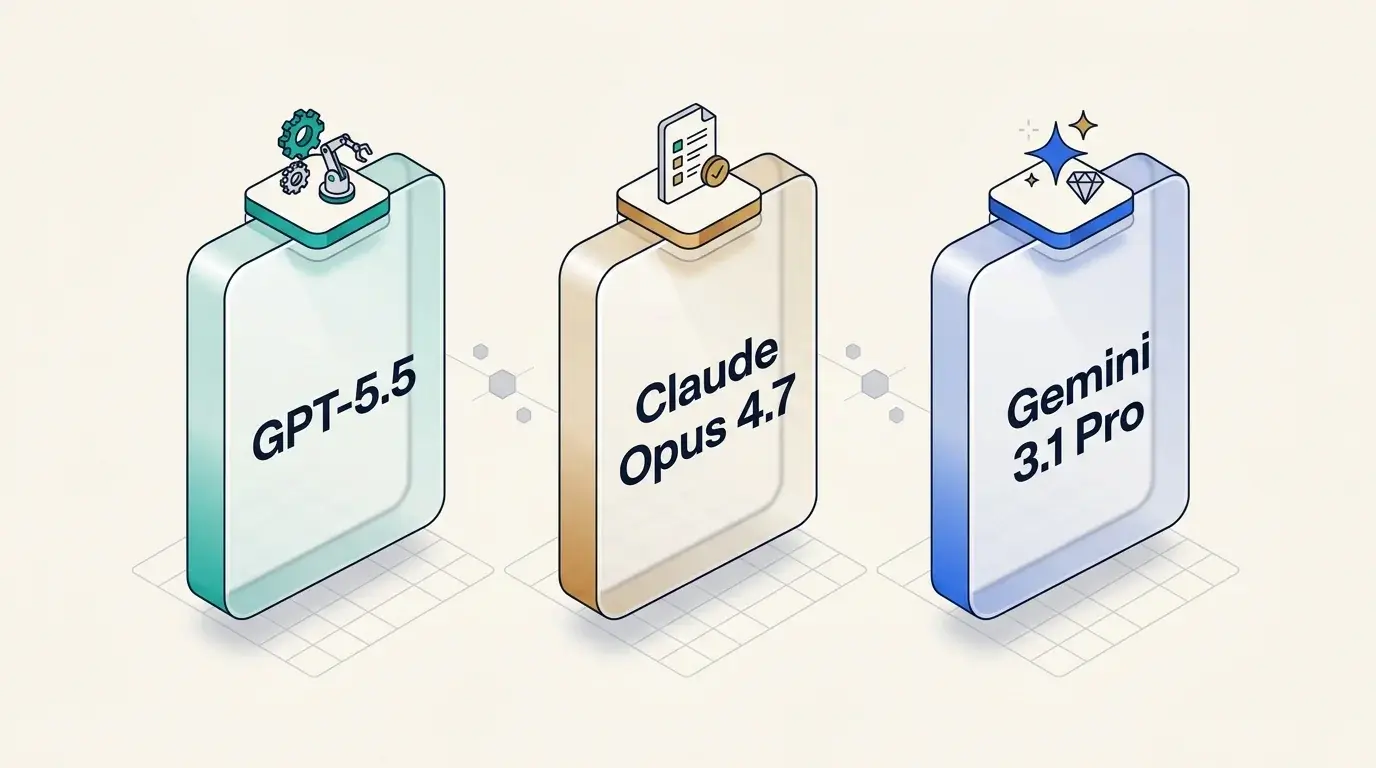
In 2026, the three biggest AI players made a bet on cybersecurity — and each chose a fundamentally different strategy. OpenAI built a specialized "permissive" model with verified access. Anthropic divided the market into public Opus and private Mythos with different permission levels. Google abandoned a specialized cyber-model altogether, betting on an agent ecosystem with Gemini, Mandiant, and Wiz. Which strategy is right depends on who you are and what you need.
📌 AI in Cybersecurity 2026 Series
- Part 1. GPT-5.5-Cyber, Daybreak, and Patch the Planet Architecture — read the article.
- Part 2. How GPT-5.5-Cyber Helps Find Vulnerabilities and Analyze Code — read the article.
- Part 3. You are currently reading this article.
⚡ TL;DR
- 🔴 GPT-5.5-Cyber (OpenAI): not a new model — a less restricted GPT-5.5 for verified defenders. CyberGym 85.6%, ExploitGym 39.5%. Strong for authorized red teams and full exploit workflows. Closed to most.
- 🟣 Claude Opus 4.8 (Anthropic): publicly available, lowest hallucination rate among tested models (~4× less than Opus 4.7). Strong for static code analysis, vulnerability triage, threat modeling. Does not perform runtime exploitation. Most honest about its limitations.
- 🔵 Gemini + Google AI Threat Defense: not a specialized cyber-model, but an agent platform — Gemini 3.1 Pro + Mandiant (threat intel) + Wiz (cloud exposure) + CodeMender (AI patching). Strongest for enterprise SOC and cloud-native organizations with large data volumes.
- ⚠️ Closed Frontier: Claude Mythos (Project Glasswing) and GPT-5.5-Cyber — the most powerful cyber capabilities — are not publicly available. For the rest, there are real and useful alternatives.
- 🎯 What you will get: an honest comparison of three strategies with real benchmarks, choice scenarios for different roles, and practical limitations of each approach
📚 Article Contents
🔐 Why Cybersecurity Requires a Special Approach from AI
Cybersecurity tasks are fundamentally different from most other AI use cases. It's not about the quality of text generation or the accuracy of an answer to an academic question. There are several specific requirements that determine why universal models without additional tuning are often inconvenient for security work.
Dual-use by Nature
Every cybersecurity task has a mirror side. Vulnerability discovery is useful for defenders and attackers simultaneously. Malware analysis helps IDS systems and malicious software authors. Reverse engineering is needed by security researchers and exploit developers. Therefore, universal models have built-in classifiers that reject these requests regardless of intent — and this significantly limits their usefulness for legitimate defenders.
The Difference Between Static and Dynamic Analysis
Reading code and finding potential vulnerabilities is one task. Running an exploit against a live system and confirming that the vulnerability is truly exploitable is fundamentally different. Most AI models, including Claude Opus 4.8, stop at the first level. GPT-5.5-Cyber, for verified actors, moves to the second. This is an important distinction for choosing a tool.
The Cost of Error — Hallucination in a Security Context
If an AI model hallucinates in a recipe response, you get a bad meal. If it hallucinates in vulnerability assessment, you either waste resources on a false positive or, worse, miss a real vulnerability by receiving a false negative with a confident model response. This is precisely why the low hallucination rate in Claude Opus 4.8 (Anthropic System Card, May 2026) is a practically important characteristic, not just an academic benchmark.
🗺️ Three Strategies: OpenAI, Anthropic, and Google Chose Different Paths
The most important insight from the 2026 comparison is that it's not a competition of "whose model knows CVEs better." The three major AI players made fundamentally different diagnoses of the problem and offered fundamentally different remedies. To choose the right tool, you first need to understand what problem each company is actually trying to solve.
🔴 OpenAI: The Problem is Classifiers, The Solution is Verified Access
OpenAI starts with a specific diagnosis: frontier AI models are already powerful enough for security work — but overly cautious security classifiers block legitimate defenders along with attackers. The solution: don't build a new model, but manageably open up the existing one for verified actors.
This is embodied in a three-tiered access architecture, where each tier is the same GPT-5.5 "brain," but with a different permission layer:
- GPT-5.5 (Standard) — for everyone; classifiers reject exploit requests, penetration testing workflows, malware PoCs
- GPT-5.5 with Trusted Access for Cyber (TAC) — for verified defenders after identity verification or corporate attestation; classifiers allow PoCs, vulnerability research, malware analysis
- GPT-5.5-Cyber — for a limited circle of Daybreak partners; full exploit workflow on authorized targets
OpenAI itself stated its bet in its official blog: "Scale the number of trusted defenders who have access to the most capable AI, while continuing to restrict access for malicious actors" (OpenAI, May 7, 2026). That is, scaling trust, not a technical breakthrough.
The strength of the approach: simplicity for those already inside — no new model, just a change in permissions. The weakness: verification is the bottleneck. TAC requires individual verification or corporate attestation; GPT-5.5-Cyber is completely unavailable without a Daybreak partnership. Most defenders in the world are outside this circle.
🟣 Anthropic: The Problem is Safety vs. Capability, The Solution is a Strict Two-Tier Boundary
Anthropic chose a strategically different approach: instead of "opening up one model for verified users," they built two parallel products with fundamentally different security profiles, with a strict, publicly declared boundary between them.
Claude Opus 4.8 — a public model for all defenders — is intentionally limited in offensive cyber capabilities. Anthropic explicitly states in its system card that during training, they "experimented with efforts to differentially reduce the model's cyber capabilities" and implemented runtime safeguards to block prohibited cybersecurity use (Opus 4.8 System Card). This is not a flaw — it's a conscious decision.
Claude Mythos Preview (Project Glasswing) — a closed frontier with qualitatively different capabilities: the first AI to complete a 32-step corporate network attack simulation, find a 27-year-old bug in OpenBSD, and discover a 17-year-old RCE vulnerability in FreeBSD. It is not publicly available. It is used by a limited circle of trusted organizations — primarily government and defense structures.
Anthropic's strategic logic: not a single permission scale, but two separate products. Opus 4.8 is maximally useful for defensive security and will never perform a full exploitation workflow. Mythos is for frontier capabilities where the risk is acceptable only in a strictly controlled environment. No amount of verification will move you from one to the other — they are different models, not different access levels to the same one.
Practical implication: Anthropic wins where reliability and minimal false positives are important. Opus 4.8 is ~4 times less likely than Opus 4.7 to confidentially err in vulnerability assessment (MindFort AI). For a SOC analyst who cannot afford an endless stream of irrelevant alerts, this is more important than benchmark percentages.
🔵 Google: The Problem is Data, The Solution is an Ecosystem, Not a Model
Google made a fundamentally different diagnosis: the cybersecurity problem isn't that models aren't "smart" enough or are overly restricted. The problem is that even the smartest model doesn't know what's happening on your network right now. Threat intelligence becomes outdated within hours. Cloud configurations change every minute. No LLM without real data can provide a contextualized answer.
The solution: don't build a specialized cyber-model, but connect AI reasoning with assets that carry real data. Google AI Threat Defense combines four components:
- Gemini 3.1 Pro — reasoning and code generation; a universal model, not cyber-specific
- Mandiant (acquired 2022, $5.4 billion) — frontline threat intelligence from thousands of incident response investigations; real TTPs, IOCs, attacker attributions
- Wiz (acquired March 2026, $32 billion) — cloud exposure mapping; understands cloud infrastructure, IAM permissions, and misconfigurations in real-time
- CodeMender (Google DeepMind, October 2025) — AI patching agent; not only finds vulnerabilities but immediately generates a patch as a PR in your IDE
Google directly contrasted itself with competitors: "Unlike other model providers that simply hand security teams a massive, unprioritized list of AI-generated alerts, we deliver prioritized fixes to accelerate remediation" (Google Cloud Blog, May 27, 2026). And reinforced its strategic choice at Google Cloud Next '26: "Instead of a dedicated cyber-model, an army of agents on top of universal Gemini and Mandiant telemetry" (Google Cloud Next '26 recap).
The strength: Mandiant-contextualized analytics — something GPT-5.5-Cyber and Claude Opus 4.8 physically cannot replicate without real threat intelligence data. Sec-Gemini v1 outperforms competitors on CTI-MCQ by 11% and CTI-Root Cause Mapping by 10.5% (Google Blog) — but this isn't a "better model," it's a "better model plus better data." The weakness: it's an enterprise platform with a corresponding level of complexity and cost. It's practically unavailable to individual researchers or small teams.
Three Different Questions — Three Different Answers
To summarize the strategies in one sentence each:
| Company |
The Question They Are Solving |
The Answer |
Who This Is Right For |
| OpenAI |
"How can we give verified defenders more than the general user?" |
The same model, different classifiers based on verification level |
Verified red teams and penetration testing organizations |
| Anthropic |
"How can we maximally help defenders without risking helping attackers?" |
Two models with a strict boundary: a public, offensively limited one + a closed frontier one |
AppSec, SOC analysts, security researchers who value reliability |
| Google |
"How can we make AI analytics contextualized, rather than isolated from the real environment?" |
An agent platform: Gemini + Mandiant + Wiz + CodeMender |
Enterprise SOC, cloud-native organizations with a large security stack |
Understanding these differences is a prerequisite for choosing the right tool. The following sections will detail the strengths and weaknesses of each approach with specific tasks.
🔴 GPT-5.5-Cyber: Strengths and Where It Truly Excels
GPT-5.5-Cyber is the right choice in very specific scenarios. The wrong choice is to think it's "generally the best model for cybersecurity."
Where GPT-5.5-Cyber Truly Excels
Authorized red teaming and penetration testing. If you need a full exploit workflow on an authorized target — from fingerprinting to post-exploitation — GPT-5.5-Cyber is the only one of the three that will execute it without stopping at a "defensive" response. This is precisely the difference demonstrated by the CVE-2025-55182 example in the first article of the series.
Automated vulnerability discovery in large codebases. GPT-5.5 (and GPT-5.5-Cyber) scores 88.1% on OpenAI's internal CTF benchmark and 81.8% on CyberGym (official GPT-5.5 release). For context, Claude Opus 4.7 on the same CyberGym scored 73.1%. This is a significant difference.
Reasoning and planning for complex multi-step attacks. GPT-5.5 on Terminal-Bench 2.0 (complex command-line workflows with planning and coordination) scores 82.7% compared to 69.4% for Claude Opus 4.7 and 68.5% for Gemini 3.1 Pro. This means for tasks requiring long-term planning and step execution — GPT-5.5 leads.
Long context. GPT-5.5 with a 1M token window and strong results on long-context benchmarks (Graphwalks BFS 1M: 45.4%) allows for analysis of large codebases without chunking. For analyzing large projects, this is a practical advantage.
Where GPT-5.5-Cyber is Not the Right Choice
For most defenders, it's simply unavailable. GPT-5.5-Cyber is only for a limited circle of verified Daybreak partners. GPT-5.5 with Trusted Access for Cyber (TAC) is a broader access level, but also requires verification. If you don't have a partnership with Daybreak and haven't passed TAC verification — you simply won't have access to it. A comparison of "which model is better" is meaningless if you cannot use one of the models being compared.
For static code review and vulnerability triage. Here, GPT-5.5-Cyber has no practical advantage over Claude Opus 4.8 — and may be worse due to a higher hallucination rate in the absence of external context (without browsing, GPT-5.5 shows an 86% hallucination rate on AA-Omniscience).
API cost: $5/1M input, $30/1M output (OpenAI pricing).
🟣 Claude Opus 4.8: Who is it the Right Choice For
Claude Opus 4.8 is the only one of the three models that Anthropic explicitly describes as "our most capable publicly available option" for security work, while honestly outlining the boundaries between the public model and the closed frontier (Mythos).
Where Claude Opus 4.8 Really Wins
Lowest hallucination rate among tested models. Anthropic reports that Opus 4.8 is ~4 times less likely than Opus 4.7 to overlook flaws in its own code without comment, with a 10-fold drop in overconfidence (MindFort AI, May 2026). In a security context, this is critical: a model that doesn't confidently label a non-exploitable finding as exploitable is worth more in an SOC than a model that scores a few benchmark points higher but generates confident false positives.
Static code analysis and vulnerability triage. Claude Opus 4.8 excels at reading CVEs and patch diffs, identifying auth bypasses, injection, broken access control, and business-logic bugs during code review, and composing threat models. TrendAI (Trend Micro) specifically chose Opus 4.8 through the Claude Cyber Verification Program for its AI-assisted vulnerability management (PR Newswire, May 28, 2026).
The "most honest" model regarding its own limitations. The Opus 4.8 system card directly states: the model "does not test software in runtime, which means it cannot confirm whether a vulnerability is actually exploitable." This is an honest position that helps the security team build the right workflow—without illusions about the model being capable of more than it actually is.
Publicly available without verification. Claude Opus 4.8 is available through the standard API and claude.ai—without any special verification programs or partnerships. This is a practical advantage for most organizations, especially smaller teams without the resources to go through TAC or Daybreak.
Where Claude Opus 4.8 is Not the Right Choice
Runtime exploitation is not its task at all. The model does not perform runtime tests and does not confirm exploitability against live systems. This is a conscious decision by Anthropic: Opus 4.8 "doesn't test software in runtime." For authorized penetration testing, you need GPT-5.5 with TAC or GPT-5.5-Cyber, not Opus 4.8.
Autonomous vulnerability discovery at scale. Here, Anthropic reserves this role for Mythos (Project Glasswing), not Opus. Mythos on the AISI CTF benchmark: 73% success rate at expert-level CTFs. Opus 4.8 is on a different level of capability in this regard.
API Price: $5/1M input, $25/1M output (Anthropic pricing). Similar to GPT-5.5 in price, but cheaper on output.
Closed Frontier: Claude Mythos (Project Glasswing)
For a complete picture—Anthropic also has a frontier cyber model, not publicly available. Claude Mythos Preview (Project Glasswing) is the first AI to complete AISI's 32-step corporate network attack simulation end-to-end (3 out of 10 attempts), found a 27-year-old TCP SACK bug in OpenBSD, and CVE-2026-4747 (a 17-year-old RCE vulnerability in FreeBSD) (MindFort AI). Do not compare Opus 4.8 with Mythos—they are fundamentally different levels of access and capabilities.
🔵 Gemini + Google AI Threat Defense: An Agent Platform Instead of a Model
Google has made a bet that seems counterintuitive against competitors' specialized cyber models: no dedicated cybersecurity model—instead, an agent platform built on top of the universal Gemini 3.1 Pro with real security assets.
Google AI Threat Defense Architecture (May 27, 2026)
Google AI Threat Defense is a platform that combines four assets (Google Cloud Blog):
- Gemini 3.1 Pro—reasoning layer and code generation for the entire platform
- Wiz (acquired for $32 billion in March 2026)—cloud exposure mapping and risk prioritization; understands cloud infrastructure, access rights, misconfigurations
- Mandiant (acquired in 2022)—frontline threat intelligence; real data on attackers, TTPs, IOCs from thousands of incident response investigations
- CodeMender (Google DeepMind, October 2025)—AI agent for generating patches directly in the developer's IDE or CLI
Workflow: Prepare → Scan and Prioritize → Remediate → Monitor. Unlike competitors who provide a long list of findings, Google focuses on prioritized fixes—not just "find," but "find and immediately propose a fix" (Help Net Security).
Where Gemini + Google AI Threat Defense Really Wins
Enterprise SOC with large data volumes and distributed infrastructure. The combination of Mandiant threat intelligence (real IOCs and TTPs) with Gemini reasoning and Wiz cloud context provides something that GPT-5.5-Cyber and Claude Opus 4.8 cannot replicate on their own: contextualized analytics—not just "this is vulnerability CVE-X," but "this vulnerability CVE-X is being used by the Salt Typhoon group, here are their IOCs in your logs from the last 14 days."
Incident Root Cause Analysis. Sec-Gemini v1 outperforms other models on CTI-MCQ by 11% and CTI-Root Cause Mapping by 10.5% (Google Blog, April 2026). This is a specialized metric for incident investigation—where and why the breach occurred.
Cloud-native organizations on Google Cloud. Wiz integration provides a native view of cloud exposure, IAM permissions, misconfigurations—in conjunction with Gemini reasoning and Mandiant playbooks. For organizations where most of their infrastructure is on Google Cloud, this integration is practically invaluable.
Automated patching via CodeMender. Finding a vulnerability is half the battle. CodeMender generates a patch directly in the developer's IDE or CLI and submits it as a PR that can be merged. This is "from finding to fix" within a single platform—competitors cannot do this.
Where Gemini + Google AI Threat Defense is Not the Right Choice
If you need a model, not a platform. Google AI Threat Defense is an enterprise product with the complexity of implementation on a corresponding scale. It is not suitable for a small startup or an individual security researcher, neither functionally nor in terms of price.
If you need authorized penetration testing. Gemini 3.1 Pro, without special cyber permissions, rejects exploit requests similarly to base GPT-5.5. The platform is focused on defensive security, not red team workflows.
Vendor lock-in. Wiz integration is most valuable on Google Cloud. Multi-cloud organizations or those on AWS/Azure will get less practical value from the cloud-exposure component.
📊 Comparative Table by Key Criteria
| Criterion |
GPT-5.5-Cyber |
Claude Opus 4.8 |
Gemini + AI Threat Defense |
| CyberGym (benchmark) |
85.6% |
~66–73% (Opus 4.6/4.7 data; 4.8 is higher) |
73.1% (Gemini 3.1 Pro, GPT-5.5 system card data) |
| Terminal-Bench 2.0 |
82.7% (GPT-5.5 base) |
69.4% (Opus 4.7) |
68.5% (Gemini 3.1 Pro) |
| Hallucination rate |
High without browsing (~86% AA-Omniscience) |
✅ Lowest among tested (~4× lower than Opus 4.7) |
Medium; Mandiant context reduces it |
| Static code analysis |
Strong |
✅ Very strong + minimal false positives |
Strong (especially with Wiz context) |
| Runtime exploitation |
✅ Yes (for verified) |
❌ No (static only) |
❌ No (defensive-only) |
| Threat Intelligence |
Via web search |
Via web search |
✅ Natively: Mandiant frontline data |
| AI-driven patching |
Manual patch generation |
Manual patch generation |
✅ CodeMender—automatic PR |
| Incident root cause |
Good |
Good |
✅ Strongest (CTI-RCM +10.5%) |
| Availability |
🔴 Only for verified Daybreak or TAC partners |
✅ Public API without verification |
🟡 Enterprise platform; not for individuals |
| Price (estimated) |
$5/$30 per 1M (API) |
$5/$25 per 1M (API) |
Enterprise pricing; not public |
| Long context |
✅ 1M tokens |
200K tokens |
1M+ tokens (Gemini 3.1 Pro) |
⚠️ Important note on benchmarks: all figures provided are vendor-stated or from independent but isolated sources. Direct comparison of models under the same conditions and on the same benchmark is only possible for GPT-5.5 vs Claude Opus 4.7 on CyberGym (official GPT-5.5 release). Other comparisons are between different measurement methodologies.
🎯 Which Model to Choose: Scenarios for Different Roles
Pentester / Red Teamer
GPT-5.5 with Trusted Access for Cyber — if verification is passed and the task includes authorized exploitation. Apply via chatgpt.com/cyber. If verification is unavailable or the task is limited to code review and vulnerability documentation — Claude Opus 4.8 via standard API with a lower risk of false positives.
SOC Analyst / Incident Response
Google AI Threat Defense — if you are in a large organization with a Google Cloud infrastructure and require Mandiant-contextualized threat intelligence. For smaller teams or those not on Google Cloud — Claude Opus 4.8 for incident analysis and threat modeling, GPT-5.5 with browsing for quick context on specific CVEs.
AppSec / Developer Security
Claude Opus 4.8 — for code review, vulnerability triage, and threat modeling in the SDLC. The lowest hallucination rate minimizes false positives, which is critical for developers who don't need another tool generating an endless list of irrelevant warnings. CodeMender (via Google AI Threat Defense) if an automated patching workflow is needed.
Security Researcher / Bug Bounty
Claude Opus 4.8 for initial code analysis and CVE context. GPT-5.5 with TAC if deeper interaction with complex technical artifacts is required. Remember: bug bounty programs have specific rules regarding tools — check the permissibility of AI-assisted discovery in a particular program.
CISO / Security Architecture
Google AI Threat Defense for enterprise-scale and strategic visibility. A separate Claude Opus 4.8 API subscription for ad-hoc analysis and threat modeling at the architecture level. GPT-5.5 with TAC for the red team if it exists and is verified.
✅ Conclusions
The main conclusion of 2026: the question "which AI model is better for cybersecurity" is incorrect. The correct question is "what task do I need to solve and who am I."
- 🔴 GPT-5.5-Cyber — best for authorized exploitation and the full penetration testing workflow. Unavailable to most. If you have access — it's the most powerful tool for red team work among publicly known options.
- 🟣 Claude Opus 4.8 — best for static code analysis, vulnerability triage, and any task where the cost of a false positive is high. Publicly available, most honest about its limitations. The right choice for most AppSec and security research teams.
- 🔵 Gemini + Google AI Threat Defense — best for enterprise SOC, incident response, and cloud-native organizations requiring Mandiant-contextualized threat intelligence and automated patching. Not for individual researchers and small teams.
And one caveat that unites all three: the most powerful cyber capabilities of 2026 — Claude Mythos and GPT-5.5-Cyber in their full scope — are not publicly available. For organizations without access to them, there are real and useful alternatives. But it's worth understanding: these public alternatives are a qualitatively different level of capability, not the same thing.
In the third article of the series — a detailed technical breakdown: how exactly these models find OWASP Top 10 vulnerabilities, analyze malware, and implement an agent-based vulnerability discovery workflow.
❓ FAQ
Can Claude Opus 4.8 find vulnerabilities better than GPT-5.5-Cyber?
It depends on the type of task. For static code analysis and vulnerability triage, Claude Opus 4.8 can be *practically* more useful due to a significantly lower level of hallucinations — fewer false positives mean less team time spent verifying irrelevant findings. For exploit generation and the CyberGym benchmark, GPT-5.5 and GPT-5.5-Cyber have an advantage (81.8% vs ~73.1% for Claude Opus 4.7). But if GPT-5.5-Cyber is unavailable to you due to the lack of TAC verification, this comparison is academic. Sources: OpenAI GPT-5.5 Release, MindFort AI Analysis of Opus 4.8.
Is a separate cyber model needed, or is a universal model sufficient?
Google proves that it's possible to do without one — but with an important caveat. Google AI Threat Defense compensates for the lack of a cyber-specific model with real security assets: Mandiant threat intel and Wiz cloud context. Without these assets, the universal Gemini 3.1 Pro behaves the same as any general model on exploit requests — it refuses. So the answer is: "a special model is not needed if there are specialized data and context." Source: Google Cloud Blog.
What is Claude Mythos and why is it not in the comparison?
Claude Mythos Preview (Project Glasswing) is Anthropic's most powerful cyber capability, not publicly available. It is used by a limited circle of trusted organizations. At AISI CTF: 73% success rate on expert-level challenges, first to complete a 32-step corporate network attack simulation. Found a 27-year-old bug in OpenBSD and a 17-year-old RCE in FreeBSD. Comparing it to public models is incorrect — they are different categories of access. More details: MindStudio Analysis.
Are Ukrainian SOC teams using these models?
There is no public data on specific Ukrainian security vendors officially using GPT-5.5-Cyber or Google AI Threat Defense. Claude Opus 4.8 is available via standard API without geographical restrictions and is the most practical option for Ukrainian security teams right now: public access, no special verification, good static analysis. Google AI Threat Defense is geared towards large enterprises — for Ukrainian MSSPs and corporate SOC teams, it is a potentially relevant option provided they have Google Cloud infrastructure.
📚 Sources