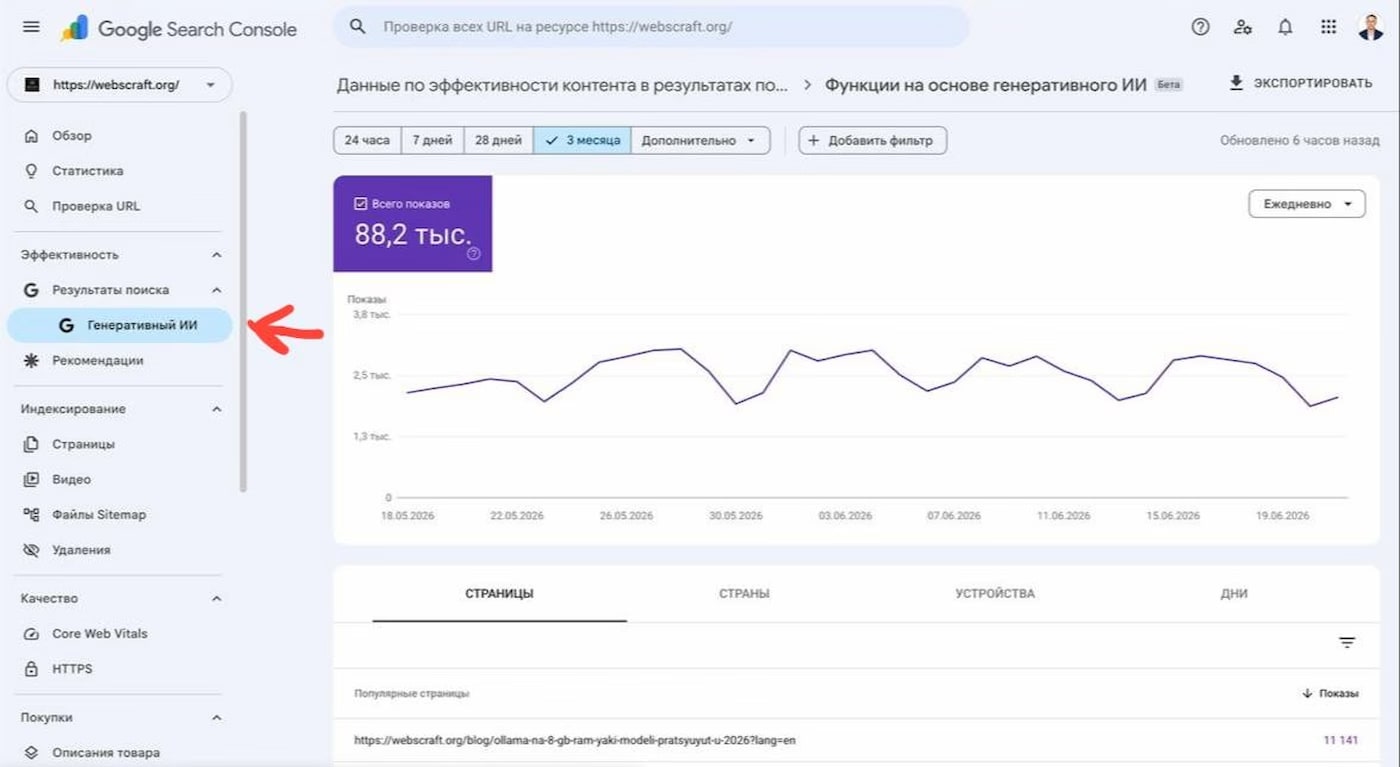
On June 3, 2026, Google launched a separate "Generative AI" report in GSC — for the first time, AI impressions are separated from classic organic search.
The report only shows Impressions — clicks, CTR, and queries are not yet available.
Data starts from May 18, 2026 — no retroactive filling.
Initially available only for a portion of sites in the UK — global rollout expected later.
A new toggle allows sites to opt out of AI responses without penalty to organic ranking.
If you've been trying to figure out for months how many of your Google impressions actually come from AI Overviews and how many from classic organic search, then on June 3, 2026, Google officially announced the Search Generative AI Performance Reports. A separate "Generative AI" report has appeared in Google Search Console — the first official tool that allows you to separate AI visibility from traditional search.
This is not a cosmetic update. For any site that relies on organic traffic — from technical blogs to large publishers — this change alters the logic of analysis. I'm already writing about how AI Overviews affect zero-click searches and traffic, and this report is the first tool that allows you to measure this impact directly. Let's break down all the details.
Why Google Separated AI Traffic into a Separate Report — and Why It Happened in the UK
Before June 3, 2026, data from AI Overviews and AI Mode was simply "buried" in the general Performance Report. Impressions from generative features were mixed with clicks on blue links — and it was impossible to separate one from the other. SEO analysts had been asking Google to fix this for years, especially after AI Mode confirmed at the beginning of 2026 that all its impressions and clicks were included in the general report without any labeling.
But the main impetus wasn't Google's kindness, but regulatory pressure. The report's rollout began precisely in the UK — and this is no coincidence. The UK Competition and Markets Authority (CMA) mandated Google to implement these tools as part of the Digital Markets, Competition and Consumers Act 2024. The penalty for non-compliance is up to 10% of the company's global annual turnover. The CMA called this package a "world first": for the first time, a search engine is legally obliged to give publishers real control over how their content is used in AI responses.
Meanwhile, Microsoft launched AI Performance in Bing Webmaster Tools on February 10, 2026 — almost four months before Google. Competition and regulation together accelerated what Google had been postponing for years.
Key point: the new report is not new data. Google confirmed that AI impressions were always included in the general Performance Report. Now you can just see them separately. The aggregated site metric will not change.
Anatomy of the Report: Which Metrics Are Present, Which Are Not — and What "May 18th" Means
The report is divided into two separate sections: Generative AI in Search (AI Overviews and AI Mode) and Generative AI in Discover. This is important because the surfaces behave fundamentally differently: Discover is a personalized feed that drives actual traffic on mobile, while AI Mode is a conversational interface where outbound clicks are becoming increasingly rare.
Available metrics in the report:
Impressions — how many times your site's URL appeared in generative Search and Discover features
Pages — which specific URLs were included in AI responses
Countries — the geography of your AI visibility
Devices — mobile or desktop (for Search only)
Dates — hourly, daily, weekly, and monthly granularity
And now, what the report does not have: clicks, CTR, average position, query data. This means you can see that you are being shown in AI — but you don't know if users are clicking through to the site from there. Google promises "additional metrics later," but without specific timelines.
An important technical detail that most reviews don't explain: the data starts from May 18, 2026 — with no retroactive filling. This starting point falls right within the window of Google's May Core Update (started May 21, ended June 2). This means the first few weeks of data in the report should be interpreted with caution: fluctuations in impressions during this period could reflect both changes in AI algorithms and turbulence from the Core Update.
For scale: according to SEO consultant Brodie Clark, a large UK website received about 120,000 AI impressions daily, which accounted for approximately 10% of all its Search impressions during the same period. For content sites in niche areas, this share can be significantly higher.
Metric
Availability in Report
Note
Impressions
✅ Yes
By pages, countries, devices, dates
Clicks
❌ No
Promised "in the future," no date
CTR
❌ No
Cannot be calculated without clicks
Average Position
❌ No
Methodology for position in AI Mode differs from organic
Queries
❌ No
Critical limitation for content strategy
AI Overviews vs AI Mode Distribution
❌ No
Data is aggregated for both surfaces together
Discover AI Data
✅ Separately
Highlighted in a separate section of the report
Search Labs / experiments
❌ Excluded
Not included in the report
Grounding as a New Signal of Authority: What the Report Actually Shows
To properly read this report, you need to understand what being included in it actually means. AI impressions in the report show which URLs Google uses for grounding its answers — that is, which pages the LLM model considers authoritative enough to rely on when generating a response. This is a signal of authority at a level of detail that simply didn't exist before.
But there's an important trap here. A single query in AI Mode can simultaneously engage content from multiple URLs through the "query fan-out" technique: Google generates multiple internal queries and aggregates answers from different sources. This complicates attribution — impressions in the report are not a direct analogue to clicks or positions in classic SEO.
The practical logic for reading the report is as follows: compare AI impressions with the classic Performance Report for the same URLs. Four scenarios arise:
High AI impressions + high organic clicks — this is your "non-commodity content": pages that work in both channels simultaneously. Protect them first and foremost.
High AI impressions + low organic clicks — "zero-click trap": Google uses your content for answers, but users don't click through. For advertising monetization, this is a problem. For branding, it might be normal.
Low AI impressions + high clicks — classic organic that is not yet of interest to AI. Figure out why: perhaps the content structure is not suitable for grounding.
Low AI impressions + low clicks — the page is weak in both dimensions, requiring revision or deletion.
How to Use the New Report in Practice: 5 Checks for SEO and GEO
Most website owners will open the new report once, look at the numbers, and close it. In reality, the greatest value appears when the data starts to be compared with the classic Performance Report.
1. Find pages with high AI impressions. Sort the report by the number of impressions and identify the URLs most frequently used by Google's generative systems.
2. Compare them with organic clicks. If a page has many AI impressions and few clicks, this is a signal for analysis. The content might be actively used in AI responses but bring almost no traffic.
3. Identify the pattern of successful pages. Look at what unites the URLs with the highest AI visibility: structure, format, depth of material, use of facts, tables, or FAQ blocks.
4. Track changes after content updates. If, after revising an article, its AI impressions start to grow faster than the site's average, it may indicate improved content suitability for generative search.
5. Create a separate AI Visibility Dashboard. Even a simple report in Looker Studio or Google Sheets will help track the dynamics of AI impressions in parallel with organic clicks and conversions.
The main rule: do not evaluate AI impressions in isolation. They only become useful when considered alongside traffic, user engagement, and business metrics.
GEO Instead of Classic SEO: How to Adapt Content to the Logic of Grounding
I've already written separately about GEO (Generative Engine Optimization) and its differences from classic SEO. But the appearance of a new report in Google Search Console adds a practical dimension to this topic. For the first time, website owners have the opportunity to track AI impressions separately from classic organic and assess how content changes affect visibility in Google's generative features.
It's important to understand: an increase in AI impressions is not direct proof of successful GEO optimization. Impression rates can be influenced by algorithm changes, query popularity, or the expansion of Google's AI features. However, the new report provides one of the first indicators that allows linking content changes to AI visibility dynamics.
What principles are most often associated with content that is successfully used in grounding and AI responses?
Self-contained paragraphs. Modern LLM systems work with content in fragments. Each paragraph should contain a complete thought and be understandable without needing to read several preceding sections. Phrasing like "as mentioned above" or "as we have already seen" creates additional context dependency.
Explicitly named entities. Instead of "he said" or "the company reported," it's better to use full names and roles: "John Mueller, a Google representative, said" or "Google reported." This reduces ambiguity and helps algorithms more accurately link facts to specific people, companies, or products.
Factual density. Specific numbers, dates, statistics, quotes, and sources are usually more valuable to generative systems than vague formulations like "some experts believe" or "studies show." The easier it is to verify a claim, the higher the probability of it being used as a source.
Clear answer structure. Blocks built on the "question → answer → confirmation" scheme align well with the format of generative answers. FAQ sections, lists, tables, and structured data from Schema.org help search engines interpret page content more quickly.
Authoritative links and sources. Links to official documents, research, technical documentation, and primary sources increase trust in the material. For AI systems, it's important not only to have the statement itself but also the ability to trace its origin.
There's another side to the coin. A high number of AI impressions doesn't always mean business success. If a site is monetized through advertising, a user might get an answer directly in AI Overviews or AI Mode and never click through to the page. In such a case, the content becomes part of the answer but doesn't generate traffic.
This is precisely why the new Google report should be used not as a success metric, but as an additional analysis tool. It helps understand how often content is used by Google's generative systems and assess whether this visibility translates into real clicks and business results.
More on the impact of the May 2026 Core Update on rankings and AI Overviews — in a separate analysis.
What's Still Missing in the Report — and Why Bing Still Offers More Detail
Despite the importance of the new report, its current version is more of a visibility indicator than a full-fledged decision-making tool. Google has taken the first step towards AI search transparency, but a number of critical data points remain unavailable.
Clicks and CTR. The report's biggest limitation is the absence of data on clicks and CTR. Currently, site owners can see AI impressions but cannot determine if this visibility translates into actual traffic. Without these metrics, it's difficult to assess the business value of presence in AI Overviews or AI Mode.
Search Queries. The report shows pages that appear in Google's generative features but does not reveal the specific queries that lead to this. This is a significant limitation for SEO and GEO: without query data, it's hard to understand what content should be scaled or improved.
Distribution Across Different AI Surfaces. In the current implementation, data is aggregated within a single report. This makes it impossible to accurately determine whether visibility was achieved through AI Overviews, AI Mode, or other generative formats. Such detail would be much more useful for analyzing user behavior.
This is where Bing Webmaster Tools currently appears to be a more mature solution. The AI Performance Report, launched in 2026, provides a broader set of data on content interaction with Bing and Copilot's AI features. Specifically, site owners can see information about content citations in AI responses and additional signals related to page usage in generative search.
Of course, Bing lags behind Google in search market share, so absolute values cannot be directly compared. However, for understanding how generative systems use website content, Bing can already be a useful source of additional analytics.
The current Google report is likely just the first iteration. If the company continues to expand Search Console's capabilities, we can expect the appearance of additional metrics in the future that will help link AI visibility to real traffic and business results.
For now, the best approach is to analyze AI impressions alongside classic Search Console data. These numbers alone don't say much, but together they allow us to understand whether an increase in presence in AI features is accompanied by an increase in organic traffic.
Frequently Asked Questions
What are Search Generative AI Performance Reports?
Search Generative AI Performance Reports are a new report in Google Search Console that shows separate statistics for website visibility in Google's generative features. It allows analysis of which pages appear in AI responses, from which countries, and on which devices. Previously, these impressions were mixed with general Search Performance data.
How do AI impressions differ from organic impressions?
Organic impressions are the classic appearances of a page in Google search results with regular results. AI impressions are instances where a URL is used or displayed in generative features such as AI Overviews or AI Mode. In both cases, content can gain visibility, but the user interaction mechanism differs.
Why are clicks and CTR missing from the report?
The current version of the Google report primarily shows visibility, not full user behavior. Click and CTR data is not yet available, so it's impossible to accurately determine how many transitions presence in AI responses generates. Therefore, AI impressions should be analyzed alongside classic SEO metrics.
Do AI impressions affect rankings?
No, the mere appearance of a page in AI responses is not a separate ranking signal. AI impressions indicate that the content was used by Google's generative systems, but this does not mean an automatic improvement in classic search positions. Content quality, query relevance, source authority, and other SEO factors remain important.
When will the report be available for all sites?
Google is rolling out the report gradually. Initially, a limited number of sites and regions gained access, after which the company plans to expand access. Google has not yet provided an exact date for the global launch for all sites.
Conclusion
After analyzing the new Search Generative AI Performance Reports, I see this not just as another Google Search Console update, but as a change in the very approach to measuring search visibility. For the first time, Google is showing a separate signal of how content is used in generative responses, not just how it ranks in classic search results.
At the same time, I do not consider AI impressions as a new "key success metric." The report still has significant limitations: no clicks, CTR, or query data. Therefore, the mere fact of appearing in AI responses does not yet mean an increase in traffic or business results. For me, it's more of a new analytical layer that needs to be evaluated alongside classic SEO metrics.
My conclusion is this: in 2026, SEO is no longer limited to search positions. It is now important to understand not only where a page is in the search results but also whether it is becoming a source of information for AI systems. Content that has a clear structure, factual basis, understandable entities, and answers specific user queries receives a new level of visibility.
I expect Google to gradually expand this report: adding more data on user interactions, sources of AI responses, and the real value of generative traffic. But even now, this tool shows the main thing — the era when SEO was evaluated only by blue links is gradually changing.