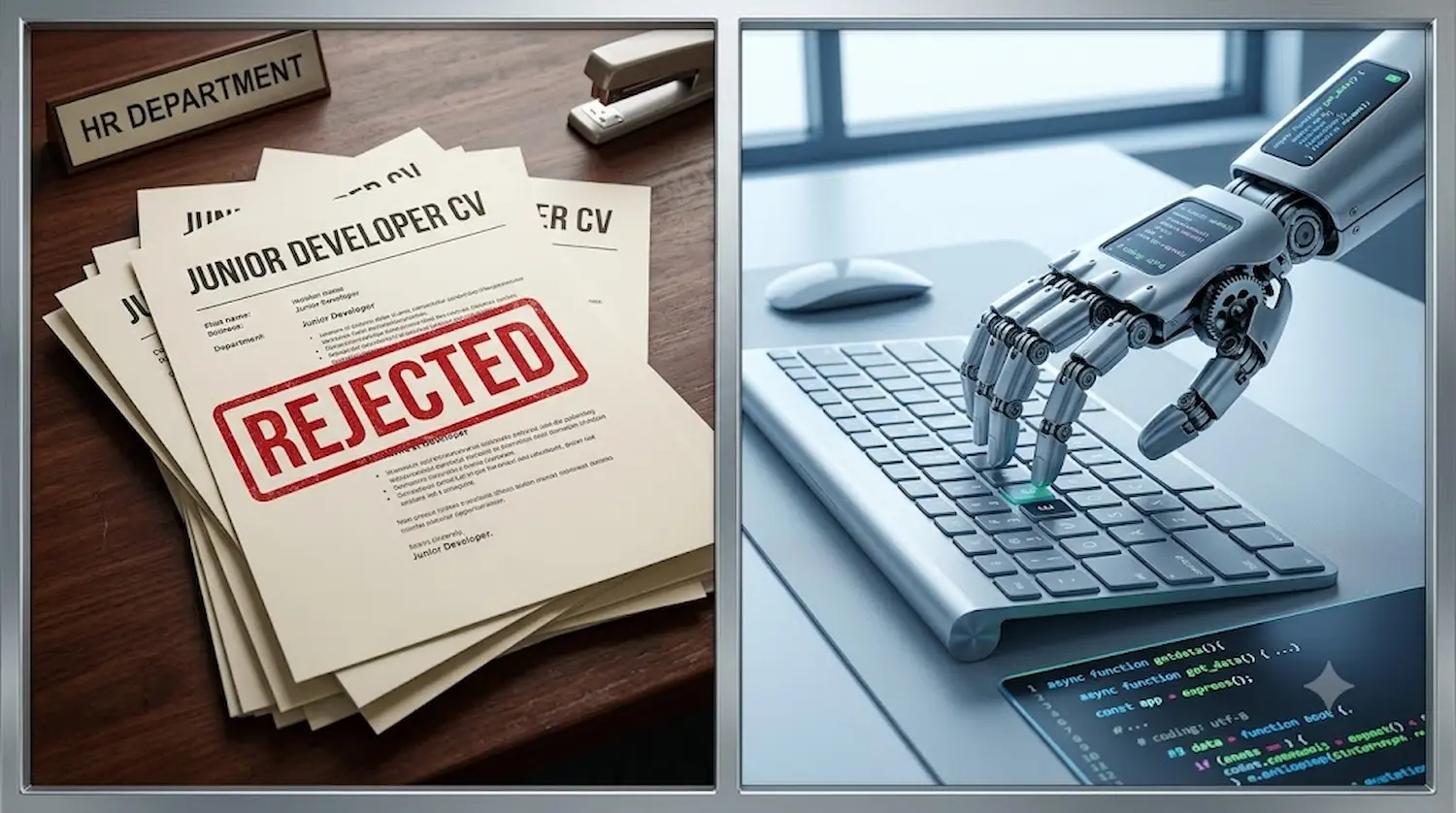
I have been managing a development team for eight years. And what is happening in the labor market now concerns me – not as an abstract piece of news, but as a business owner who sees the consequences on specific projects. Companies are massively refusing to hire juniors, replacing them with AI tools. On paper, this looks like savings. In practice, it's a time bomb that will explode in 3-5 years when it turns out there's no one to become a senior.
⚡ In a nutshell
📉 Hiring of juniors has collapsed: entry-level developer vacancies have fallen by 28–40% from their 2022 peak (Final Round AI, 2026); employment among developers aged 22–25 has decreased by almost 20% since the end of 2022 (Stanford Digital Economy Lab)
⚠️ The talent pipeline is breaking: the share of juniors among new IT hires has fallen from 15% to 7% in two years (Altersquare, 2026) — there will be no one to become a senior in 5 years
🔥 68% of seniors report burnout due to constantly checking AI code instead of developing themselves (Altersquare, 2026)
✅ There's another side: IBM, on the contrary, has tripled junior hiring by rethinking their role (statement by CHRO Nickle LaMoreaux) — and this might turn out to be the right bet
🎯 You will get: an honest data analysis, my own experience with the WebsCraft team, and specific advice on what to do if you hire developers
I've seen it happen: a real hiring story from 2026
Over the past year, several startup founder acquaintances have approached me with the same question: "Why do I need a junior for $1500 when Copilot costs $10 a month and writes code faster?" The logic is understandable. The numbers seem convincing at first glance. But each time, I saw a hidden risk in this question that isn't visible in the short term.
I was once a junior myself. In my first year on a Java project, I wrote mediocre code that senior colleagues rewrote, explaining why it was done a certain way and not another. It seemed inefficient for the company at the moment — an experienced developer spent time on reviews instead of writing their own code. But it was precisely through this process that I learned architectural solutions that are not found in any tutorial. If this stage is removed from the industry, where will seniors come from in five years?
Why companies are making this bet (and why it's attractive on paper)
Honestly, the decision to cut juniors has a rational basis, not just blind faith in hype. AI coding assistants have indeed radically changed productivity. One executive I spoke with put it directly: "Four years ago, I was that junior writing boilerplate CRUD code. Today, I see graduates unable to find their first job — not because they are unprofessional, but because the company asks: why pay a junior $90,000 when GitHub Copilot costs $10?"
The data confirms this. The adoption of AI tools among developers is almost universal: 84% of developers already use AI in their daily work according to the Stack Overflow Developer Survey 2025, which is 14 percentage points higher than in 2023 [citation:4][citation:8]. AI's productivity on real tasks has also increased dramatically: on the SWE-bench benchmark (real GitHub issues), AI went from solving 4.4% of tasks to 71.7% in just a year or two . For a business that counts every dollar, the numbers look unambiguous.
Now for the most important part — how much junior hiring has actually decreased, according to data from several independent sources.
Stanford Digital Economy Lab conducted a study based on actual ADP payroll data (not surveys, but actual salary payments for 3.5–5 million employees) and found: employment among developers aged 22–25 has fallen by almost 20% from its peak level at the end of 2022 as of July 2025. For comparison, employment among developers aged 30+ in the same AI-vulnerable professions has *increased* by 6–12% over the same period.
Indeed Hiring Lab reports: "junior developer" and "entry-level software engineer" vacancies have fallen by approximately 40% compared to the 2022 peak, while senior positions have declined much less — by approximately 19%. This means the reduction is disproportionate: it hits the entry into the profession the hardest.
A separate and very telling figure is internal data from large companies: the share of juniors among all new IT hires has fallen from 15% to approximately 7% in just two years. This means that even where companies are still hiring, they are almost twice as likely to hire people without experience.
Indicator
Value
Source
Employment of developers aged 22–25 (since end of 2022)
−20%
Stanford Digital Economy Lab (ADP payroll data)
Entry-level developer vacancies (since 2022 peak)
−28% to −40%
Indeed Hiring Lab, Final Round AI
Share of juniors among new IT hires
from 15% to 7%
Altersquare analytics, 2026
Employment of developers aged 30+ in the same professions
+6% to +12%
Stanford Digital Economy Lab
HR managers who believe AI can replace interns
70%
SHRM survey, 2024
Technical internships (compared to 2023)
−30%
Handshake
💡 Important clarification: data for "programmers" and "software developers" (a more architectural role) differs significantly. In the US, employment of "programmers" fell by 27.5% between 2023 and 2025, while "software developers" fell by only 0.3%. This confirms: AI is replacing routine code writing, not engineering thinking.
The Paradox Nobody Notices: Where Will Seniors Come From in 5 Years?
This is the weakest point of the entire "cut juniors to save money" strategy. Seniors don't appear out of thin air – they grow from juniors through years of practice, mistakes, and corrections. If a company isn't hiring anyone for entry-level positions today, in 3-5 years it will face a severe shortage of mid-level and senior developers.
The industry has been through this cycle before. After the 2008 financial crisis, companies massively froze junior hiring – it seemed like a logical decision during a period of uncertainty. But a few years later, around 2012, these same companies faced a severe shortage of developers with three to five years of experience. Because they simply didn't hire anyone at the right time. A gap formed in the talent pipeline. The same pattern is now forming again – only this time, the cause is not a crisis, but AI.
Amazon Web Services CEO Matt Garman publicly stated that replacing junior developers with AI is "one of the dumbest things I've heard." He warned that companies stopping junior hiring now are creating a dangerous gap in their talent pipeline. "If you don't have a pipeline of talent that you're building, and you don't have juniors that you're mentoring and growing, then your whole system is going to blow up at some point," Fortune quotes him as saying. This is not my theory – it's the opinion of the head of one of the largest tech companies in the world.
Forrester, in its 2026 forecast, goes even further: a 20% drop in computer science majors is expected, as applicants react to negative signals from the job market. This forms a feedback loop: fewer CS graduates today → a smaller potential pool of seniors in 5-10 years, precisely when AI can no longer compensate for the lack of human experience in complex architectural decisions.
But there is another, deeper risk that is almost never discussed. Even if companies maintain minimal junior hiring, the very *nature* of their work is changing drastically. When a newcomer, instead of writing code from scratch, immediately learns to check and correct AI-generated code, they miss the most important stage of development: the pain of mistakes, understanding the consequences of their own decisions, and searching for non-standard approaches when there is no ready-made answer.
Checking AI code is an *analyst's* skill. Creating complex systems from scratch is an *architect's* skill. If we remove the first stage, in 5 years we risk getting a generation of "super-reviewers" who can quickly fix bugs in others' code but are incapable of designing a new system when AI lacks sufficient data for prompts. And such tasks arise every time a business enters an uncharted niche.
In other words, the problem is not just the *quantity* of future seniors. The problem is their *quality*. Will an engineer who has never written a large project independently be able to create something fundamentally new beyond AI's training data? I fear the answer is no.
This echoes my recent article, where I detailed why AI coding won't make you money if you don't understand what you're building. Without a deep understanding of architecture and business context, any AI-generated code remains just a tool, not a strategy. And it is precisely this understanding that AI cannot impart to a newcomer.
AI Generates Code That Looks Correct – And That's the Most Dangerous Part
In my projects, I've repeatedly encountered situations where AI-generated code passed superficial review, looked structurally correct, and then broke in production after a few weeks. One specific case: fixing a bug with infinite re-indexing due to an @PreUpdate annotation in a Spring Boot project. AI suggested a solution that was syntactically flawless and even passed local tests. The problem turned out to be deeper – in the logic of triggers themselves and how Hibernate handles entity state during updates. This understanding comes only from experience working with a specific framework, not from generating code based on a task description.
AI doesn't know your project's business context, the history of architectural decisions, or why a particular module was written a certain way five years ago. It generates statistically plausible code based on patterns from training data – and this leads us to the key problem I detailed in the article on AI hallucinations: the model doesn't "know" facts, it predicts the most probable next token. In the context of code, this means AI writes what *usually* works in similar situations – but not what works *in your specific system* with its unique dependencies.
Therefore, experienced developers are spending more and more time not on writing code, but on checking and correcting AI-generated code. This is a fundamentally different activity that requires different skills – and, as it turns out, is differently exhausting.
Seniors as "AI Controllers": A New Kind of Burnout
68% of senior developers report burnout in 2024–2026 – and a significant portion links it precisely to the change in their role. Instead of designing systems and writing code, they spend more and more time checking AI-generated output, hunting for hidden errors and security vulnerabilities in code that "looks correct."
This is not the work people went into programming for. Reviewing others' (even AI-generated) code is a useful skill, but when it becomes the primary daily activity instead of independently developing complex systems, job satisfaction plummets. I've seen this pattern among colleagues: a person who previously enthusiastically designed architecture transforms into a constant "quality controller" of AI output – and gradually loses interest in their work.
A separate important effect that is rarely discussed: when juniors disappear from a team, seniors lose one of the most important sources of their own professional growth. Explaining architectural decisions to newcomers forces an experienced engineer to articulate their own thinking more clearly. Reviewing code from a less experienced colleague reveals hidden assumptions and encourages better documentation. Without this process, seniors also degrade and develop more slowly – it's just less noticeable than the direct reduction of juniors.
✅ What Works Better: AI as an Amplifier, Not a Replacement
It's worth providing a counter-example here that personally inspires me more than pessimistic forecasts. Under CHRO Nichole Lamoureux, IBM took the opposite path in early 2026 – tripling junior hiring while other companies were cutting back. But they did it smartly: they rethought the very role of a junior. Instead of routine coding, new hires at IBM spend more time interpreting client needs and verifying AI outputs for correctness – meaning they learn to understand business context from day one, not after years of routine work.
“The companies that will be most successful in 3-5 years are those that doubled down on hiring entry-level talent precisely during this challenging period.”
From my experience with the WebsCraft team, I'm convinced: AI works best as a tool for accelerating routine tasks – generating boilerplate code, initial documentation drafts, quick searches across large codebases. All of this used to consume hours of a junior's or mid-level developer's time. But architectural decisions, evaluating trade-offs between approaches, understanding the specifics of a client project, and responsibility for the final decision – these remain the work of a human who has gone through a path of practice and mistakes.
The formula that truly works: AI takes over routine tasks – humans retain control over complexity. Not "AI instead of a junior," but "AI as a tool that allows a junior to reach interesting and complex tasks faster, instead of writing CRUD boilerplate for years."
🎯 Conclusion: 5 Steps to Take Now
If you are a business owner or CTO – here is a practical action plan based on data and my 8 years of experience:
📊 Don't just count short-term savings. $90,000 for a junior vs. $10 for Copilot – attractive arithmetic today, but it doesn't account for the cost of a senior deficit in 3-5 years.
🔄 Rethink the junior role, don't abolish it. Instead of routine coding – learning to work with AI tools, reviewing their output, understanding business context from day one.
🏗️ Maintain a minimal talent pipeline. Even one or two juniors per team preserve the company's ability to grow its own seniors, rather than competing for scarce experienced personnel in a few years.
🧠 Monitor senior burnout. If experienced developers spend more and more time fixing AI code instead of designing systems – this is a signal to review the balance.
⚡ AI is a productivity tool, not a replacement for experience. The best results come from teams where AI accelerates routine tasks, and humans remain responsible for architecture and complex decisions.
🔮 What's next? The data doesn't yet provide a definitive answer on whether the junior position market will recover on its own, or if a senior deficit in a few years will become the industry's next crisis. But companies that are consciously investing in their talent pool now – like IBM – are making a bet that has historically paid off.
The main question: are you using AI as a replacement for human experience, or as a tool that allows it to be formed faster? The answer to this question will determine who wins the talent race in 5 years.
❓ Frequently Asked Questions (FAQ)
Will AI replace junior developers in 2026?
Partially. Data from Stanford Digital Economy Lab shows a nearly 20% decrease in employment for developers aged 22-25 since late 2022. However, category analysis shows: AI primarily replaces routine "programming" (writing boilerplate code), while roles focused on architecture and system design ("software developer") have been practically unaffected. AI is taking over not the profession as a whole, but a specific type of task.
Which companies are still hiring junior developers?
Large enterprise companies like IBM are increasing junior hiring, rethinking their role. Reductions are most noticeable among startups and companies focused solely on short-term savings. 92% of companies plan to hire new people this year – the problem isn't the overall hiring volume, but that entry-level positions are being cut.
What will the job market for programmers look like in 5 years?
Forecasts vary. The CEO of AWS publicly warns of a dangerous gap in the talent pipeline in 3-5 years. Forrester predicts a 20% decrease in CS applicants, which could exacerbate a future senior deficit. At the same time, the US Bureau of Labor Statistics predicts a 15-17% growth in software developer employment by 2033-2034. The most likely scenario is polarization: demand for specialists (AI engineers, system architects) will grow, while demand for entry-level generalists without AI skills will fall.
How can a junior developer find a job in 2026?
According to LinkedIn 2025 data, developers with AI tool skills receive offers 2.3 times faster than those who don't. The key is not to avoid AI, but to demonstrate the ability to work with it consciously: understanding when to trust AI output and when to verify it more deeply. A portfolio of real projects and practical experience are valued more than grades on a diploma alone.
Is it worth learning to be a programmer now?
Yes, but with an understanding of the new realities. The profession is not disappearing, but transforming. Demand is shifting towards engineers who can work with AI tools, understand system architecture, and business context. A pure "coder" without strategic thinking is indeed becoming less needed, but an engineer capable of designing complex systems and making data-driven decisions remains critically important.
How much does a junior developer earn in 2026?
Entry-level salaries remain stable in the Western market ($60,000–$90,000 per year in the US depending on the region), but competition for these positions has significantly increased. In Ukraine and Eastern Europe, junior developer salaries start from $800–$1500 per month, depending on the tech stack and AI tool proficiency.