
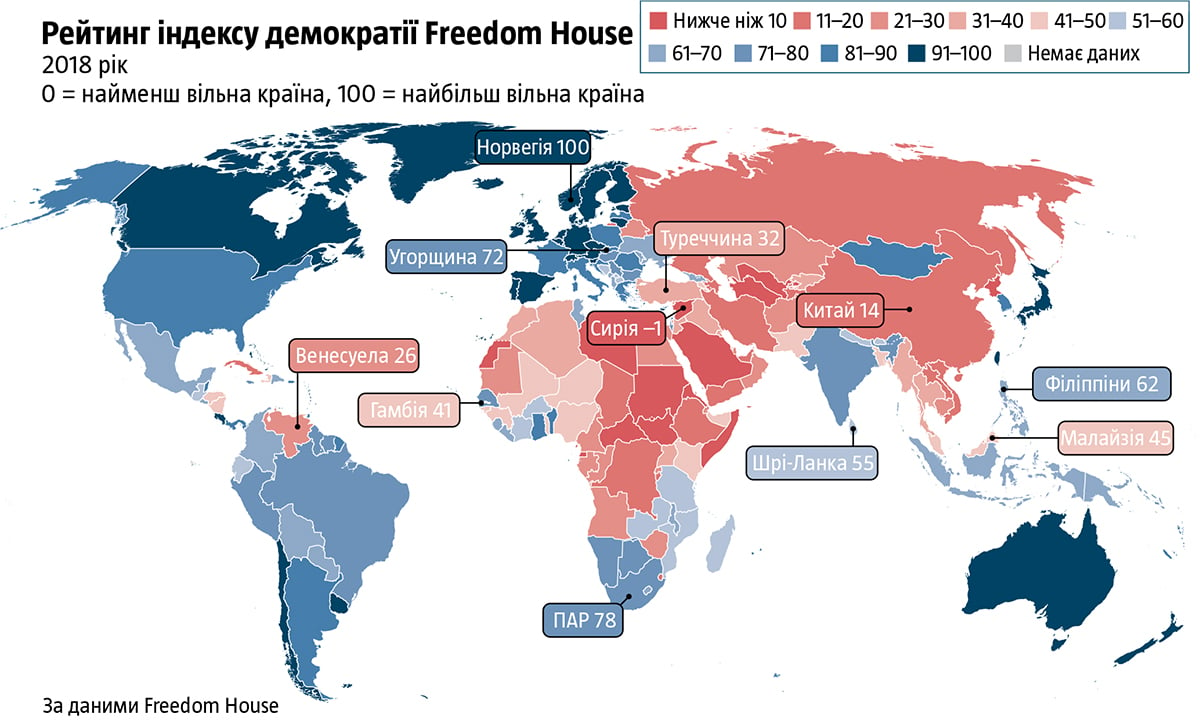
Why are democracies often wealthier than dictatorships?
The question of the connection between political systems and economic well-being has concerned researchers for centuries. Statistics show a clear pattern: democratic countries, on average, demonstrate a higher level of economic development than authoritarian regimes. But what is behind this correlation?
1. Protection of private property and the rule of law
Key factor: A stable legal system and guarantees of property.
Advantages of democracies:
• Independent courts protect property rights
• Constitutional limits on power prevent arbitrariness
• Transparent legislation creates a predictable environment for business
• Equality before the law ensures fair competition
Problems of dictatorships:
• Property can be confiscated at the will of the ruler
• Lack of independent courts
• Corruption and nepotism distort economic processes
• Instability of the regime creates uncertainty for investment
Example: Singapore and Hong Kong (until 2020) showed that authoritarian systems can be effective while maintaining the rule of law in the economic sphere.
2. Innovation and freedom of enterprise
Key factor: Creating conditions for creativity and economic experimentation.
Democratic advantages:
• Freedom of speech promotes the exchange of ideas
• Open markets stimulate competition
• Educational freedom develops human capital
• Pluralism of opinions leads to innovative solutions
Limitations of authoritarianism:
• Censorship suppresses creativity
• State control stifles entrepreneurial initiative
• Fear of repression reduces the willingness to experiment
• Centralized planning is less efficient than the market
Example: Silicon Valley arose thanks to a combination of academic freedom, venture capital, and a culture of experimentation, which is characteristic of democratic societies.
3. Long-term planning and stability of institutions
Key factor: The ability to sustain development through changes in government.
Institutional advantages:
• Regular change of power through elections ensures renewal
• A system of checks and balances prevents extremes
• Public oversight limits corruption
• Continuity of policy thanks to institutional memory
Problems of concentration of power:
• Decisions depend on the will of one person or a narrow group
• Lack of mechanisms for correcting errors
• High risks when the regime changes
• Short-term thinking for the sake of retaining power
4. Quality of human capital
Key factor: Investment in education and the development of citizens.
Democratic investments:
• Mass quality education as a political necessity
• Free access to information and knowledge
• Meritocracy in the civil service
• Social mobility through education
Authoritarian restrictions:
• Education can be perceived as a threat to the regime
• Restrictions on access to information
• Appointments based on loyalty, not competence
• Brain drain due to political restrictions
5. Efficiency of public administration
Key factor: Accountability of the government to society.
Control mechanisms in democracies:
• Free press as the "fourth estate"
• Parliamentary control over the executive branch
• Active civil society
• Regular reporting to voters
Weaknesses of autocracy:
• Lack of feedback from society
• Concealment of inefficiency and errors
• Cult of personality hinders criticism
• Corruption as a systemic problem
6. International trade and investment
Key factor: Trust of the international community.
Advantages of open systems:
• Higher confidence of foreign investors
• Participation in international economic organizations
• Access to advanced technologies
• Cultural exchange promotes innovation
Isolationist tendencies:
• Sanctions and restrictions against authoritarian regimes
• Limited access to international capital markets
• Technological restrictions and embargoes
• Capital outflow due to political risks
Exceptions and nuances
Successful authoritarian economies:
• China: Combining authoritarian politics with a market economy
• Singapore: "Enlightened dictatorship" with strong institutions
• UAE: Oil revenues + effective management
Problematic democracies:
• Greece (2010s): Debt crisis despite democracy
• Brazil: High inequality and corruption
• India: Slow pace of poverty reduction
Empirical data
Statistical facts:
• Average GDP per capita in full democracies: $47,000
• Average GDP per capita in authoritarian regimes: $12,000
• 80% of countries with incomes above $20,000 per capita are democracies
• Corruption Perception Index: democracies are on average 40% "cleaner"
Cause-and-effect relationships
Wealth → Democracy:
• A growing middle class demands political rights
• An educated population is more critical of the government
• Economic independence reduces dependence on the state
Democracy → Wealth:
• Better institutions promote growth
• Protection of property rights stimulates investment
• Competition of ideas leads to innovation
Conclusion
The link between democracy and economic prosperity is not absolute, but statistically significant.
Key mechanisms for the success of democracies:
• Protection of private property and the rule of law
• Stimulating innovation through freedom
• Long-term institutional stability
• Investment in human capital
• Accountability of the government to society
• Integration into the global economy
However, it is important to remember that democracy in itself does not guarantee prosperity. The quality of institutions, a culture of the rule of law, and effective public administration are necessary. Some authoritarian regimes can achieve impressive economic results, but in the long term, democratic systems demonstrate greater resilience and adaptability.
The main conclusion: It is not so much democracy itself that makes countries wealthier, but the quality of institutions, which are most often