Z.ai is the platform through which Zhipu AI sells its GLM models outside of China: a free chat, an OpenAI-compatible API, and a subscription for coding. The company released five versions of GLM-5 in 2026, so most reviews written in the spring are already outdated.
In short: the flagship is currently GLM-5.3 with a 1M token context. It's cheaper than Western frontier models but has its own license, service limitations, and geopolitical risks that are worth considering before making a choice.
Updated: November 10, 2026. Model prices and versions checked as of this date.
⚡ In Short
- ✅ Z.ai is the international brand of Zhipu AI: chat chat.z.ai, API api.z.ai, and GLM Coding Plan.
- ✅ Flagship: GLM-5.3, 1M token context, text-only, reasoning always enabled.
- ✅ Budget option: GLM-5.3-Flash with MIT license and image support.
- ⚠️ Chat and Agent are web interface modes. In the API, agents are assembled via standard tool calling.
- 🎯 In this article, you will learn: which GLM model to choose, how much it costs, and where Z.ai falls short compared to Western models.
📚 Article Contents
Separate articles in the cluster:
🎯 What is Z.ai in 2026
Z.ai is the international brand of the Chinese company Zhipu AI (Knowledge Atlas Technology, ticker 2513.HK). Under this brand, they operate the free chat chat.z.ai, an OpenAI-compatible API, and the GLM Coding Plan subscription for coding tools.
The main product is the GLM family of models with open weights. As of November 2026, the flagship is GLM-5.3.
Who is behind the platform
Zhipu AI was founded in 2019 by Tsinghua University professors Tang Jie and Li Jueanxi. Investors include Alibaba, Ant Group, Tencent, Meituan, Xiaomi, HongShan, and Prosperity7 Ventures (Caproasia).
On January 8, 2026, the company went public on the Hong Kong Stock Exchange, raising HK$4.35 billion (The Star). Zhipu itself calls itself the world's first public company developing foundation models.
How the lineup has changed in 2026
| Model | Release | What's New |
|---|
| GLM-5 | February | Transition to DeepSeek Sparse Attention, 744B / 40B active |
| GLM-5.1 | April | Long agent tasks |
| GLM-5.2 | June | 1M token context |
| GLM-5.3 | August | Current flagship: stronger code and long tasks |
| GLM-5.3-Flash | August | Affordable model with MIT license and native vision |
Sources: AI release tracker, Wikipedia: GLM. Prices, context, and licenses for each model are in the next section.
Why Z.ai is worth knowing for developers
- ✔️ Price. The API is noticeably cheaper than Western frontier models, and older versions of GLM-5 continue to be sold at lower prices than the flagship.
- ✔️ Open weights. Models can be run independently, but the license differs: GLM-5.3 has its own, while GLM-5.3-Flash has a standard MIT license.
- ✔️ Migration. The API is compatible with OpenAI SDK: usually, you just need to change the base_url and key.
- ⚠️ Risks. It's a Chinese company, and there are concerns about service stability under load and where your data is processed. More on this in the limitations section.
Conclusion: Z.ai is a serious alternative to Western APIs in terms of price and openness, but the choice depends on how critical service stability and data jurisdiction are for you.
🧩 The GLM Lineup: Which Model for What
Quick answer: for most tasks, start with GLM-5.3-Flash: it's cheap, has an MIT license, and understands images. Use GLM-5.3 for the most complex code and long agent tasks if its license suits you.
| Model | Use Case | Context | Input | API Price, $ per 1M (input / output) | Weight License |
|---|
| GLM-5.3 | Complex code, long agent tasks | 1M | Text | 1.40 / 4.40 | Proprietary glm-5.3 license |
| GLM-5.3-Flash | Low-cost production, images, and video | 1M | Text, images, video | 0.15 / 0.50 | MIT |
| GLM-5.2 | Previous flagship | 1M | Text | 1.40 / 4.40 | MIT |
| GLM-5 | Cheapest access to a large GLM-5 model | 200K | Text | 1.00 / 3.20 | MIT |
Prices checked on November 10, 2026, according to Developers Digest and Codersera. GLM-5.3 specs are from Z.ai documentation. The current pricing is on docs.z.ai.
What's Important to Know Before Choosing
- ✔️ GLM-5.3 is not a new architecture. The base model is the same as in GLM-5.2; all improvements were made during post-training. Z.ai claims a 50% gain on their own Z.ai Code Bench.
- ✔️ GLM-5.3-Flash is a separate model, not a cut-down flagship: 320B parameters, with 18B active, native image and video support (IntuitionLabs).
- ⚠️ GLM-5.3 License. It adds a security check from Z.ai for AI companies with revenue over $10 billion. For a regular company, this is not a limitation, but it's no longer a pure MIT license.
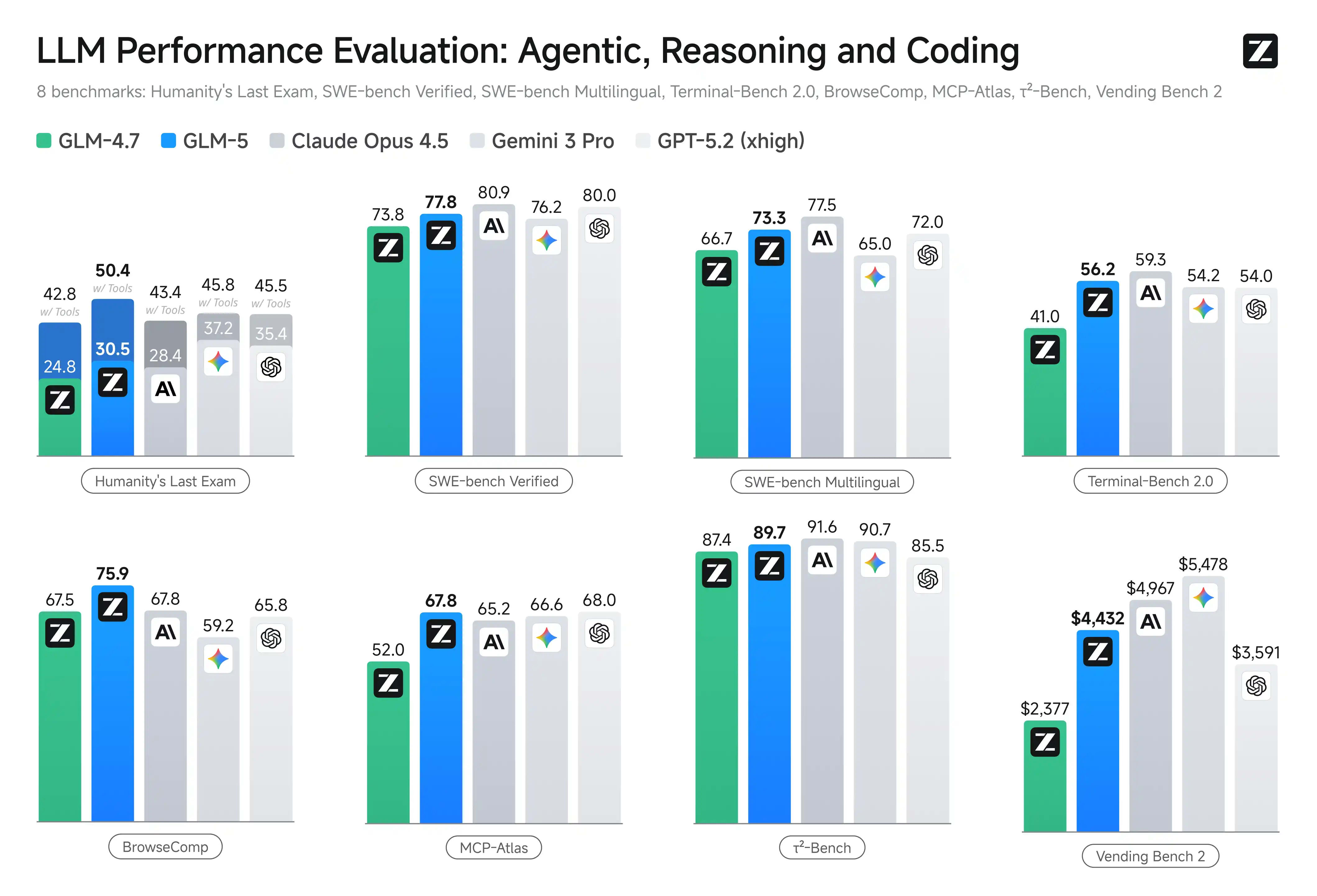
- ⚠️ Benchmarks are from Z.ai itself. Compare models on your own tasks, not by tables from announcements.
- 💡 Self-hosting is only realistic for Flash: its FP8 weights take about 306 GiB, excluding the KV cache. The flagship requires a cluster.
More details on the first version's architecture can be found in the article GLM-5: Architecture, Benchmarks, Capabilities, and Limitations.
💬 Web Interface: Chat vs. Agent
Quick answer: Chat and Agent are two modes of the chat.z.ai website, not different models or API endpoints. Chat responds with text. Agent plans steps itself, calls built-in tools, and delivers a ready file: a document, spreadsheet, or website.
| Chat | Agent |
|---|
| Result | Text, code, explanations | Ready file: .docx, .pdf, .xlsx, website, slides |
| How it works | One response per query | Cycle: plan → tool → check → fix |
| Speed | Faster | Slower, due to many steps |
| When to choose | Questions, ideas, code reviews | Report from raw data, document from a template, website prototype |
Example from the GLM-5 announcement: a query "create a sponsorship proposal for a school football team" in Agent mode returns a ready .docx with sections, tables, and placeholders for images (Z.ai).
⚠️ Important: the web chat is free but not intended for confidential company data. Documents you upload are processed on Z.ai servers.
More details: Chat Mode in Z.ai and Agent Mode in Z.ai.
⚙️ API: OpenAI Compatibility, Tool Calling, Reasoning
Quick answer: Z.ai's API follows the OpenAI protocol, so in most projects, you just need to change the base_url, key, and model name. There's no separate "agent mode" in the API; you build the agent yourself using standard tool calling.
Endpoints
| Protocol | Base URL | Purpose |
|---|
| OpenAI Chat Completions | https://api.z.ai/api/paas/v4 | Standard requests with per-token billing |
| OpenAI Chat Completions (coding) | https://api.z.ai/api/coding/paas/v4 | For the GLM Coding Plan subscription |
| OpenAI Responses | https://api.z.ai/api/v1 | For Responses API clients |
| Anthropic Messages | https://api.z.ai/api/anthropic | For tools on the Anthropic protocol, like Claude Code |
Source: GLM-5.3 Documentation.
Reasoning: What Changed in GLM-5.3
In GLM-5.3, the reasoning level is set by the reasoning_effort parameter: low, high, or max (defaults to max). Reasoning can no longer be disabled.
⚠️ Migration: if your code sends thinking: {"type": "disabled"}, change it to enabled and set reasoning_effort: "low" before migrating to glm-5.3. Otherwise, the request will fail.
Example Request (cURL)
curl -X POST "https://api.z.ai/api/paas/v4/chat/completions" \
  -H "Authorization: Bearer $ZAI_API_KEY" \
  -H "Content-Type: application/json" \
  -d '{
    "model": "glm-5.3",
    "messages": [{"role": "user", "content": "Explain the difference between REST and gRPC"}],
    "thinking": {"type": "enabled"},
    "reasoning_effort": "low",
    "stream": true
  }'
For simple answers, use low: it's faster and cheaper. Reserve max for code and complex tasks.
How to Build an Agent via API
Tool calling follows the OpenAI standard: you provide tools with JSON Schema, the model returns tool_calls, your code executes the function, and sends the result back in a message with the role tool. The cycle repeats until the model provides a final answer.
- Request with
tools and tool_choice: "auto".
- The model returns
tool_calls with the function name and arguments.
- Your code executes the function and adds the result to the history.
- Repeat the request with the updated history until the final answer.
Streaming, structured output, and context caching are also supported. Cached input costs less, so it's beneficial to keep long system prompts and history unchanged between requests. Documentation: Function Calling, Structured Output, Context Caching.
Conclusion: if you already have code for OpenAI, migrating to Z.ai takes minutes. The main thing is to remember that reasoning is always enabled in GLM-5.3 and to choose its level correctly.
💳 GLM Coding Plan: Pricing and Quotas
Quick answer: GLM Coding Plan is a subscription for coding tools (Claude Code, Cline, Cursor, etc.) with a fixed price instead of paying per token. All plans grant access to GLM-5.3 and GLM-5.3-Flash; the only difference is the quota.
| Plan | Price per Month | Paid Annually | Quota |
|---|
| Lite | $18 | $12.60 | 2,000 points per 5h, 10,000 per week |
| Pro | $80 | $56 | 6x Lite |
| Max | $168 | $117.60 | 14x Lite |
Data as of October 15, 2026, from MorphLLM. Paying quarterly gives a 20% discount, annually — 30%. Z.ai frequently changes pricing and promotions, so check prices at z.ai/subscribe before purchasing.
How to Save Quota
- ✔️ Off-peak hours. Requests during off-peak hours and all day on weekends consume only 50% of points (Z.ai).
- ✔️ Flash for routine tasks. Assign simple edits and explanations to GLM-5.3-Flash; save the flagship for complex tasks.
- ✔️ Reasoning level. Using
low for minor tasks noticeably saves tokens.
⚠️ When your quota is exhausted, requests are paused until the next 5-hour window. You cannot pay extra for exceeding limits (Techsy).
⚠️ Limitations
Quick answer: Z.ai's main risks are data jurisdiction, service limitations under load, and the fact that the flagship model only works with text. Self-hosting is only feasible for GLM-5.3-Flash.
| Limitation | What this means in practice |
|---|
| Data Jurisdiction | The cloud API and chat belong to a Chinese company. For personal data from the EU, first check where it's processed and if there's a data processing agreement. |
| Subscription Limits | After exhausting your quota, you're paused until the next window. Pro plan slots are limited and replenished daily (MorphLLM). |
| Text-only Flagship | GLM-5.3 does not accept images. Only Flash has vision, and in image understanding tests, it lags behind Gemini: 53.4 vs. 70.9 on BabyVision, according to Z.ai itself (LLM Stats). |
| Reasoning Always On | Even at low, the model reasons, which adds unnecessary latency for simple responses. |
| Self-hosting | Flash in FP8 requires about 306 GiB of weights, meaning several server GPUs. The flagship needs a cluster. |
| GLM-5.3 License | Not a pure MIT license: for AI companies with revenue over $10 billion, Z.ai requires a security review. |
Measure generation speed and latency yourself with your own prompts: they depend on the model, reasoning level, and current service load.
🧭 When to Choose Z.ai, and When Not To
| ✅ Choose Z.ai if | ❌ Look elsewhere if |
|---|
| You need a cheap API for code and agents | You're working with personal data from the EU without a verified agreement |
| You want a subscription for Claude Code or Cline cheaper than Western options | You need guaranteed throughput during peak hours |
| Open weights with MIT (GLM-5.3-Flash) are important | Your primary task is image and video analysis |
| You already have code for OpenAI and want to compare quickly | You need the lowest latency for simple responses |
❓ Frequently Asked Questions
Is Z.ai free?
The web chat chat.z.ai is free, with limits. The API offers the free GLM-4.7-Flash model (Second Talent). For coding, the cheapest option is GLM Coding Plan Lite, starting at $12.60/month when paid annually.
Which GLM model should I choose?
For most tasks, GLM-5.3-Flash: it's significantly cheaper, has an MIT license, and supports images. GLM-5.3 is for complex code and long agent tasks. GLM-5 makes sense only if you need the cheapest large model and a 200K context is sufficient.
How much does the Z.ai API cost?
As of November 2026: GLM-5.3 is $1.40 per 1M input and $4.40 per 1M output tokens, GLM-5.3-Flash is $0.15 and $0.50, GLM-5 is $1.00 and $3.20. Cached input is cheaper, so stable system prompts are more cost-effective.
Can I run GLM locally?
Technically yes: the weights are open. Practically, only GLM-5.3-Flash, and only on several server GPUs, as even it takes about 306 GiB in FP8. No GLM-5 model will run on a laptop.
✅ Conclusions
- 🔹 The lineup has changed. GLM-5 is no longer the flagship; it's now GLM-5.3, and GLM-5.3-Flash is more cost-effective for most tasks.
- 🔹 Chat and Agent are website modes. In the API, agents are assembled via standard tool calling.
- 🔹 Migration is simple. The API is compatible with OpenAI and Anthropic, but GLM-5.3's reasoning cannot be disabled.
- 🔹 Key risks include data jurisdiction, limitations under load, and the text-only flagship.
Main takeaway: Z.ai is a strong choice when price and open weights are important, and your data doesn't fall under strict requirements. For sensitive EU data or image-related tasks, consider comparing alternatives.